The post From Google Shopping To AI Shopping: What Ecommerce Brands Need To Change appeared first on Webplanners.
]]>A customer searches for a product, compares a few results, visits a website and decides whether to buy.
AI is changing how that journey starts.
A shopper can now describe what they need in much more detail, rather than searching for one or two product keywords. Google says its AI shopping experiences are designed around longer, more conversational shopping queries, with product information such as prices, reviews and inventory brought into the experience.
That creates a new challenge for ecommerce brands.
It is no longer enough to have a product catalogue that simply contains names, prices and short descriptions. Your product information needs to give search and AI systems enough context to understand what you sell, who it suits and how it compares with other options.
In this blog, we’ll look at what is changing from Google Shopping to AI shopping and the practical changes ecommerce brands can make now.
AI shopping puts greater emphasis on the quality and completeness of product information.
For ecommerce brands, the key priorities are:
- Keep product feeds accurate and up to date.
- Add useful product attributes, not just basic descriptions.
- Make product pages helpful for real buying decisions.
- Keep information consistent between your website and Merchant Center.
- Use structured product data to provide clearer context.
- Add genuine reviews and first-hand product information where relevant.
- Use AI SEO to understand how products may appear across conversational search experiences.
Google’s Merchant Center now provides AI performance insights covering conversational shopping queries, product attributes and different stages of the shopping journey. These insights are currently available for eligible Merchant Center accounts in Australia, among other markets.
Google Shopping Was Built Around Products. AI Shopping Adds Context
Traditional Shopping searches often have a clear product focus.
Someone might search for:
“Leather office chair Melbourne”
An AI-assisted shopping journey can be much more specific:
“I need a comfortable leather office chair for working eight hours a day, with good back support, under $600 and available for delivery in Melbourne.”
The second query contains several buying signals:
- Product type
- Material
- Use case
- Comfort
- Feature requirements
- Price range
- Location
- Delivery expectations
Google’s AI performance reporting now separates conversational shopping into discovery, evaluation and ready-to-buy stages. It also identifies popular product terms and attributes that shoppers use in those conversations.
For retailers, this means product information needs to cover more than the product name.
Product Data Is Becoming A Bigger Part Of The Shopping Experience
Your product feed might not be the part of your website customers see, but it plays an important role in how products are presented across Google’s shopping systems.
Google states that product data is used to match products to relevant queries and is a foundational input for its AI-powered formats and experiences. Missing or conflicting information can also create eligibility and display problems.
That makes product data worth treating as an ongoing business asset rather than a technical setup completed once.
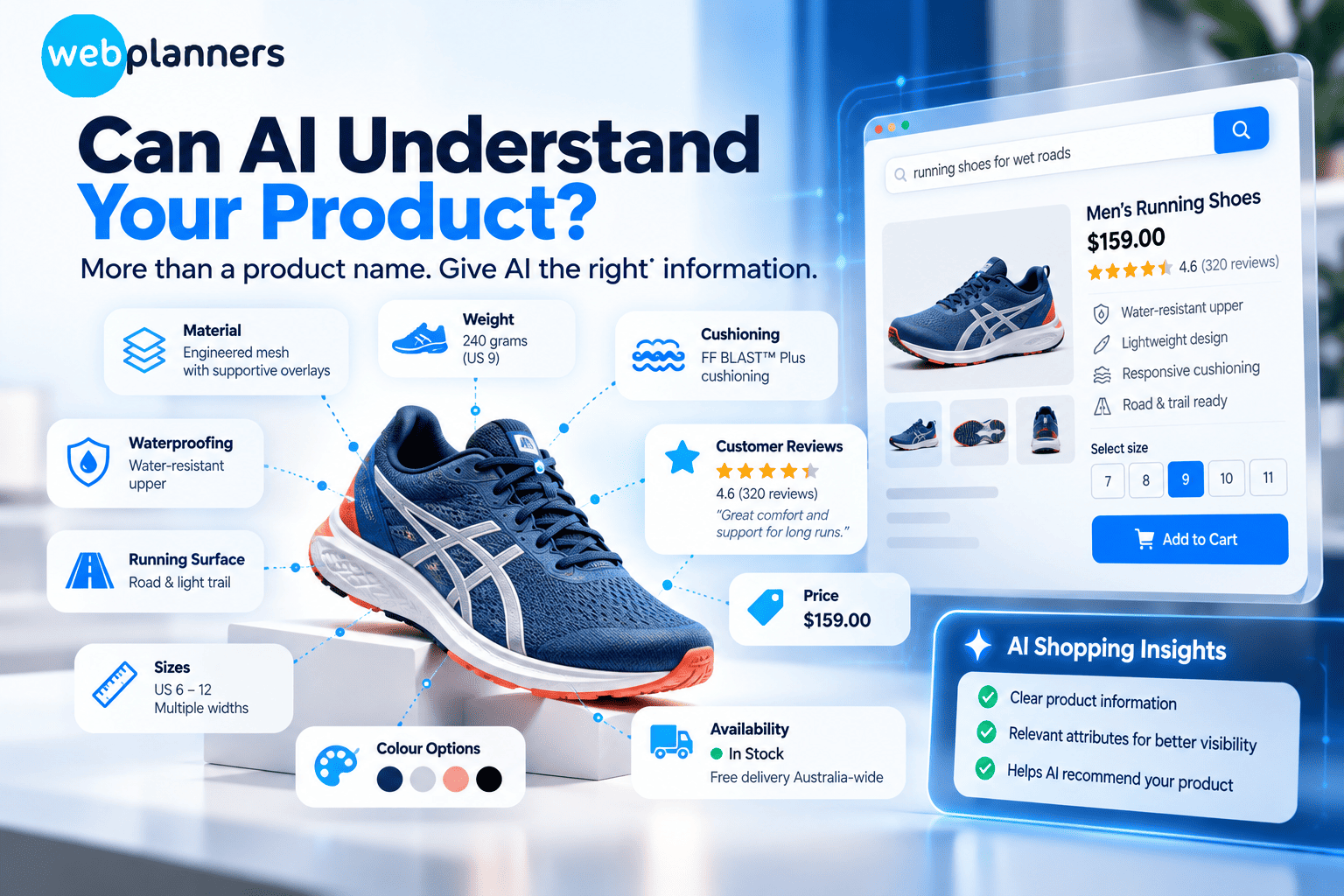
For example, an online running shoe retailer could provide:
- Shoe weight.
- Heel-to-toe drop.
- Cushioning level.
- Running surface.
- Waterproofing.
- Width options.
- Available sizes.
- Upper material.
- Recommended use.
- Product reviews.
These details give customers more information to work with, while also giving search systems more context about the product.
Prepare Your Ecommerce Brand For AI Shopping
Your Product Page Still Needs To Do The Selling
Better product feeds do not make product pages less important.
Once a customer reaches your website, the page needs to answer the questions that influence the purchase.
A furniture retailer, for example, should not stop at:
“Modern three-seater sofa made from premium fabric.”
A stronger product page could explain:
- Exact dimensions
- Seat depth
- Fabric composition
- Cleaning requirements
- Cushion filling
- Assembly requirements
- Delivery options
- Warranty
- Suitable room sizes
- Customer feedback
This is also where useful product expertise can separate one retailer from hundreds of stores selling similar products.
The e-commerce SEO strategy behind a site should therefore look beyond rankings and consider whether each important product page provides enough information for someone to make a confident decision.
Product Feeds And Websites Need To Agree
One of the simplest problems ecommerce brands can fix is inconsistency.
Imagine your website lists a product at $249, while the product feed still shows $279.
Or the website shows a product as available in five colours, while the feed only contains two.
Or a product has detailed material information on the website but none of those attributes are included in the submitted product data.
Google specifically identifies conflicting information between feeds and websites as a potential issue.
This is why ecommerce teams should regularly check:
- Prices
- Availability
- Product variants
- Images
- Product identifiers
- Shipping information
- Product attributes
- Descriptions
- Promotions
Google’s 2026 Merchant Center specification updates also added further product-level shipping attributes and a video link attribute, showing how much more detailed product data is becoming.
AI SEO Needs To Start With Real Product Information
AI SEO is not simply about adding more AI-generated content to an ecommerce website.
The foundation is still accurate, useful and well-structured information.
For a skincare retailer, that could mean explaining:
- Skin type
- Key ingredients
- Concentration
- Product texture
- How to use it
- Potential product combinations
- Storage requirements
- Suitable use cases
For a commercial equipment supplier, it could mean providing:
- Technical specifications
- Capacity
- Dimensions
- Operating requirements
- Suitable industries
- Warranty information
- Replacement parts
- Maintenance requirements
AI SEO also depends on clear site structure, well-organised product information and content that gives AI systems enough context to understand what a business sells and when its products are relevant.
It is about making the information behind your products clearer and more useful.
Reviews Add Information That Product Feeds Cannot
Product specifications tell customers what a product is.
Reviews can tell them what it is actually like to use.
For example, a shoe retailer might list the correct technical specifications, but customers may reveal that:
- The shoe runs slightly narrow.
- It feels better for longer runs.
- The colour looks different in natural light.
- The sole performs well on wet surfaces.
That kind of first-hand information adds another layer of context.
Ecommerce brands should therefore treat genuine reviews as useful product information, rather than simply as a collection of star ratings.
The same principle applies to original product photography, demonstrations, comparison information and practical advice based on real customer questions.
Search Is Becoming More Conversational, But The Basics Still Matter
AI shopping does not eliminate the need for a technically sound ecommerce website. Product pages still need to be accessible, fast, mobile-friendly, and well-structured. Structured data helps search engines to understand products, prices, availability and other details.
A practical schema markup checklist can help ecommerce teams check whether important product information is being clearly communicated.
Site performance matters too. Product pages that take too long to load create a poor experience regardless of how customers arrive.
This is why Core Web Vitals and AI search remain relevant when improving ecommerce websites for the changing search experience.
Product Information Should Match How People Actually Shop
The biggest change may be the shift from short product searches towards questions, comparisons and specific requirements.
Someone buying a mattress may ask:
“Which mattress is suitable for a side sleeper who gets hot at night?”
Someone buying a laptop may ask:
“Which laptop is suitable for video editing, has 32GB RAM and costs less than $2,500?”
Someone buying commercial equipment may ask:
“What coffee machine is suitable for a busy Melbourne café serving 300 cups a day?”
These are not just keyword variations.
They represent different buying requirements.
Ecommerce brands need product information that addresses those requirements naturally.
This is also where supporting content can help. Comparison pages, buying advice, product explainers and useful FAQs can give customers more context before they reach a product page.
Local And Conversational Intent Still Have A Place
AI shopping does not make local SEO or voice SEO irrelevant.
It can make them more connected to ecommerce.
A customer might ask:
“Where can I buy a compact air purifier near Melbourne CBD today?”
Or:
“What is the best baby car seat available near me under $500?”
These searches combine product intent with location.
That means ecommerce brands with physical stores should keep their business information, store locations, opening hours, product availability and local pages accurate.
A properly managed local SEO strategy can support these location-based journeys, while voice search SEO can help address more conversational search behaviour.
What Ecommerce Brands Should Change Now
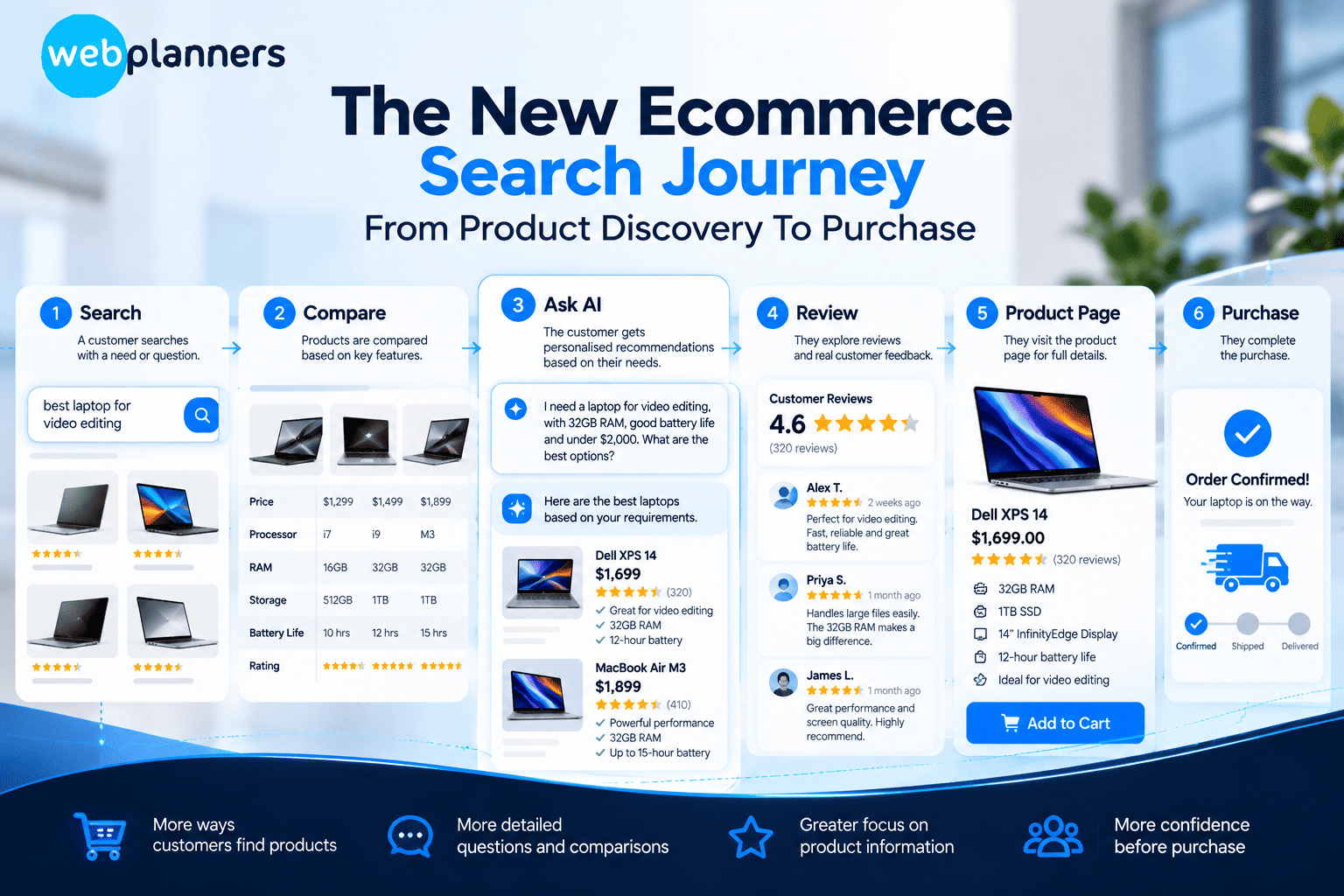
The practical work can start with a product data audit.
1. Review Your Product Feed
Start by checking for missing attributes, wrong prices, outdated stock levels, product variants and descriptions that do not match across your listings.
2. Improve Product Information
Give customers the specifications and practical details they need to compare products properly. Without this, they will look elsewhere.
3. Strengthen Product Structured Data
Make sure key details like price, availability and product information are easy for search systems to read and understand.
4. Use Real Customer Questions
Look at what customers actually ask. Support enquiries, reviews, sales conversations and onsite searches all reveal the information people need but cannot find.
5. Review AI Shopping Visibility
If your Merchant Center account shows AI performance insights, check popular terms, product attributes and shopping-stage data. This shows where your product information might be missing opportunities.
For larger ecommerce sites, a Melbourne SEO consultant can help connect product data, technical performance, content and AI search visibility into one practical plan.
The Shift Is From Product Listings To Product Understanding
Google Shopping helped retailers put products in front of people searching for them.
AI shopping is moving the experience towards understanding why someone wants a product and which option fits their requirements.
That makes product information more valuable than ever.
The brands that adapt do not need to fill every page with more words. They need to provide better information, keep their data accurate and make their products easier to understand.
For Australian ecommerce businesses, the next stage of search is not simply about getting products seen.
It is about giving search and AI systems enough useful information to understand what makes those products relevant.
Build A Stronger Strategy For AI Shopping
Conclusion
AI shopping is making product information part of the customer journey before someone reaches your website.
Ecommerce brands should focus on accurate data, useful product pages, strong feeds and information that answers real buying questions.
Webplanners helps Melbourne ecommerce businesses build stronger product visibility across changing search experiences. Talk to Webplanners about your ecommerce growth strategy.
FAQs
Does AI Shopping Mean Ecommerce Brands Need To Rewrite Every Product Description?
No. Begin with the products that generate the most revenue and search visibility. Improve missing specifications, vague descriptions, product features and customer-facing information before making any large scale changes across the entire catalogue.
How Often Should Ecommerce Product Data Be Reviewed?
Product data should be checked when prices, stock, variants, shipping or other vital product data changes. Regular audits can also be used to identify missing attributes and inconsistencies that may creep in over time.
Can AI Shopping Send Customers Directly To A Product?
Yes. Google is developing shopping experiences where customers can see product information within AI interfaces, and eligible products can also participate in native commerce experiences that allow checkout directly on certain Google surfaces.
What Is The Biggest Mistake Ecommerce Brands Make With AI Shopping?
Treating AI shopping as a content-writing exercise. The bigger opportunity is improving the underlying product information: attributes, specifications, pricing, availability, reviews, structured data and feed quality. Better content helps, but it works best when the product data underneath it is accurate and complete.
The post From Google Shopping To AI Shopping: What Ecommerce Brands Need To Change appeared first on Webplanners.
]]>The post The New SEO Moat: Why Real Experience Is Harder For Competitors To Copy appeared first on Webplanners.
]]>Yet one can have a major advantage online: real experience.
A solar installer has seen hundreds of different properties. A commercial accountant has worked through complex financial situations. A furniture retailer knows which questions customers ask before buying. A manufacturer understands the problems its customers face after years of working with them.
That knowledge is difficult to reproduce.
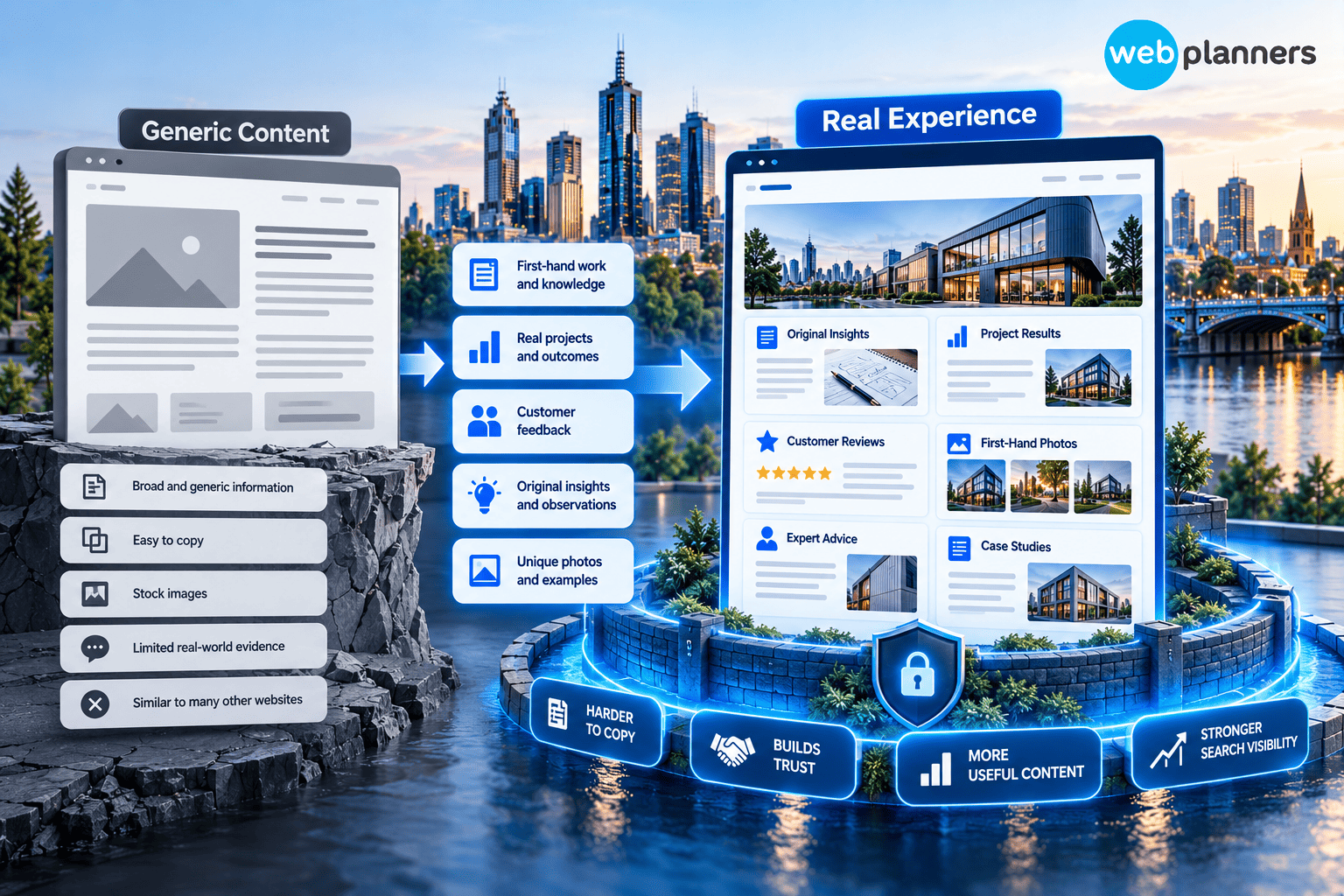
As search becomes more conversational and AI systems become more involved in how people research businesses, generic information becomes easier to produce. Real business experience is different because it comes from actual customers, projects, products, processes and decisions.
In this blog, we’ll look at why first-hand experience is becoming a valuable SEO asset, how businesses can turn existing knowledge into useful content, and how that knowledge can support visibility across traditional search and AI-driven search.
Real experience gives businesses information that competitors cannot easily reproduce.
It can come from:
- Questions customers ask repeatedly.
- Problems your team solves every week.
- Lessons from completed projects.
- Product testing and customer feedback.
- Original business data.
- Industry-specific processes.
- Expert opinions based on actual work.
- Local knowledge built through years of serving a particular market.
The opportunity is not to publish more content simply for the sake of SEO. It is to make your existing knowledge visible in ways that genuinely help customers.
Generic Information Is Becoming Easier To Copy
Consider two businesses selling home solar systems.
Both publish a page about choosing solar panels.
The first explains:
- Types of solar panels.
- General energy efficiency.
- Basic installation information.
- Common terminology.
The second business goes further.
It explains what its installers regularly see on Melbourne properties, why certain roof designs create installation challenges, which mistakes homeowners make when comparing quotes and what customers should ask before signing an installation agreement.
Both businesses are talking about solar panels.
But the second business brings something different to the conversation: experience from doing the work.
That distinction matters because searchers can already find thousands of pages covering basic information.
The harder question is:
Why should someone read your page instead of the hundreds of others available?
Real experience can provide the answer.
Build Content Competitors Cannot Easily Copy
Your Business Already Has Knowledge Competitors Do Not
Many businesses underestimate how much useful knowledge already exists inside their organisation.
- Sales teams hear objections.
- Customer service teams hear recurring questions.
- Technicians solve practical problems.
- Consultants make recommendations.
- Product teams see how customers use products.
- Managers see patterns across projects and customers.
That information can become valuable content.
For example, a childcare business may know the questions parents ask before choosing a centre.
A running shoe retailer may know that customers frequently choose shoes based on appearance rather than fit.
A commercial property business may know which questions tenants repeatedly ask before signing a lease.
A B2B software company may know that implementation problems often come from internal processes rather than the software itself.
These insights are much harder to reproduce accurately than generic definitions.
Experience Gives Content A Genuine Point Of Difference
A business does not need to invent a completely new topic.
It can take a familiar customer question and answer it from its own experience.
For example:
“How much does a bathroom renovation cost?”
Thousands of websites can provide general price ranges.
A renovation company could instead explain the factors it sees in real projects:
- How access to the property affects labour.
- Why waterproofing can change the project scope.
- Which materials create higher installation costs.
- What customers often forget to budget for.
- Why changing the layout can affect plumbing costs.
- Which decisions tend to cause delays.
The subject is still bathroom renovation costs.
The information is simply more useful because it reflects real work.
This fits naturally with people-first SEO, where the goal is to provide information that helps the reader rather than producing pages mainly to capture search traffic. A strong SEO strategy should give that useful information a clear place within the wider website.
Experience Does Not Mean Talking About Your Business All The Time
There is a common mistake here.
A business can try to demonstrate experience by repeatedly saying:
“We have years of experience.”
That statement alone tells the customer very little.
A better approach is to show the experience through the information itself.
- A financial adviser can explain the mistakes clients commonly make when planning cash flow.
- A dentist can explain what patients commonly ask before a treatment.
- A manufacturer can explain why a particular production problem occurs.
- A property manager can explain what landlords frequently overlook before leasing a property.
The experience becomes part of the answer. That makes the content more useful without turning every page into a company profile.
Original Data Can Make Your Content Harder To Replace
First-hand experience becomes even more valuable when a business has its own data.
- An ecommerce retailer might analyse its most frequently returned products.
- A healthcare business could review the questions patients ask most often.
- A property company could analyse trends across its own portfolio.
- A B2B software provider could publish aggregated findings from implementation projects.
- A manufacturer could share common production issues identified across its customer base.
This creates information that competitors cannot simply reproduce by rewriting another website.
Original research, authentic statistics, case studies and business-specific findings can give content a stronger reason to exist.
Your Experts Should Be Part Of The Content
A business can have excellent expertise and still hide it.
Readers should be able to understand who is responsible for the information, particularly when the subject requires specialist knowledge.
For example, a technical article about commercial refrigeration becomes more credible when the reader can see the relevant expertise behind it.
The same applies to accounting, healthcare, engineering, construction, finance, manufacturing and other specialist industries.
Useful signals can include:
- A clear author or reviewer.
- Relevant qualifications or professional experience.
- First-hand involvement with the subject.
- Appropriate references and supporting sources.
- A clear date showing when information was reviewed or updated.
These details support trust while giving search systems more context about the people and organisation behind the information.
They also connect with entity SEO, where understanding the business, its people, expertise and relationships can form part of how search systems interpret an organisation.
Real Experience Can Strengthen The Whole Website
Experience should not live in one blog post.
A business might have valuable knowledge spread across its product pages, service information, FAQs, case studies and educational content.
These pages can support each other when the links make sense.
For example, a commercial janitorial company may have:
Workplace cleaning checklist → infection control information → common cleaning mistakes → service enquiry Commercial cleaning services
Each page is a different stage in the customer research.
The links help readers to the next relevant piece of information and form stronger relationships between related pages.
That is where a thoughtful internal linking strategy becomes useful. Links should help the reader continue their research, not simply exist to place more links on a page.
Local Experience Can Be A Real Advantage
Local businesses have another form of experience that larger competitors may struggle to replicate.
A Melbourne business can have years of knowledge about the customers, suburbs, conditions and buying patterns within its market.
A landscaper may understand common site conditions across different Melbourne suburbs.
A removalist may know which apartment buildings present access challenges.
A property service provider may understand seasonal issues that affect local customers.
A restaurant may know what local customers value at different times of the year.
This information can support local SEO when it is genuinely useful rather than added simply to mention suburbs.
Local knowledge can also strengthen the wider content strategy because it gives customers information that a generic national page cannot provide.
AI Makes Genuine Experience More Valuable
AI can produce a basic explanation of almost any subject in seconds.
That changes the value of generic content.
If hundreds of businesses can generate similar explanations, simply producing another version does not create much differentiation.
AI can explain how a roof installation works.
It cannot claim genuine first-hand experience of installing that roof.
It can describe common manufacturing problems.
It has not operated the machinery.
It can explain the basics of a financial process.
It has not worked through a specific customer’s situation.
Businesses still need to provide real-world knowledge.
AI can help organise, analyse and present that knowledge, but the underlying experience needs to come from people who actually understand the subject.
That is one reason AI SEO should not become synonymous with automatically producing large volumes of generic content.
Experience Can Support Visibility In AI Search Too

Traditional search is not the only place where business expertise matters.
AI search systems can provide answers to detailed questions by drawing information from different sources.
A customer might ask:
“What should I consider before installing solar panels on an older Melbourne home?”
A generic page may explain solar panels.
A more useful page could combine installation considerations, property-specific issues, practical advice and questions homeowners should ask installers.
That gives the information more depth and context.
This is also where GEO becomes relevant. The objective is not simply to repeat keywords. It is to make useful, well-supported information available in a form that can contribute to AI-driven answers.
Likewise, AEO focuses on providing clear answers to the questions people ask.
The three approaches can work alongside broader SEO rather than becoming isolated content exercises.
What Your Sales Team Knows Could Become Your Best Content
One of the easiest places to find experience-based topics is your sales process.
Ask your team:
- What questions do prospects ask before buying?
- What objections come up repeatedly?
- What do customers misunderstand?
- What mistakes do people make before contacting you?
- What makes customers choose one option over another?
- What do experienced staff explain during consultations?
- What problems do customers only realise after purchasing?
- What advice would your team give someone making the same decision today?
These questions can produce better content ideas than simply looking for another keyword variation.
They can also create content that supports customers much earlier in the buying process.
For businesses that need a strategic view of where this knowledge should sit across the website, working with an experienced SEO consultant can help connect the content opportunities with the wider search strategy.
Make Your Business Experience Work Harder In Search
Conclusion
Competitors can copy a keyword, heading, topic, and even copy the structure of a successful page.
What they cannot easily copy is what your business has genuinely learned through years of serving customers.
That includes your observations, processes, customer questions, original data, specialist knowledge and lessons from real projects.
This is where experience becomes more than an E-E-A-T principle. It becomes a competitive content asset.
It can strengthen the information on your website, give customers better reasons to trust what they read, and provide useful material for both traditional and AI-driven search.
Businesses should therefore look inward before looking for another generic content idea.
The knowledge your team already has could be the SEO advantage your competitors cannot simply copy.
If you want to turn that knowledge into a stronger search strategy, talk to Webplanners about where your existing expertise can create more search visibility.
FAQs
How to Turn Customer Questions into SEO Content?
Begin by gathering questions from sales calls, support interactions, emails, reviews and consultations. Group similar questions together, then figure out which ones are worth answering in detail on the site. Best topics usually involve a real concern that can impact a customer’s decision.
Does Experience-Based Content Work For Ecommerce Businesses?
Yes. Ecommerce brands may utilise product testing, feedback from consumers, returns data, buying patterns, comparisons, and practical product advice. For instance, a mattress retailer might discuss how different sleeping positions affect product choice based on customer enquiries and product knowledge.
Can A Small Business Build This Type Of Content Without A Dedicated Content Team?
Yes. Much of the useful information can come from short interviews with people already working in the business. A writer can then turn those conversations into polished content while the subject-matter expert checks the accuracy.
The post The New SEO Moat: Why Real Experience Is Harder For Competitors To Copy appeared first on Webplanners.
]]>The post Search Is Splitting Into Multiple Journeys: Is Your Business Present Across All Of Them? appeared first on Webplanners.
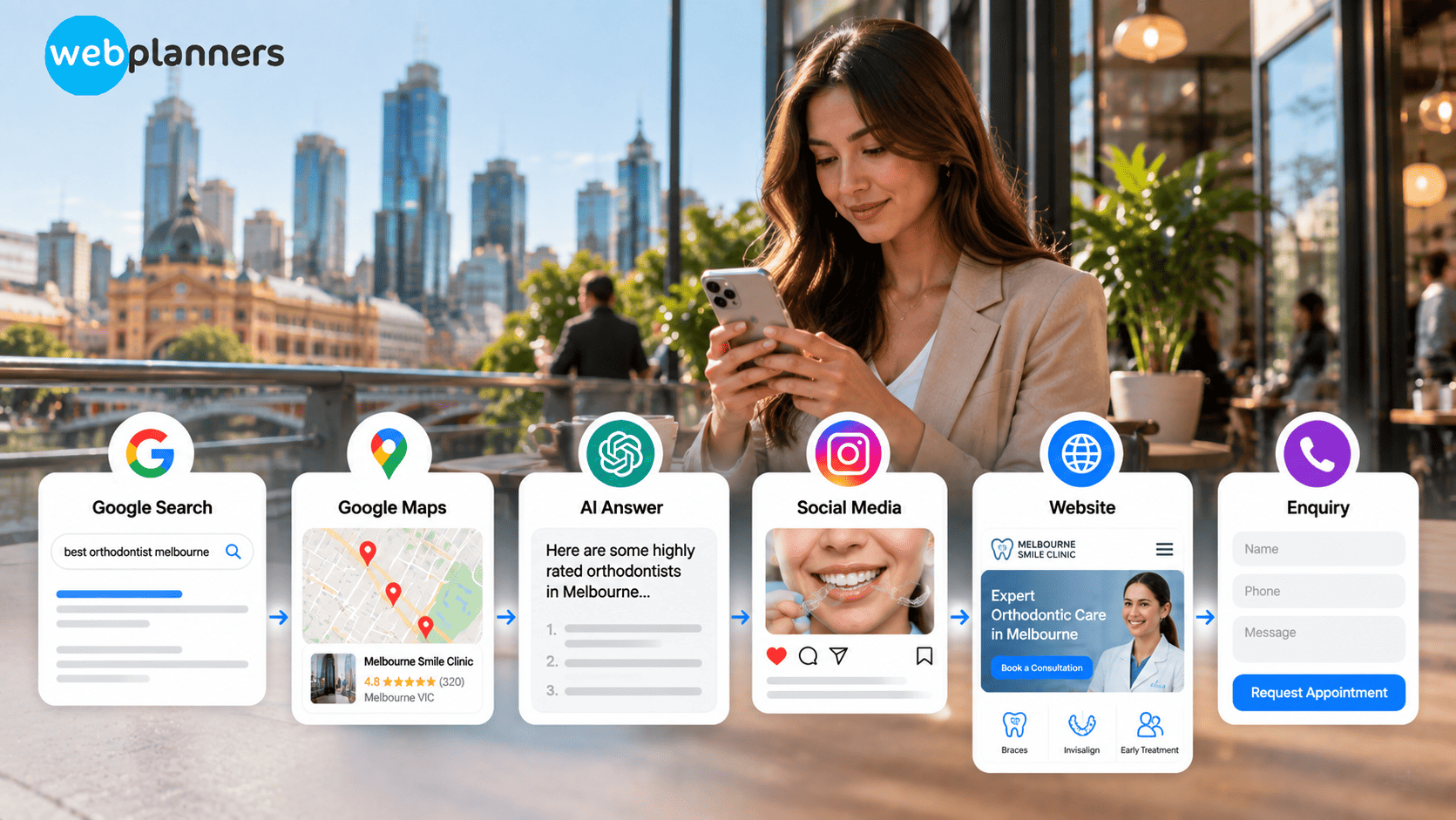
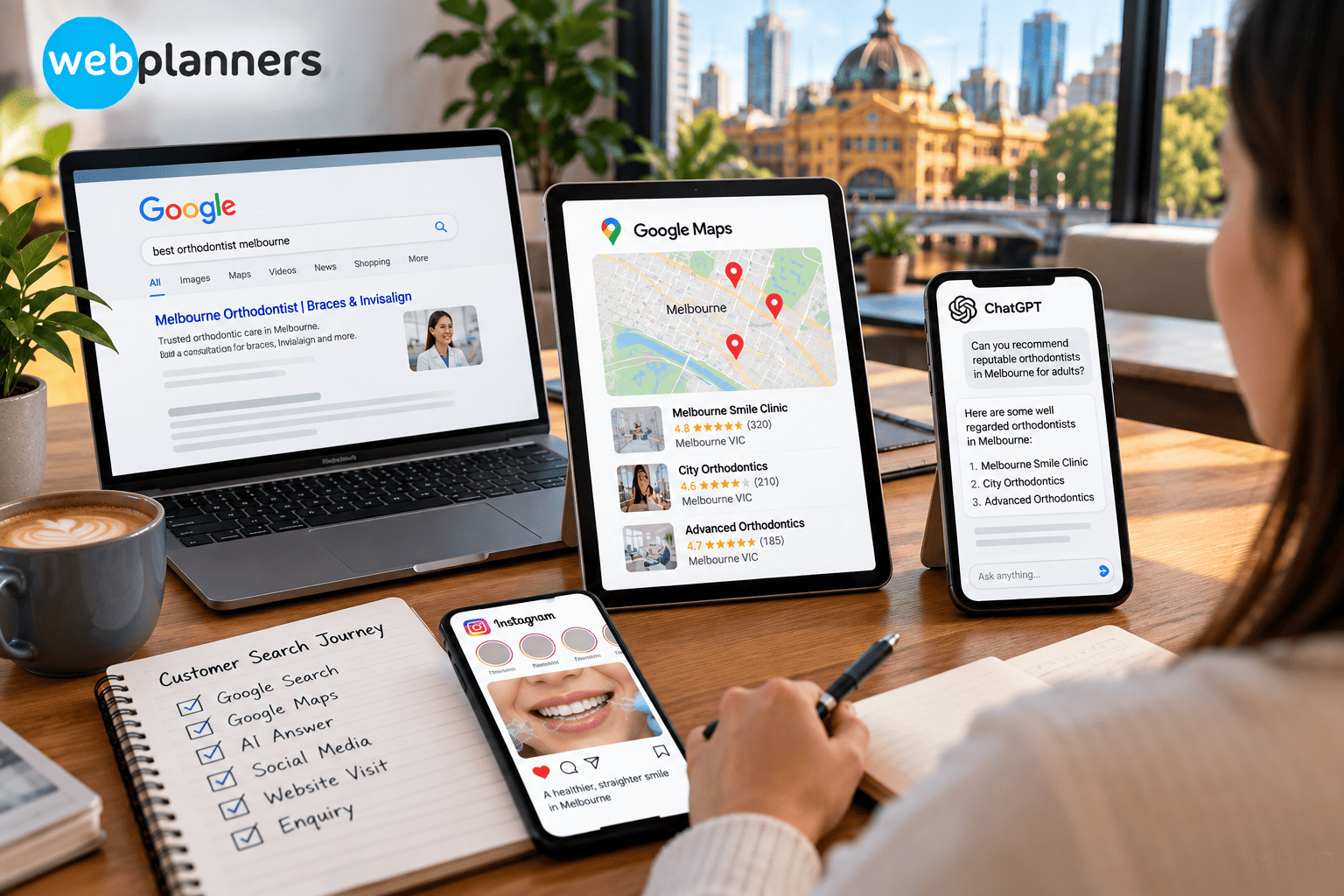
]]>A customer might search Google, check Maps, ask an AI platform for recommendations, read reviews, watch a video, compare businesses on social media and then visit a website before making a decision.
For businesses, this changes what visibility really means.
A furniture retailer, for example, may be found through Google when someone searches for a dining table, through Instagram when they see a room setup, through Google Maps when they want to visit a showroom, and through an AI platform when they ask which furniture stores are worth considering.
A business can face the same shift. An operations manager looking for warehouse software might search Google first, then ask an AI platform to compare providers, read customer reviews, watch product demonstrations and only then contact a shortlisted company.
The search journey has become fragmented.
In this blog, we’ll look at what that means for businesses and how Google, Maps, AI, social platforms, voice search and websites now work together throughout the customer journey.
Search visibility is no longer about appearing for one keyword or holding one Google position.
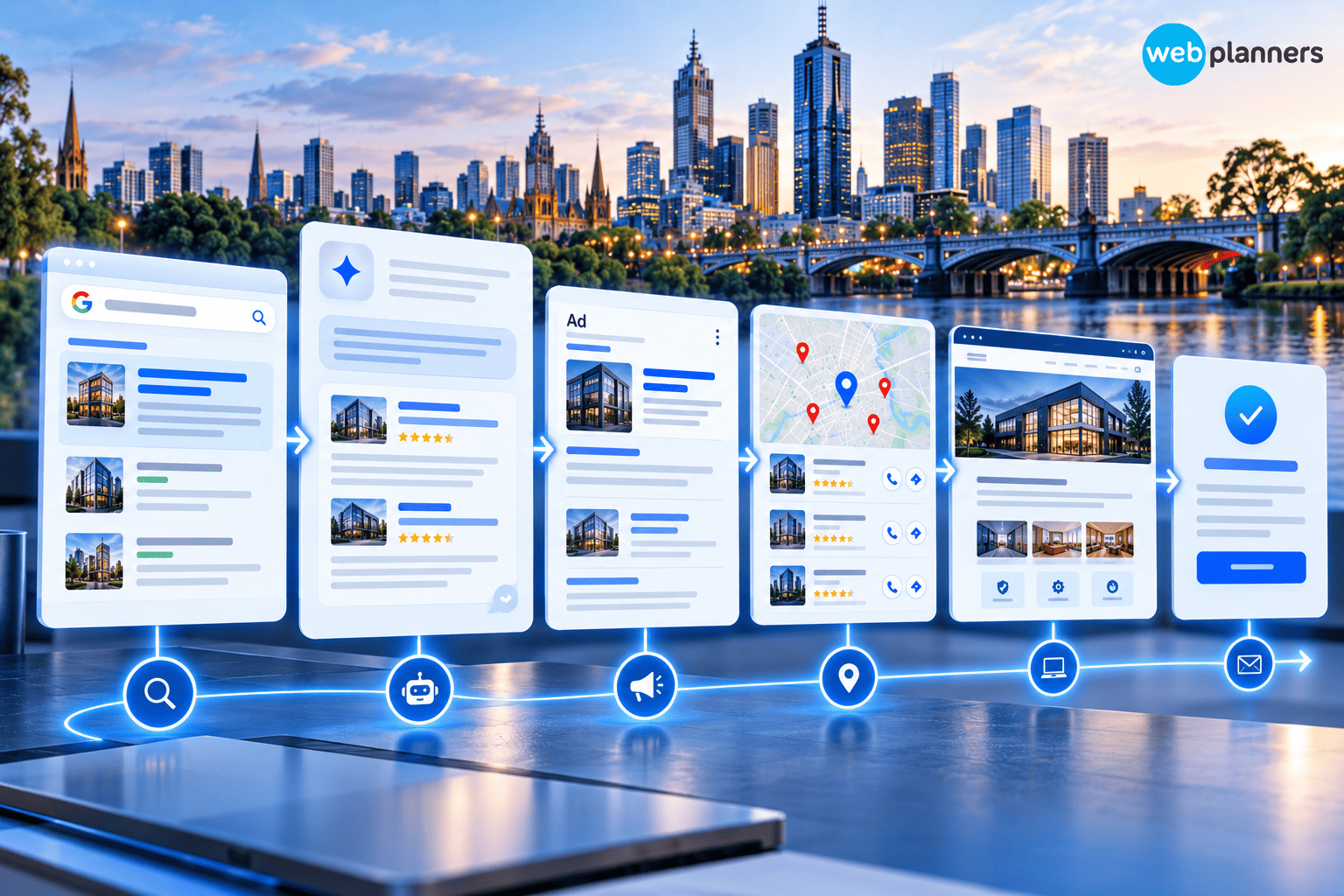
Customers can encounter a business through several channels before they make contact. This includes:
- Google organic results and AI-generated search experiences.
- Google Maps and local business listings.
- AI platforms and conversational search.
- Social media and video content.
- Reviews and third-party websites.
- Voice searches and location-based queries.
- The business website itself.
The goal is not to create a completely different strategy for every platform. It is to build a consistent, useful and trustworthy digital presence that works across the places customers actually search.
The Customer Journey Has Become Much More Fragmented
Think about someone looking for a new sofa.
Their first search might be:
“Best modular sofas Melbourne.”
They may then check Maps to see which stores are nearby. They could look at Instagram for styling ideas, read customer reviews and ask ChatGPT something like:
“Which Melbourne furniture stores have good options for small apartments?”
They might eventually visit a retailer’s website to compare prices, delivery information, materials and returns.
The customer has moved through several search environments without necessarily thinking about them as separate channels.
Someone researching commercial accounting software might search for providers, read comparison pages, check reviews, ask an AI tool for suitable options and then visit two or three websites before requesting a demonstration.
This means a business can be visible at one stage and absent at another.
Strengthen Your Visibility Across Search Journeys
Google Still Matters, But The Results Page Is Changing
Traditional Google search remains important, but the experience around the results continues to change.
AI-generated answers can provide information directly within search experiences, reducing the need for users to open several individual websites.
That makes the quality and clarity of the information surrounding a business increasingly important.
For example, a Melbourne home renovation company might have a page targeting kitchen renovations. But customers could also search:
- How much does a kitchen renovation cost?
- What should I ask a renovation company?
- How long does a kitchen renovation take?
- Which materials work best for small kitchens?
The business has opportunities to provide useful information throughout that research process, rather than relying on one commercial page.
Understanding how AI search systems select and present information is already becoming part of modern search strategy. How Google’s AI Overviews choose information.
AI Search Can Change The Way People Shortlist Businesses
AI search adds another layer to the customer journey.
Instead of opening several search results and comparing them manually, a customer can ask a detailed question and receive a response that brings together information from multiple sources.
Consider a business selling commercial cleaning equipment.
A potential buyer might ask:
“What commercial cleaning equipment is suitable for a large hospitality venue in Melbourne?”
The response could consider product types, use cases, specifications, reviews and suppliers.
This creates a different visibility challenge for the business.
Its website needs to explain its products clearly. Its expertise needs to be evident. Important information should not be buried in vague marketing language.
This connects with the growing importance of entity-based SEO, where search systems need to understand what a business is, what it offers, where it operates and how its different areas of expertise relate to one another.
Maps, Reviews And Local Search Can Shape The Decision
For businesses that operate locally, the search journey often moves between organic search and local discovery.
Imagine someone looking for a family dentist.
They might find a practice through Google, check its location in Maps, read reviews, look at photos, check opening hours and then visit the website.
The website is only one part of that experience. Consistent business information matters across these touchpoints.
Name, address, phone number, opening hours, service areas, categories and other important details should make sense wherever customers encounter the business.
This also connects with voice search. A customer might ask a phone assistant for a nearby business, opening hours or a specific product or service. The wording may be more conversational than a traditional typed search.
Social Media Can Influence Search Without Being The Final Destination
Social platforms can play a different role in the search journey. A customer may not use Instagram or YouTube to find a business in the first place. They may encounter the brand through content and then search for it elsewhere.
For example, a skincare brand could publish a short video explaining how to use a particular product. Someone sees the video, searches the brand on Google, checks reviews and then visits the website.
For a B2B manufacturer, a product demonstration on LinkedIn or YouTube could trigger a later branded search from a potential buyer.
Social content therefore does not have to produce the final conversion to have value. It can create awareness that leads to another search.
Your Website Becomes The Place Where Everything Comes Together
A fragmented search journey does not make the website less important.
It gives the website a different role.
Someone arriving from Google, Maps, social media or an AI recommendation should be able to quickly understand:
- What the business offers.
- Who the products or services are for.
- What makes the business credible.
- Where it operates.
- What evidence supports its claims.
- What the customer should do next.
The site also needs a strong technical foundation.
Fast loading times, mobile usability, structured data, logical internal links and clear content organisation all help users and search systems understand the business.
This is why internal linking needs to support the customer’s next question rather than simply add links between pages.
Consistency Matters More As Search Spreads Across More Places
A business can control its website, but it cannot control every platform where customers may encounter information about it.
That makes consistency important.
Imagine a Melbourne furniture retailer whose website says it specialises in custom dining tables, while an old directory listing describes it only as a general furniture store.
Inconsistent information can create confusion for customers and make it harder for search systems to build a clear understanding of the business.
Structured data can also provide additional context around products, services, organisations and other entities. It forms part of the technical foundation discussed in Webplanners’ earlier work on preparing websites for AI search.
Better Search Visibility Starts With Better Information
Businesses do not need to create completely separate content for Google, Maps, AI platforms, social media and voice search.
The better approach is to start with genuinely useful information. E-E-A-T principles call for content that demonstrates real experience, expertise, authority and trust, supported by credible information and appropriate evidence.
For example, a commercial property company could publish insights based on actual market observations. An appliance retailer could explain common product issues based on customer questions. A manufacturing company could publish technical information based on its own experience.
That type of content gives customers something more useful than another generic page targeting a keyword.
What Should Businesses Measure Now?
If customers move across several search environments, measuring only organic traffic gives an incomplete picture.
Businesses should also consider:
- Which searches bring qualified visitors?
- How often does the brand appear for important questions?
- Are customers finding the business through local search?
- Which pages assist customers before they enquire?
- Is branded search increasing?
- Which content attracts relevant audiences?
- Are reviews and third-party mentions supporting credibility?
- Where are potential customers dropping out of the journey?
This broader view also helps explain why SEO, AEO and GEO increasingly overlap while serving different search experiences.
Make Your Business Easier To Find Everywhere
Conclusion
The customer may never think about SEO, AI search, Maps or structured data.
They simply want an answer.
They want to know which product is right, which business can solve their problem, whether a company is trustworthy, how much something costs or where they can get it.
Businesses that understand this can build content and digital experiences around the questions customers actually ask.
A furniture buyer, a parent choosing a dentist, a manufacturer comparing suppliers and a business owner researching accounting software may all take different routes.
The common factor is that search now happens across more places.
The question is no longer only “Where do we rank?”
It is also “Where can customers find useful, trustworthy information about us throughout their decision?”
For Melbourne businesses, that broader view is becoming an important part of building sustainable search visibility.
Want to see where your business appears across today’s search journey? Talk to Webplanners about assessing your current search visibility.
FAQs
Does A Customer Have To Visit A Website Before Contacting A Business?
No. A customer may call from a Maps listing, message through social media, visit a physical location or contact a business after seeing an AI-generated recommendation. The website still plays an important role, but it may not be the first or final touchpoint.
How Can A B2B Business Show Up During The Research Stage?
Useful educational content can answer the questions buyers ask before contacting sales. This could include product comparisons, implementation considerations, technical explanations, pricing factors, common mistakes and practical buying considerations.
Should Every Business Create Content For AI Search Separately?
Not necessarily. Strong, well-organised information written for real customers can support several search environments. The focus should be on accuracy, clear context, first-hand expertise and useful answers rather than creating multiple versions of the same information for different platforms.
The post Search Is Splitting Into Multiple Journeys: Is Your Business Present Across All Of Them? appeared first on Webplanners.
]]>The post In-House SEO vs Agency vs Freelancer: What’s Right for Your Melbourne Business in 2026? appeared first on Webplanners.
]]>For a Melbourne business, the decision should not come down to price alone. Your website size, internal resources, competition, growth plans and the amount of SEO work required all matter.
Search itself has also become broader. Businesses now need to think about traditional search, local visibility and AI-powered search as part of the same strategy.
In this blog, we compare in-house SEO, freelancers and agencies, looking at their strengths, limitations, flexibility and ability to support long-term growth.
An in-house SEO specialist gives you close control and strong business knowledge, but one person may not cover every area of modern SEO.
A freelancer can provide focused expertise and direct communication, making the model suitable for defined requirements or smaller campaigns.
An agency gives you access to a wider team across technical SEO, content, local search, strategy and AI SEO. For businesses that need ongoing support across several areas, this broader capability can make an agency the more practical long-term choice.
In-House SEO: Strong Business Knowledge, Limited Specialist Coverage
An internal SEO specialist understands your business from the inside. They can work closely with marketing, sales, development and management teams, while keeping SEO closely connected to commercial priorities.
This can work particularly well when:
- SEO is a major part of your marketing strategy.
- You already have an experienced digital marketing team.
- Developers and content resources are available internally.
- SEO requires frequent attention and internal coordination.
The challenge is the range of skills required.
Modern SEO can involve technical optimisation, content strategy, search intent, internal linking, analytics, local search and AI SEO. One person may be strong in several of these areas without having deep experience across all of them.
Building an internal team can solve that problem, but it also means additional hiring, software, training and management costs.
Freelancer SEO: Focused Expertise Without A Full-Time Hire
A freelancer can suit a business that needs specialist SEO support without building an internal team.
For example, a freelancer might help with:
- A technical SEO audit.
- Keyword and search intent research.
- Content planning.
- Local search.
- Website migration.
- Ongoing SEO management.
Direct communication can make this model appealing. You are usually working with the person responsible for the SEO work.
The limitation is capacity.
If your website needs technical work, content, development support, local search, analytics and AI SEO at the same time, one person may not have enough time or specialist coverage to manage everything.
Choose The Right SEO Model For Your Business
SEO Agency: Broader Expertise Under One Strategy

Instead of relying on one person, your business can access specialists across technical SEO, content, analytics, local search and AI SEO.
This matters because SEO problems rarely exist in isolation.
For example, a website’s structure can affect how important pages are found. Weak internal linking can limit the connection between related services. Technical issues can affect content visibility. Location-based businesses may need their website and local search presence to work together.
An agency can address these areas as part of one strategy.
This broader capability is particularly useful when SEO is an ongoing growth channel rather than an occasional project.
In-House vs Freelancer vs Agency: How They Compare
| Factor | In-House | Freelancer | Agency |
|---|---|---|---|
| Business knowledge | High. | Builds over time. | Builds over time. |
| Specialist coverage | Depends on the internal team. | Depends on the individual. | Broader team coverage. |
| Scalability | Requires additional hiring. | Limited by individual capacity. | Easier to scale resources. |
| Technical SEO | Depends on internal expertise. | Depends on specialist skills. | Multiple specialists may be available. |
| Content support | Usually requires internal resources. | Depends on scope. | Can be part of the wider service. |
| Local search | Requires internal capability. | Depends on experience. | Can be integrated into the wider strategy. |
| AI SEO | Depends on internal knowledge. | Depends on individual expertise. | Can involve multiple specialists. |
| Strategic support | Depends on seniority. | Usually individual-led. | Team-based. |
The comparison becomes more useful when you consider where your business is heading over the next 12 to 24 months.
Start With Your Website, Not The Provider Type
A small Melbourne business with a straightforward service website may only need focused SEO support.
A growing eCommerce business with hundreds of products has different requirements. It may need technical SEO, category optimisation, product content, structured data and internal linking.
A business targeting several Melbourne suburbs may need location pages, local content and a stronger connection between its services and locations.
This is where the complexity of your website becomes important. The more areas SEO touches, the more useful broader specialist coverage can become.
For example, a business may start with local SEO, then need technical SEO, content and broader organic search support as its website and service areas grow.
SEO Is Now Part Of A Broader Search Strategy
Customers no longer search only with short keywords.
They can use longer questions, conversational searches and AI-powered search experiences when researching a product, service or business.
A customer might search:
“Which Melbourne dentist offers weekend appointments for families?”
rather than simply searching for:
“Dentist Melbourne.”
That means a website needs to communicate its services, location, expertise and useful customer information clearly.
The same principle applies to businesses selling products, providing professional services or operating across multiple locations.
This is where AI SEO can fit naturally into an existing SEO strategy. They do not replace technical SEO, useful content or sound website structure. They add another consideration to how information is presented and understood across different search experiences.
Businesses that have already invested heavily in traditional SEO may also need to reassess what visibility means when customers receive answers before they click through to a website.
Cost Is Only One Part Of The Decision
Comparing providers purely by monthly price can give you an incomplete picture.
An internal employee involves salary, superannuation, software, training and management.
A freelancer may require a smaller commitment, but the scope can be narrower.
An agency may cost more than one individual, but the engagement can provide access to several specialists without requiring separate hires.
The better question is:
What SEO work does the business need, and who can realistically deliver it?
This also helps when comparing agency proposals. Look at the actual work included, who will complete it, how progress will be measured and whether the strategy can adapt as your business changes.
What Should You Ask Before Choosing An SEO Partner?
Who Will Actually Work On The Campaign?
Find out who handles strategy, implementation, technical work and reporting. Do not assume the person presenting the proposal will manage the campaign.
What Will You Work On First?
The provider should be able to explain the priorities based on your website and commercial goals, rather than giving you a generic monthly checklist.
How Will Success Be Measured?
Rankings matter, but they are not the only measure. Depending on your business, qualified traffic, enquiries, leads, sales and revenue may be more meaningful.
Can You Work With Our Existing Team?
If you already have developers, content writers or a marketing manager, your SEO partner should be able to work alongside them.
How Does AI Search Fit Into The Strategy?
Ask how AI search is being considered alongside traditional SEO. The answer should connect AI search with your website structure, content, search intent and existing organic strategy.
If your business needs strategic input before committing to ongoing work, an SEO consultant in Melbourne can also help assess your current position and identify priorities.
Make A Smarter Decision About SEO
Why An Agency Can Be The Stronger Long-Term Option
The biggest advantage of an agency is not simply having more people. It is having access to different areas of expertise that can work together.
A technical SEO specialist can identify website issues. A content specialist can address information gaps. A local search specialist can work on location-based visibility. Strategy and analytics can connect those activities to business outcomes.
That becomes increasingly valuable as your business changes.
You may launch new services, add locations, expand into eCommerce or start targeting new markets. An agency can adjust the SEO strategy without requiring you to hire a new specialist every time your requirements change.
For businesses that want SEO to remain an ongoing growth channel, this combination of expertise and scalability can make the agency model a stronger fit.
Conclusion
In-house SEO offers control. A freelancer provides focused expertise. An agency offers broader specialist coverage and greater capacity.
For a Melbourne business that needs ongoing support across technical SEO, content, local search and AI search, an agency can provide the resources and flexibility needed to keep the strategy moving as the business grows.
If you’re reviewing your current SEO efforts, talk to Webplanners about your goals, website and growth plans. Our team can build a practical SEO strategy around what your business actually needs.
FAQs
Can An Agency Work With An Existing Marketing Team?
Yes. An agency can work alongside your marketing, development and content teams, allowing the business to retain its internal knowledge while adding specialist SEO expertise.
Is An SEO Agency Suitable For A Small Business?
It can be, provided the scope matches the business. A small business does not necessarily need a large SEO campaign, but specialist support can be valuable when organic search is an important source of enquiries or sales.
How Do I Know If My Business Has Outgrown A Freelancer?
Look at the range of work required. If SEO increasingly involves technical development, content, analytics, local search and AI search at the same time, one person may struggle to provide the required capacity.
The post In-House SEO vs Agency vs Freelancer: What’s Right for Your Melbourne Business in 2026? appeared first on Webplanners.
]]>The post E-commerce SEO in the Age of AI: What Online Stores Need to Change appeared first on Webplanners.
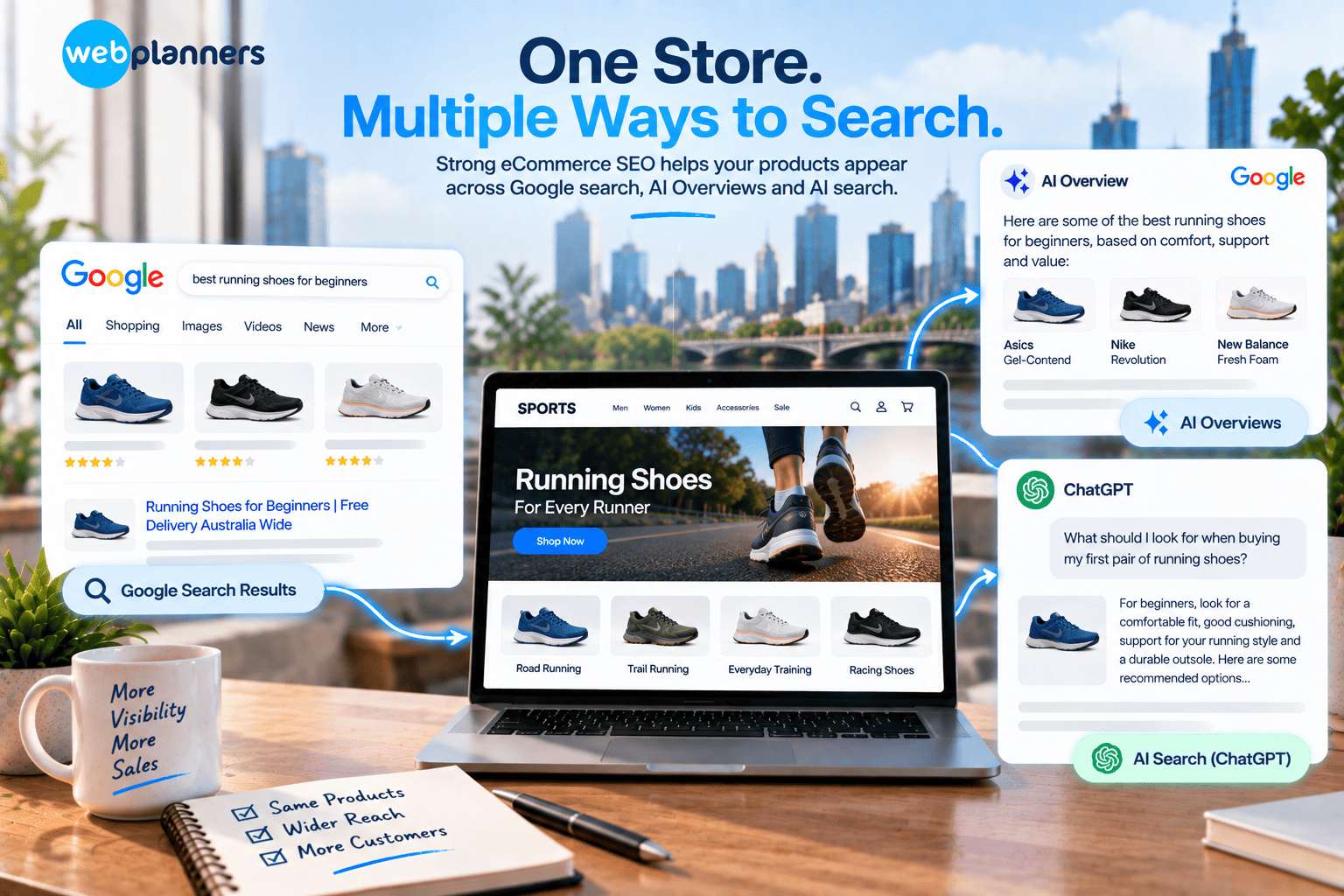
]]>A shopper might now ask Google or an AI search tool, “What are the best running shoes for someone who walks and runs several times a week?” rather than simply searching for “running shoes Melbourne”. They may ask which sofa suits a small apartment, which skincare product is better for dry skin, or which laptop offers the best battery life for university.
That changes what an eCommerce website needs to communicate. Keep reading as this blog looks at what online stores need to change across product pages, category architecture, structured data and content.
AI has not replaced eCommerce SEO. It has changed the amount and type of information a store needs to communicate.
Product pages need more than a product name, price and short description. Category pages need a clear purpose. Product variants, availability, reviews and other commercial details need to be presented accurately. Content should answer genuine shopping questions rather than repeat generic keywords.
AEO and GEO can be useful ways to think about visibility in conversational and generative search, but they should sit alongside solid SEO rather than replace it. Google states that there are no special requirements or separate schema types needed just to appear in AI Overviews or AI Mode.
1. Product Pages Need to Answer Real Buying Questions
A traditional product page might contain:
- Product name.
- Price.
- A few images.
- Short description.
- Add-to-cart button.
- Basic specifications.
That can be enough for a customer who already knows exactly what they want. It is less useful for someone still comparing options.
AI-driven search can involve much more specific questions.
For example, someone shopping for a dining table might ask:
- Is this table suitable for a six-person dining room?
- What material is it made from?
- Is it easy to clean?
- How much assembly is required?
- What chairs work well with it?
- Is it suitable for a small apartment?
- What are the delivery options?
Your product page does not need to turn into a huge block of text. It needs to provide the information a shopper genuinely needs at the point of consideration.
Google’s current AI search guidance places particular emphasis on useful, unique content that offers information beyond generic material repeated across the web.
Prepare Your Online Store For AI Search
2. Product Descriptions Should Provide Context
Changing a product description from:
“Women’s black running shoes. Lightweight running shoes for women. Buy women’s running shoes online.”
to a longer version stuffed with variations of “women’s running shoes” does not solve the underlying problem.
Instead, explain what makes the product useful.
For example:
Lightweight road running shoes for everyday training
Then provide information about:
- Cushioning
- Fit
- Weight
- Intended running surface
- Distance suitability
- Materials
- Available sizes
- Care instructions
- Warranty
- Delivery and returns
This gives search systems and shoppers more meaningful information to work with.
3. Category Pages Need a Clearer Role
One common eCommerce problem is treating category pages as simple collections of product links.
A well-structured category page can do much more.
Take an online furniture store:
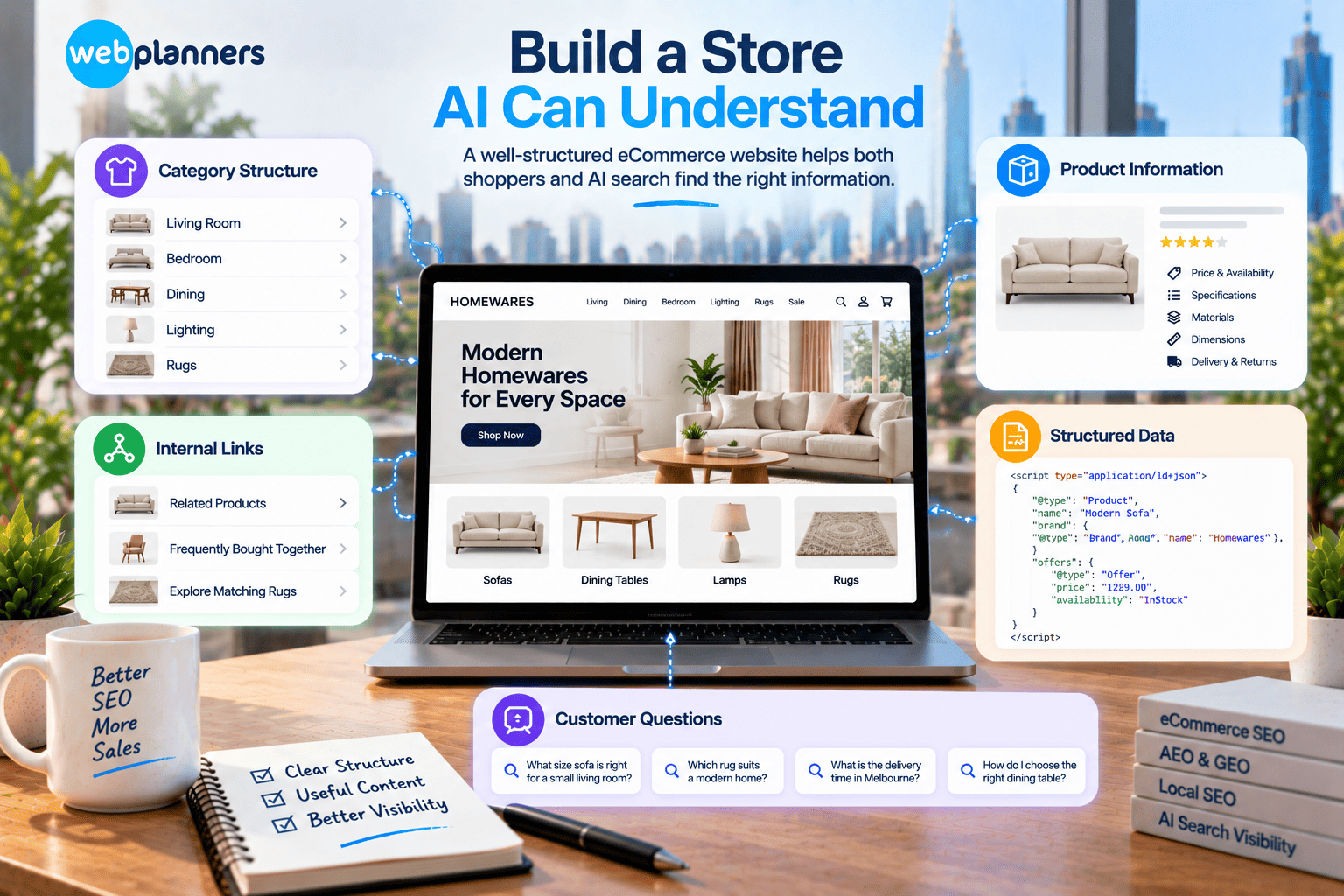
Living Room Furniture
→ Sofas
→ Modular Sofas
→ Sofa Beds
→ Armchairs
→ Coffee Tables
→ TV Units
The category page should explain what the category contains, help shoppers compare relevant options and connect naturally to important subcategories.
This creates a clearer relationship between the store’s products and topics.
The same principle applies to fashion, electronics, homewares, beauty, sporting goods and almost any other eCommerce sector.
4. Product Data Needs to be Technically Clear
AI search does not remove the need for technical SEO. In fact, large online stores have even more information that needs to be presented accurately.
Google supports Product structured data for information such as product details, offers, reviews, ratings and availability. Merchant listing experiences can also use information such as price, shipping and returns.
For stores selling products with multiple versions, variant information matters too.
A clothing retailer might sell one jacket in:
- Black
- Navy
- Green
- Small
- Medium
- Large
Google provides ProductGroup and Product structured data specifically for product variants such as different sizes, colours and materials.
The important point is that structured data should reflect what shoppers can actually see and buy. It is not a shortcut to AI visibility.
Google explicitly says there is no special schema markup required for AI Overviews or AI Mode. Structured data remains useful as part of broader SEO and search appearance work.
5. AEO Matters When Shoppers Ask Questions
AEO, or Answer Engine Optimisation, is useful as a way of thinking about question-based search.
For an eCommerce store, that means considering the questions people ask before they buy.
A furniture retailer could answer:
What size sofa is suitable for a small living room?
A skincare retailer could answer:
What should I look for in a moisturiser for dry skin?
An activewear store could answer:
What should I wear for running in cold weather?
These questions can sit within category content, buying resources, product comparisons or relevant product pages.
The goal is not to turn every page into an FAQ. It is to provide genuinely useful answers where they help someone make a purchase decision.
6. GEO Should Support the Wider SEO Strategy
GEO, or Generative Engine Optimisation, is another term businesses increasingly encounter when discussing AI search.
For an online store, the practical question is not simply, “How do we optimise for GEO?”
It is:
Does our website contain useful, reliable information that an AI system can understand and reference when someone asks a relevant shopping question?
That means looking at:
- Product information
- Category relationships
- Buying advice
- Comparisons
- Reviews
- Brand information
- Delivery and returns
- Original expertise
- Relevant local information
Google’s current AI search guidance specifically warns against chasing supposed AEO or GEO shortcuts. It recommends continuing with strong SEO foundations and useful, non-commodity content.
7. Local SEO Still Matters for E-commerce
Selling online does not automatically make location irrelevant.
Many eCommerce businesses have:
- Melbourne showrooms
- Physical retail stores
- Click-and-collect locations
- Local delivery areas
- Warehouses
- Installation services
- Service teams
- Melbourne-specific offers
A shopper might search for:
“Where can I buy a sofa in Melbourne?”
or:
“Best furniture store near Richmond with delivery?”
The website needs to communicate its location and services clearly.
This is where local SEO services can complement eCommerce SEO. Local business information, location pages, Google Business Profile information and relevant website content all contribute to a clearer local presence.
8. Strategy Plays An Important Role
AI tools can speed up parts of eCommerce SEO.
They can help teams:
- Group large keyword datasets.
- Identify recurring customer questions.
- Compare product attributes.
- Find gaps between categories.
- Create content briefs.
- Analyse internal linking opportunities.
- Summarise large inventories.
- Assist with initial product copy.
But publishing thousands of automatically generated product descriptions creates a different problem.
If 1,000 products receive almost identical AI-written descriptions with only the product name and colour changed, the store has not created 1,000 useful pieces of information.
Generative AI can assist with content creation, but mass-produced pages that add little value can fall under its scaled content abuse policies.
Human review still matters, particularly for product specifications, claims, comparisons and buying advice.
9. Measure Visibility Beyond Traditional Rankings
A strong eCommerce SEO strategy should not rely on one number.
Look at:
- Organic revenue.
- Product page traffic.
- Category page performance.
- Non-brand search traffic.
- Conversion rates.
- Assisted conversions.
- Product visibility.
- Search Console performance.
- AI search visibility where measurable.
- Queries generating commercial traffic.
That matters for eCommerce because shopping behaviour is becoming increasingly visual as well as conversational.
A product can be relevant to a customer even when that customer does not begin with a traditional ten-word Google query.
Build A Stronger SEO Strategy For Your Store
Conclusion
AI has not created a completely separate version of SEO for online stores. It has made the quality and clarity of existing information more important.
A product page should help someone understand a product. A category page should help someone understand their options. Structured data should accurately describe the information already present. Internal links should connect related areas of the store. Content should answer genuine questions. Local information should be clear when location influences the purchase.
That is where AI SEO becomes practical. It is not about filling a website with AI-generated text or chasing a new technical trick. It is about making the store useful and understandable across the different ways people now search.
For an online retailer, working with an experienced eCommerce SEO company in Melbourne can help bring these areas together across technical SEO, content, product architecture and search visibility.
Ready to strengthen your eCommerce search presence? Talk to Webplanners today and let’s discuss how we can help your online store attract more qualified customers.
FAQs
Should an eCommerce website have different content for AI search?
Not necessarily. Google says there are no specific content requirements for AI Overviews or AI Mode. Existing SEO basics still count, with useful, people-first content at the core.
Should every product page have a long description?
No. The length of the page should be defined by what the shopper needs to know. There’s no set word count for a product page, just enough accurate information to help your customers make their purchasing decision. There is no ideal page length for generative AI search.
Can AI write all my product descriptions?
AI can assist in the process, especially for large inventories, but human review and original product information is still important. Creating lots of low-quality pages automatically can lead to spam and quality problems.
The post E-commerce SEO in the Age of AI: What Online Stores Need to Change appeared first on Webplanners.
]]>The post 6 SEO Myths That Still Mislead Business Owners in 2026 appeared first on Webplanners.
]]>Some businesses still worry about hitting a specific keyword density. Others think ranking number one guarantees leads, that every page needs thousands of words, or that AI search means traditional SEO no longer matters.
Google itself addresses several of these misconceptions in its current SEO documentation, including keyword stuffing, word count, PageRank, duplicate content, heading structure and E-E-A-T. It also states that SEO best practices remain relevant to its generative AI search features.
Keep reading as we’ll explore common SEO myths from what actually deserves your attention in 2026.
1. Myth
: SEO is just about putting keywords on a page
Keywords still matter because they help describe what a page is about. But SEO is not a matter of repeating the same phrase until Google gets the message.
Google says its language systems can understand how pages relate to different queries without requiring every exact keyword variation to appear on the page. It also explicitly classifies excessive keyword repetition as keyword stuffing.
A better approach is to understand the topic behind the search.
For example, a page about family car washing might naturally cover the keywords that help establish relevance. The useful information gives the page substance.
2. Myth: Every page needs a specific word count to rank
A page should contain enough information to satisfy its purpose, rather than stretching a simple subject into 2,000 words because an SEO tool recommends it.
A product page for a pair of running shoes does not need to become a lengthy essay. It needs the information a buyer actually needs:
- Materials
- Fit
- Sizes
- Features
- Use cases
- Delivery
- Returns
A detailed comparison page may need substantially more information.
Useful content beats arbitrary word counts.
3. Myth: Ranking number one means your SEO is working perfectly
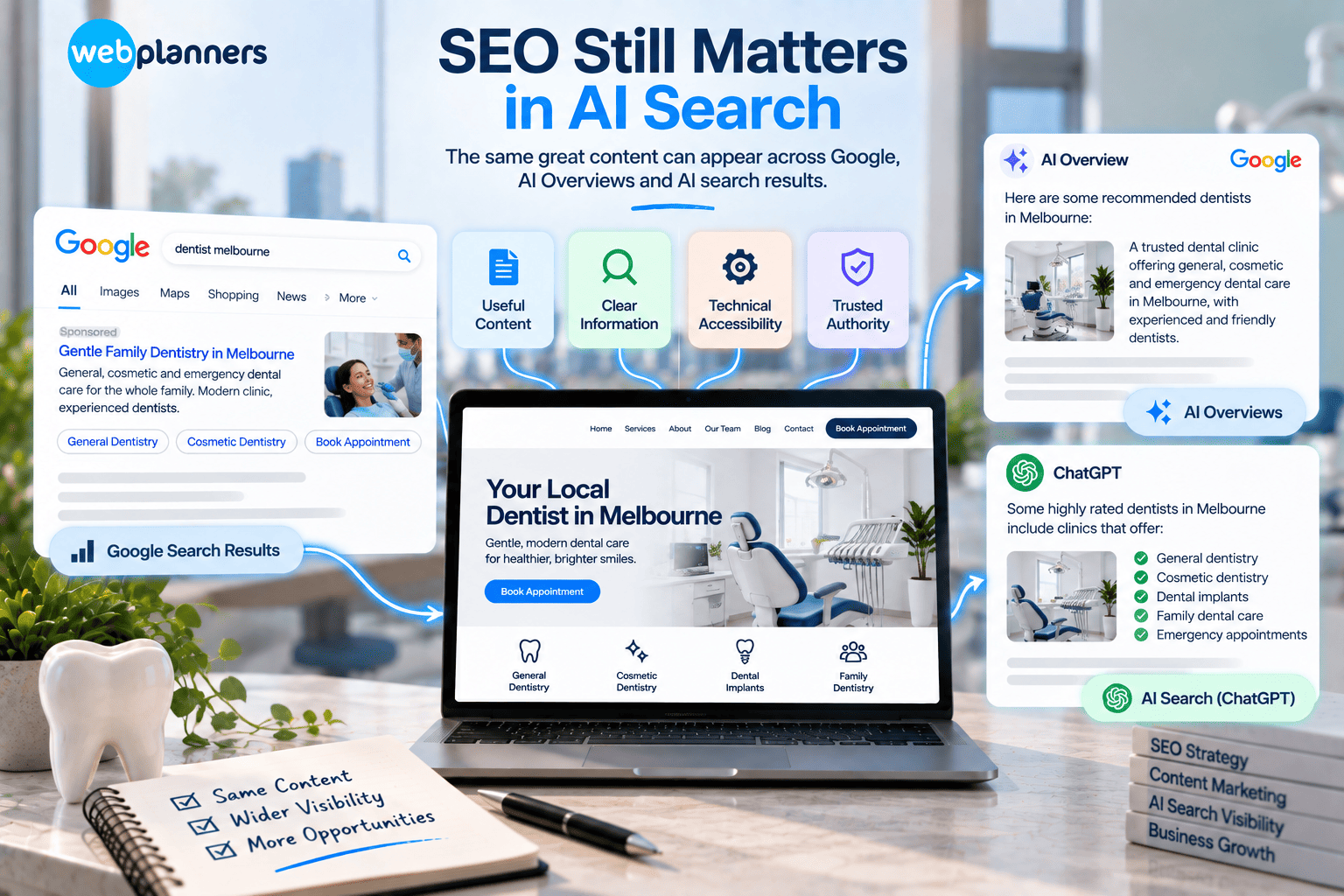
A page can rank highly for a search that generates plenty of impressions but few enquiries. Another page might receive less traffic but bring customers who are ready to buy.
That means SEO reporting should look beyond position.
Consider:
- Organic conversions.
- Qualified enquiries.
- Revenue.
- Search impressions.
- Click-through rates.
- Relevant landing pages.
- Branded search activity.
This becomes even more important as search results change. Google now includes AI Overviews and AI Mode alongside traditional results, while Search Console provides reporting for generative AI features.
The question is not simply “What position are we in?”
It is “Is organic search bringing the right people to the business?”
4. Myth: SEO is dead because people are using AI
AI search has changed how people can find information. It has not made SEO irrelevant.
Google’s current documentation says its generative AI search features are based on its core Search ranking and quality systems, and that SEO best practices remain relevant.
What has changed is the search journey.
A customer might now ask an AI platform:
“Which Melbourne car detailing businesses should I consider for a ceramic coating?”
instead of searching only:
“car detailing Melbourne”
That creates additional opportunities for useful, specific content.
This is where services such as AEO and GEO have entered the conversation. They can be useful ways to think about answer-focused and generative search visibility, but Google itself warns against treating AEO or GEO “hacks” as a shortcut to rankings or AI visibility.
Traditional SEO remains part of the foundation.
5. Myth: Local SEO is only about your Google Business Profile
A Google Business Profile is important for many local businesses, but local visibility does not begin and end there.
Your website can also provide useful local context through:
- Service areas.
- Location-specific services.
- Contact details.
- Local landing pages.
- Relevant customer information.
- Business information.
- Consistent references to where you operate.
For example, a Melbourne car wash targeting customers across several suburbs should make its service areas clear rather than simply repeating “car wash Melbourne” throughout the site.
That is why local SEO services often involve both your Google Business Profile and the wider website.
6. Myth: E-E-A-T is a ranking factor you can simply optimise
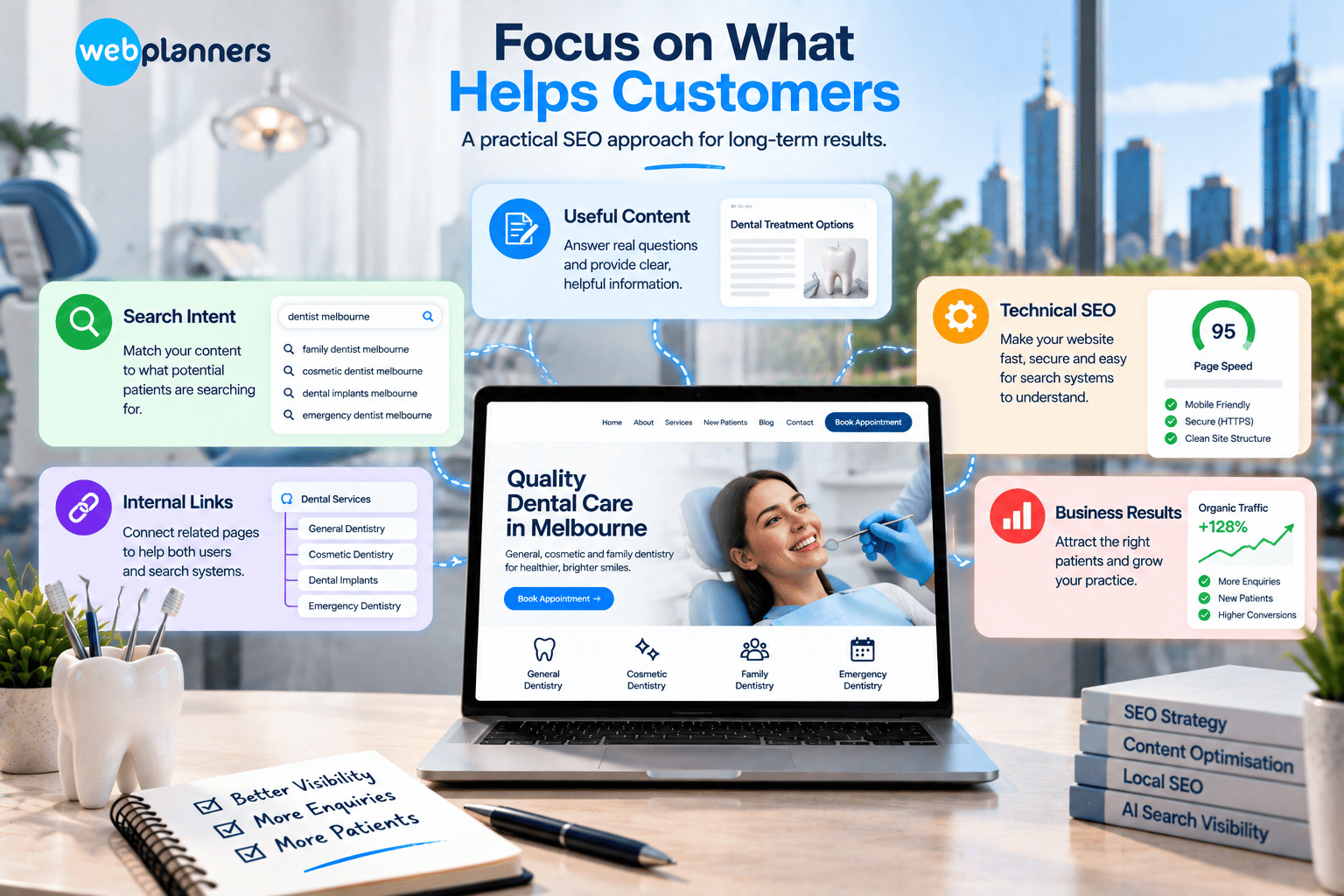
This one causes considerable confusion. Google states that E-E-A-T is not itself a ranking factor.
That does not mean experience, expertise, authority and trust are irrelevant.
They influence how useful and trustworthy content appears to users, and Google’s people-first guidance specifically asks whether content demonstrates first-hand expertise and whether readers can understand the expertise behind the information.
So instead of adding “E-E-A-T” to a page and calling the job done, show the substance behind your claims.
For a construction business, that could mean:
- Project experience.
- Building methods.
- Material knowledge.
- Before-and-after examples.
- Relevant qualifications.
- Detailed project explanations.
- Genuine customer outcomes.
Evidence is more useful than a label. For businesses that need specialist support, working with an SEO consultant in Melbourne can help turn these fundamentals into a strategy based on the site’s actual problems rather than a checklist of fashionable tactics.
Conclusion
Most SEO myths have something in common: they turn a complex system into one simple rule.
“Use this many keywords.”
“Write this many words.”
“Get this many backlinks.”
“Publish every week.”
“AI has replaced SEO.”
Real SEO does not work that neatly.
Google uses many systems to understand and rank content, and its own documentation repeatedly points site owners back towards useful content, technical accessibility, relevant links and a good user experience.
For businesses, that means the strongest strategy is rarely the one with the most tricks.
It is the one that makes the website genuinely useful to the people who matter.
If your website needs a clearer search strategy, Webplanners SEO services can help assess the technical, content and search opportunities across your site, including traditional organic search and newer AI-driven search experiences.
Want to know which SEO myths are holding your website back? Speak with the Webplanners team for a practical review of your current search strategy.
FAQs
How long does it take to see results from SEO changes?
There is no fixed timeframe. Google says some changes can be reflected within hours, while others may take several months, and recommends waiting a few weeks before assessing the effect of many changes.
Should small businesses invest in SEO if most customers come from local searches?
Yes, local search can be an important source of customers, particularly when people are looking for nearby services. The right approach depends on the business, service area, competition and customer behaviour, so local SEO should be tied to actual business goals rather than treated as a standalone checklist.
Can AI-generated content rank on Google?
AI-assisted content can appear in Search, but using AI does not give content a ranking advantage. Google focuses on whether content provides value and warns against scaled production of low-value content intended primarily to manipulate Search.
The post 6 SEO Myths That Still Mislead Business Owners in 2026 appeared first on Webplanners.
]]>The post Is Your Website Easy for AI to Understand? 7 Things to Check appeared first on Webplanners.
]]>The issue is not about making a website “AI-friendly” by adding a few phrases or creating pages written for machines. It is about whether the important information on your website is visible, specific, consistent and easy to interpret.
Google’s current guidance is clear on one important point: its generative AI features still rely on core Search ranking and quality systems. There is no separate set of magic SEO tricks that guarantees visibility in AI Overviews or AI Mode.
Keep reading, as we’ll look at practical checks you can run on your website to see whether your content is clear enough for AI systems to interpret, connect and use.
An AI system does not see your website in quite the same way a customer does.
A customer can look at a page and quickly understand that you sell premium running shoes, operate in Melbourne and offer same-day delivery. An AI system needs that information to be available in a form it can access and interpret consistently.
Start with these checks:
- Can search systems access the actual page content?
- Is the main purpose of the page obvious?
- Can important information be read without interaction?
- Do your headings reflect real customer questions?
- Are your business entities and relationships clear?
- Are important claims supported by useful evidence?
- Do internal links reinforce the meaning of the page?
These checks are more useful than simply writing for AI.
1. Can Search Systems Access The Actual Page Content?
Start with the simplest question:
If the page loads in a browser, can a search system access the same important information?
Modern websites often rely heavily on JavaScript. That is not automatically a problem, but it can become one when important information only appears after a user interaction or after additional scripts run.
For example, an online retailer may have a product page where the browser shows:
“Organic cotton activewear made in Australia.”
But if the key product description, specifications or availability information is only generated through a client-side application, you need to check how the rendered page is actually seen by search systems.
Google recommends using tools such as URL Inspection to check how it crawls and renders a URL.
Check this:
- View the page source and rendered page.
- Test important URLs in Search Console.
- Check whether key copy appears after rendering.
- Look for content loaded only after clicks or scripts.
- Check that important pages are not blocked from crawling.
This is particularly important for websites built around complex JavaScript frameworks, product filters, interactive tools and dynamic content.
Make Your Website Easier For AI To Understand
2. Is The Main Purpose of The Page Obvious?
An AI system should not have to work through five paragraphs of promotional copy before understanding what a construction business actually does.
Take a construction company targeting Melbourne homeowners.
The first section should make the service immediately clear:
Residential Construction Services in Melbourne
Then quickly explain:
- What types of construction projects the company handles?
- Whether it works on new builds, extensions or renovations?
- Which areas it services?
- Who the service is designed for?
- What makes its approach or experience relevant?
Compare that with a page that begins with:
“Building your dream home is an exciting journey, and choosing the right construction partner is an important decision…”
That opening could appear on almost any builder’s website.
A clear page purpose starts with the basics: a descriptive title, useful headings and specific opening copy.
For a construction website, the same principle applies across project and service pages. A visually impressive site still needs a clear information structure so customers and search systems can quickly understand what the business does.
3. Can Important Information Be Read Without Interaction?
This is one of the most overlooked checks. Businesses often hide useful information inside:
- Tabs
- Accordions
- Sliders
- Pop-ups
- Hover states
- “Read more” controls
- Product filters
- Interactive calculators
These features can be useful for customers. The problem comes when essential information is available only after an interaction that a search system may not experience in the same way.
For example, a furniture retailer might place all product dimensions inside an expandable tab.
A customer can click it.
But if the page’s main content does not clearly expose those dimensions in an accessible way, the information becomes less useful as a source for search.
The same issue can affect:
- Pricing conditions.
- Service areas.
- Product specifications.
- Delivery information.
- Warranty details.
- Eligibility requirements.
- Important product differences.
Interactive design should improve access to information, not become the only place where the information exists.
4. Do Your Headings Reflect What Customers Actually Want to Know?
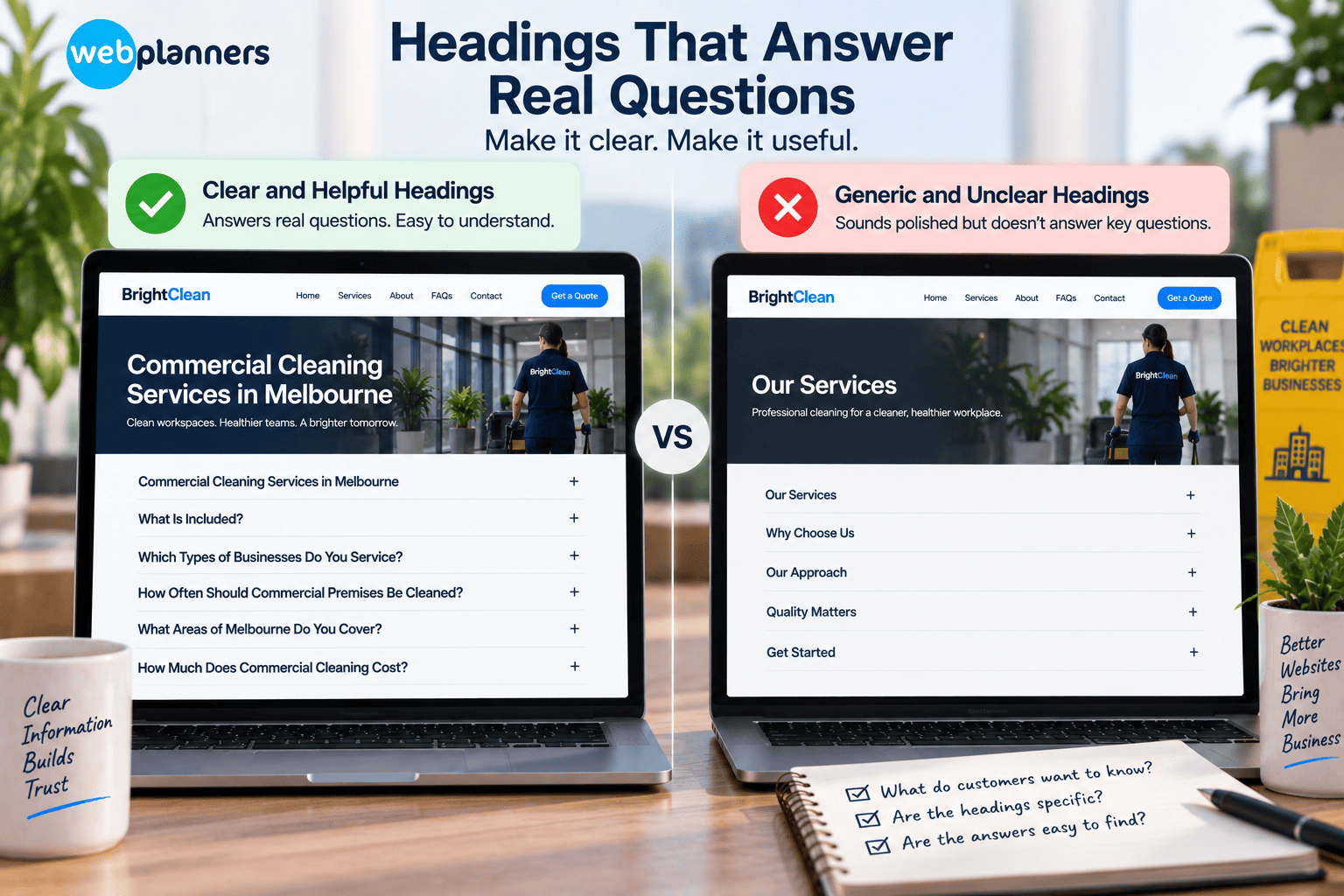
Headings are not just formatting.
They give both users and search systems clues about how information is organised.
A page about commercial cleaning services could use headings such as:
- Commercial Cleaning Services in Melbourne
- What Is Included?
- Which Types of Businesses Do You Service?
- How Often Should Commercial Premises Be Cleaned?
- What Areas of Melbourne Do You Cover?
- How Much Does Commercial Cleaning Cost?
These headings establish a much clearer information structure than:
- Our Services
- Why Choose Us
- Our Approach
- Quality Matters
- Get Started
The second set sounds polished but communicates very little.
This is where the principles behind Answer Engine Optimisation can be useful without turning every page into a collection of FAQs. The aim is to make genuinely useful answers easy to locate.
5. Are Your Business Entities and Relationships Clear?
AI needs more than isolated words.
It needs context.
Suppose a website mentions:
“Melbourne”
That alone says very little.
But if the website consistently connects:
Business → Service → Location → Audience → Product → Industry
the relationship becomes much clearer.
For example:
Melbourne-based activewear retailer → women’s running clothing → online and Melbourne store → runners and fitness customers → leggings, tops and jackets
That gives far more context than repeating “activewear Melbourne” throughout the page.
Look at your website and ask:
- Is the company name consistent?
- Are products and services named consistently?
- Are locations clearly stated?
- Are related services connected?
- Does the website clearly distinguish brands, products and services?
- Do different pages contradict each other?
This is where Entity SEO becomes relevant, but the practical task is straightforward: make the business and its relationships easy to understand.
6. Are Important Claims Supported by Useful Information?
AI systems have plenty of generic information available to them.
Your website becomes more useful when it contains information that is specific to your business.
Consider these two statements:
“We provide high-quality solar solutions.”
and:
“Our Melbourne residential solar installations use panels rated for Australian conditions, with system sizing based on household energy consumption, roof orientation and available roof space.”
The second gives a much clearer picture.
It contains details that can help a customer understand the service.
Useful supporting information could include:
- Product specifications.
- Testing information.
- First-hand observations.
- Original research.
- Case studies.
- Detailed comparisons.
- Process explanations.
- Real examples.
- Relevant credentials.
- Customer outcomes.
This is not a reason to make every page longer. It is a reason to make important pages more specific.
Improve Your Website’s Search Visibility
7. Do Your Internal Links Explain How Your Content Fits Together?
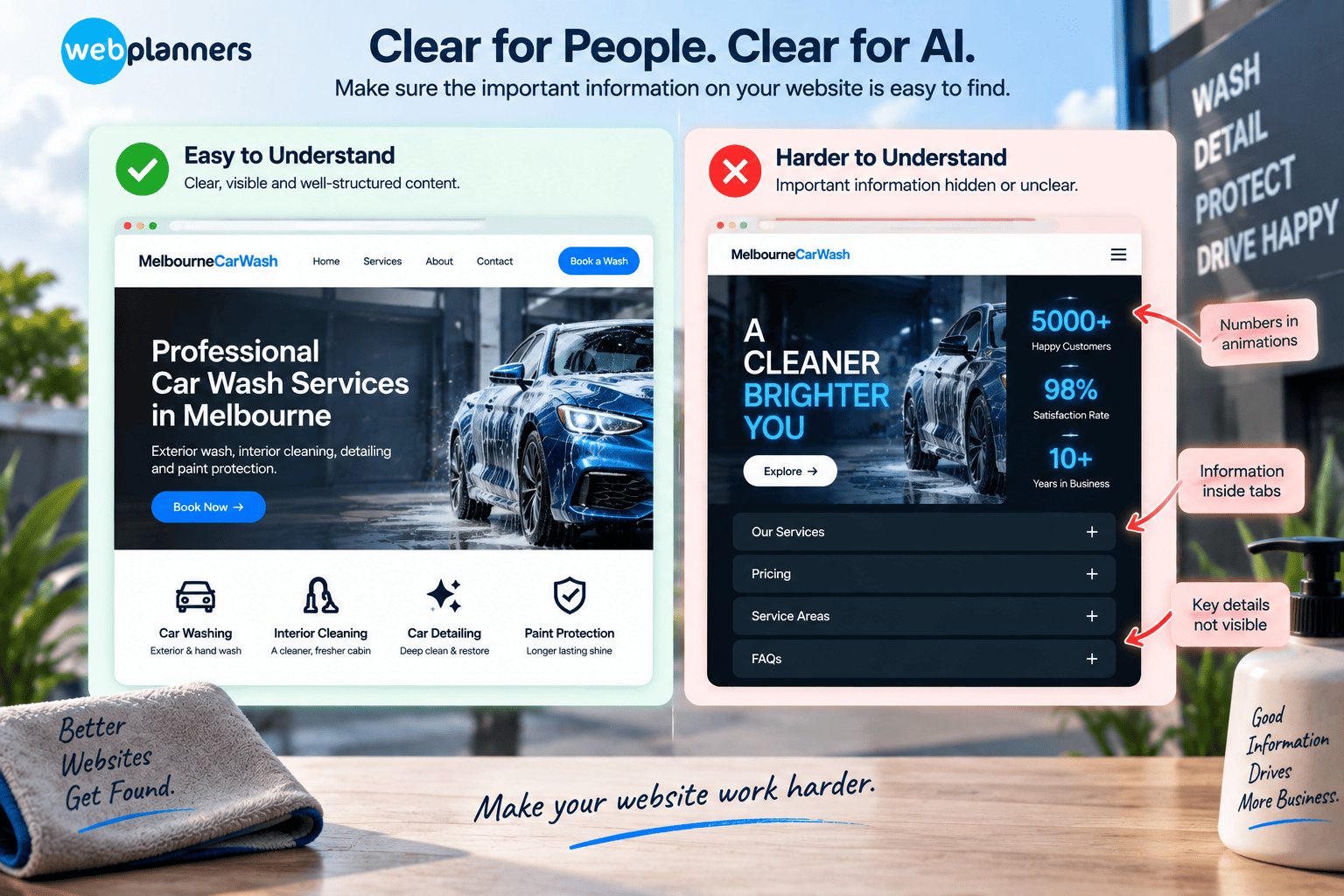
Internal links do more than connect one page to another. They help both customers and search systems understand how different parts of your website relate to each other.
Suppose a Melbourne car wash business has pages covering:
Car Washing → Interior Cleaning → Car Detailing → Ceramic Coating → Paint Protection
A visitor should be able to move naturally between closely related services without being presented with a long list of unrelated links.
The anchor text matters too.
Instead of:
“Click here to learn more.”
Use:
“See how our car detailing services can give your vehicle a deeper clean.”
The anchor gives the visitor context before they click and makes the relationship between the two pages clearer.
Relying on an expert SEO consultant can help you get more organic traffic with internal linking
For this website, the same principle applies to AI search: link where the next page genuinely adds context, not because every page needs three internal links.
Conclusion
An AI-readable website is not a website filled with AI terminology.
It is a website where the important information is accessible, specific, connected and consistent.
Start with your most valuable pages. Check what a customer needs to understand, then check whether that information is actually available to search systems in a clear form.
If you want to assess the wider technical foundation, rely on our trusted AI SEO company in Melbourne. Our team can review how your website handles crawlability, content structure, internal linking and search visibility across key pages.
Want to know how clearly AI can understand your website? Talk to Webplanners for a practical website and AI search assessment.
FAQs
Can a website be technically sound but still difficult for AI to understand?
Yes. Technical accessibility is only one part of the picture. A page can be crawlable while still being vague, inconsistent or lacking the information needed to explain the business, product or service clearly.
Does adding an AI-readable summary to every page help?
No, not automatically. Summary is helpful when it provides a concise explanation of a complicated page but the same generic AI-focussed summary on multiple pages adds little value. The important information should be in the underlying page content.
Should I change my website if AI search traffic is currently low?
Not only AI traffic. First, look at the commercially relevant pages: how your customers find your products or services, and whether the essential information is easily accessible and presented clearly. AI search should be looked at in conjunction with organic traffic, enquiries, sales and other business outcomes.
The post Is Your Website Easy for AI to Understand? 7 Things to Check appeared first on Webplanners.
]]>The post Why Your Best-Performing SEO Pages May Not Be Your Best AI Search Pages appeared first on Webplanners.
]]>That is because traditional SEO performance and AI search visibility are related, but they are not the same thing. A page that performs strongly for a specific keyword may not contain the depth, context, evidence or direct answers needed when an AI system builds a response from multiple sources.
Google itself states that its generative AI search features continue to rely on core Search ranking and quality systems, while also advising site owners to focus on clear technical structure and unique, useful content.
Keep reading, as we’ll look at why strong SEO pages can be overlooked in AI search and what businesses should assess across their existing content.
Your highest-traffic SEO page is not automatically your strongest AI search asset.
A page may perform well because it targets a valuable keyword, has strong backlinks, matches search intent and has built authority over time. AI systems have a broader task when generating an answer: they need to understand the subject, identify relevant information, connect concepts and select useful sources for a particular question.
That means businesses should assess more than rankings and traffic.
Look at:
- Whether the page answers specific customer questions
- Whether the information is detailed enough to provide useful context
- Whether expertise and first-hand knowledge are visible
- Whether the page clearly relates to the business and its core entities
- Whether supporting pages strengthen the topic
- Whether important information exists as accessible page content
- Whether the page remains useful when a customer asks a more specific question
Google’s advice also makes an important point: there is no separate technical shortcut that guarantees visibility in generative AI features. Strong SEO fundamentals remain central.
A Page Can Win Google Traffic Without Answering the Bigger Question
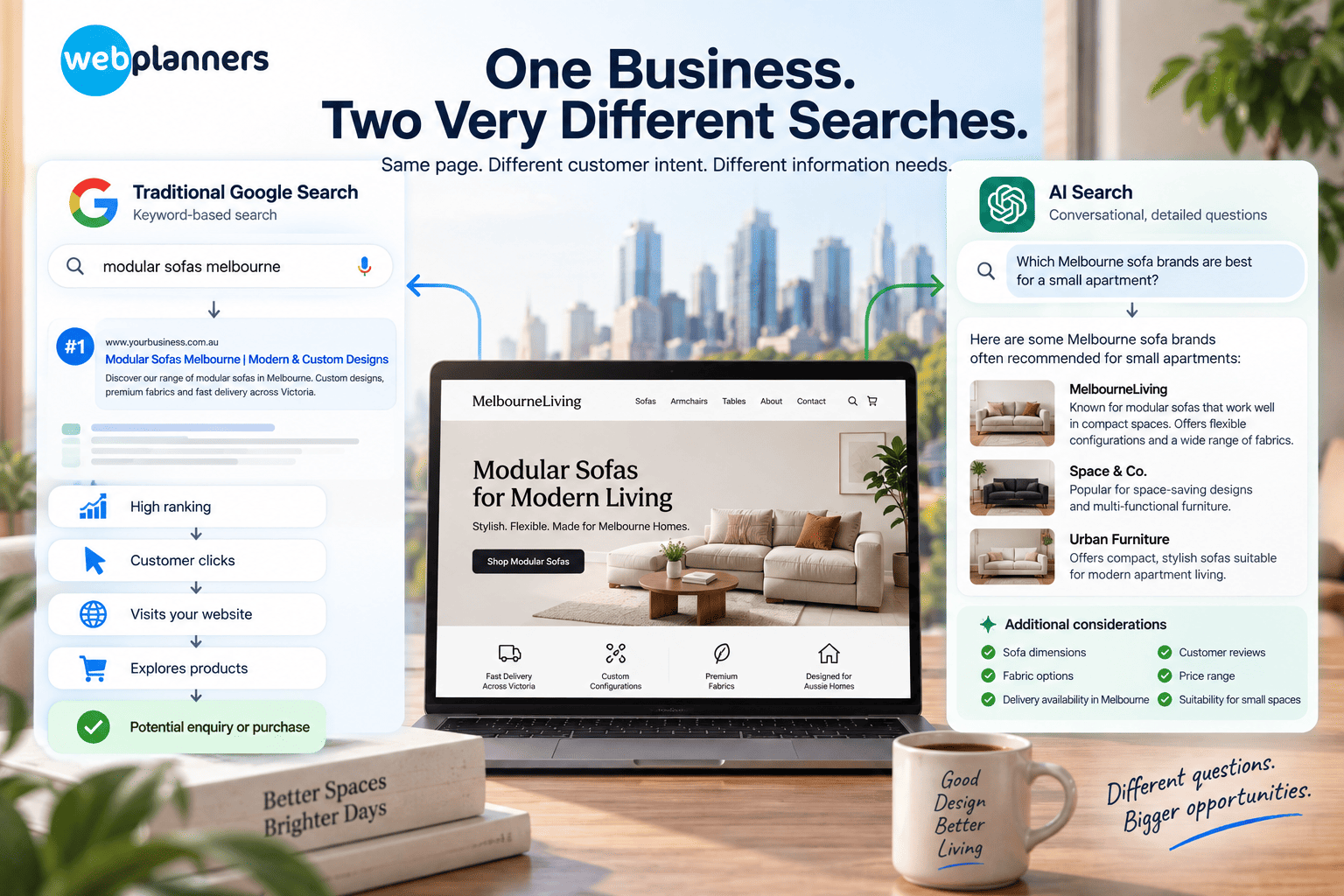
Consider an online furniture business with a page targeting:
“modular sofas Melbourne”
The page ranks well and receives steady organic traffic.
It might contain:
- A product range
- Pricing information
- Product specifications
- Delivery details
- Strong internal links
- Optimised title and headings
From a traditional SEO perspective, that page may perform very well.
But a customer could ask an AI platform:
“Which modular sofas are best for a small Melbourne apartment?”
That question introduces several additional considerations:
- Space requirements
- Sofa dimensions
- Configuration options
- Fabric suitability
- Delivery availability
- Apartment access
- Price range
- Customer reviews
- Product comparisons
The original page may rank for the broad search while providing little information that directly addresses the more specific question.
This is one reason AI SEO requires businesses to look beyond individual keyword positions and consider the information customers need throughout the decision process.
Why AI Search Changes What Makes a Page Useful
Traditional search often starts with a keyword.
AI search can start with a complete question.
That difference matters.
Someone searching:
“Melbourne activewear”
has a relatively broad intent.
Someone asking:
“Which Melbourne activewear brands make durable leggings for regular gym training?”
has already supplied context, preferences and a potential buying requirement.
The AI system has to interpret that request and identify information that helps answer it.
This is where a page’s information depth becomes important.
A strong page does not need to contain every possible question. It should, however, provide enough useful information for its main subject to be understood clearly.
Google’s current generative AI guidance recommends unique, useful content aimed at people rather than content produced simply to target different variations of search queries.
That distinction is important. Businesses should not create dozens of near-identical pages just because AI search can generate many variations of a question. Instead, strengthen the pages that genuinely deserve to exist.
Strengthen Your Website For AI Search
Traffic Tells You What People Visit But No What AI Needs
Organic traffic is still an important SEO measurement.
So are:
- Rankings
- Click-through rate
- Conversions
- Engagement
- Revenue
- Leads
But these metrics answer a different question:
How is this page performing in traditional search and business outcomes?
AI search introduces another question:
Does this page contain information that can support an answer to a customer’s more detailed query?
A page receiving 10,000 monthly visits may have strong commercial value. Another page receiving 500 visits may contain far more specific information about your products, processes or expertise.
Neither traffic figure tells you which page an AI system may use for a particular response.
This is why AI search analysis should sit alongside your existing SEO reporting rather than replace it.
What Can Make a Strong SEO Page More Useful for AI Search?
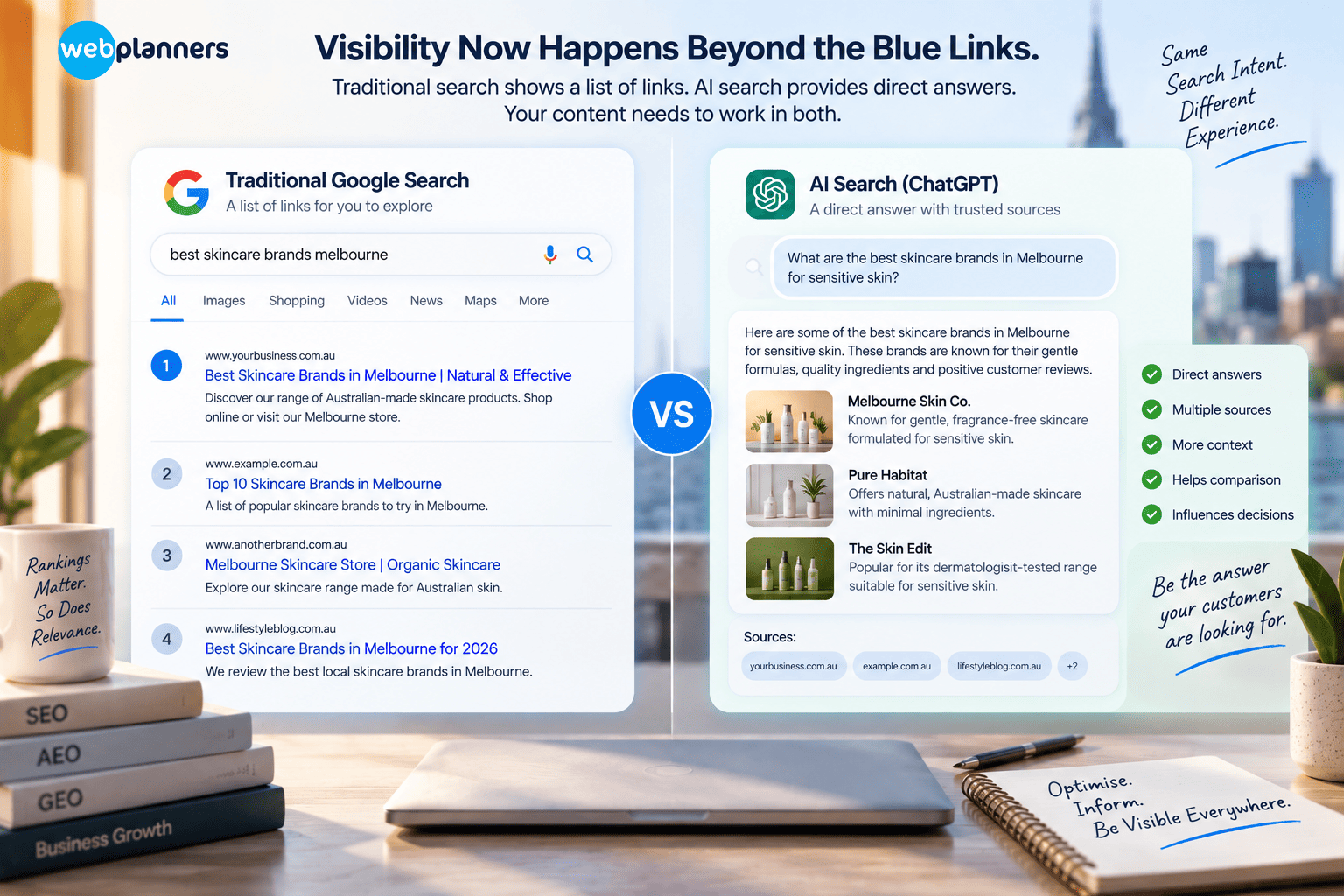
1. Clear Answers to Real Customer Questions
Important information should be easy to locate and easy to read on a page.
In an activewear business that could be:
- Which fabrics are good for high-intensity training?
- What is the fit of leggings?
- What is the difference between compression and everyday activewear?
- How should customers care for technical fabrics?
- What products do you have for different training styles?
The questions can be about ingredients, skin types, product use, routines and product combinations for a skincare brand.
This is where AEO and GEO become relevant. Answer-focused content can make important information clearer for both users and search systems.
The goal is not to turn every page into a long FAQ. It is to answer the questions that genuinely belong to the page.
2. Evidence of Experience and Expertise
AI systems can draw from many sources. Generic statements provide little differentiation.
Compare:
“We sell high-quality activewear.”
with:
“Our running tights use a four-way stretch fabric tested through repeated training sessions, with a higher waistband designed to stay in place during movement.”
The second statement provides specific information.
It tells the reader:
- What the product does
- How it is designed
- What experience informs the claim
- Why the feature matters
This is where E-E-A-T becomes useful. Experience, expertise, authority and trust are not simply boxes to tick. They should appear through the actual information a business publishes.
Author information, first-hand observations, product testing, original research, useful comparisons and evidence can all add substance where they genuinely apply.
3. Strong Connections Between Pages
AI search does not only depend on one isolated page.
Your website should make the relationship between important topics clear.
For example, a skincare website might have:
Skincare:
→ Sensitive Skin
→ Fragrance-Free Products
→ Moisturisers
→ Ingredients
→ Product Guides
Each page serves a different purpose while contributing to a broader understanding of the business.
This is also where Entity SEO matters. Your website should make it clear what your business is, what you sell, which services or products belong to you, who you serve and how different parts of your offering relate to each other.
A well-structured site gives search systems more context than a collection of unrelated pages targeting individual keywords.
4. Information that goes beyond generic descriptions
One of the biggest problems with AI search content is sameness.
If ten websites publish almost identical explanations of a topic, there is little reason for an AI system to rely heavily on one particular page.
Businesses have an opportunity to add information that comes from their own experience.
That could include:
- Original research
- Product testing
- Customer insights
- First-hand observations
- Local knowledge
- Industry-specific examples
- Detailed comparisons
- Proprietary data
- Case studies
The Webplanners material on generative AI content also highlights comprehensive topic coverage, question-and-answer formats, original research, case studies and useful comparisons as content formats that can provide stronger source value.
The key point is simple: give people something useful that cannot be produced by swapping a few words in an existing page.
What Should You Check on Your Highest-Performing Pages?
Start with your top organic pages rather than creating new content immediately.
For each page, ask:
Does the page answer the obvious next question?
If someone reads the page, what would they ask next?
Add useful information where there is a genuine gap.
Is the page specific enough?
Replace broad claims with concrete information wherever possible.
Is your expertise visible?
Show relevant experience, evidence, examples and supporting information instead of relying on promotional statements.
Does the page explain the business clearly?
Make your products, services, audience, location and areas of expertise clear.
Does the page connect to related content?
Use relevant internal links to help users and search systems understand the wider subject.
Does the page still make sense outside its target keyword?
Remove the keyword and read the page as a customer would.
If the content becomes vague without the keyword, it probably needs stronger substance.
Build Content That Supports AI Search Visibility
Don’t Rewrite Every High-performing Page for AI
This is where many businesses can waste time.
A page that already performs well does not automatically need a complete rewrite.
Start by identifying what is missing.
For example:
| Existing strength | Possible gap |
|---|---|
| Strong organic rankings | Limited answers to detailed questions |
| High traffic | Little first-hand information |
| Good backlinks | Weak connection to related topics |
| Strong product descriptions | Few comparison points |
| Clear service information | Limited evidence of expertise |
| Good local rankings | Weak supporting information about location |
| Strong commercial intent | Little information for earlier research stages |
The right response may be a targeted content improvement, stronger internal linking, clearer page structure or additional evidence. It does not have to mean starting again.
Google’s own guidance supports this approach: its recommendations for generative AI search continue to emphasise sound SEO fundamentals, useful content and clear technical structure rather than separate AI-only tricks.
Conclusion
Your best SEO page and your best AI search page may be the same page.
But they may also be completely different.
Rankings and traffic show where your website performs in traditional search. AI search adds another layer: whether your content contains clear, useful and trustworthy information that can support more detailed customer questions.
The answer is not to abandon SEO or create a separate set of pages for every AI query. Strengthen the pages that already matter, add genuine expertise and useful detail, connect related topics, and measure how your visibility changes across both traditional and AI search.
Want to know whether your existing SEO strategy is ready for AI search? Talk to the Webplanners team for a practical assessment of your website, content and search visibility.
FAQs
Can a page with low organic traffic still be valuable for AI search?
Yes. Traffic counts visits, not the overall utility of information on a page. A page with a modest amount of organic traffic may have very specific information that helps support detailed customer questions, comparisons or recommendations.
How often should I review pages that perform well in SEO?
Not necessarily. It creates needless duplication to make large numbers of pages for minor variations on the same question. When it truly belongs on an existing relevant page, it is generally more useful to strengthen that page. Google’s guidance today also cautions against creating content at scale to primarily manipulate Search or generative AI visibility.
How often should I review pages that perform well in SEO?
There’s no set review period that works for all websites. Important pages to review: When customer needs change Products / services change Search behaviour changes Organic performance and conversions change For AI search, also verify that the information continues to accurately represent the business and addresses current customer questions.
The post Why Your Best-Performing SEO Pages May Not Be Your Best AI Search Pages appeared first on Webplanners.
]]>The post What Happens When Customers Ask AI Which Melbourne Business to Choose? appeared first on Webplanners.
]]>A question such as:
“Which Melbourne businesses should I consider for this?”
asks AI to do more than match a keyword. It needs to understand what the businesses offer, who they serve, where they operate, what makes them relevant and what information supports the recommendation.
The same shift is happening in Google. AI Overviews can appear above traditional results for eligible searches, giving users a summary with links to supporting web pages. Google says these AI features build on its existing Search systems, which means strong technical SEO, useful content and clear information still matter.
In this blog, we’ll look at how AI search evaluates businesses, what influences visibility, and what you can do to improve your presence across AI search.
How Modern Search Has Evolved?
Traditional search often starts with a phrase such as:
“women’s activewear Melbourne”
The customer then receives a set of results and decides which websites to visit.
An AI search might instead be:
“Which Melbourne activewear businesses are worth considering for comfortable gym clothes?”
Or:
“What Australian activewear brands are suitable for everyday wear?”
The difference is important.
The second type of question contains intent, context and a decision.
The customer is not simply looking for a page about activewear. They want help deciding between options.
AI therefore needs to connect information about:
- The business
- Its products or services
- Its location
- Its customers
- Its areas of expertise
- Its reputation
- The specific need in the question
That is why simply adding more keywords is unlikely to address the whole problem.
Improve How Your Business Appears In AI Search
What Does AI Need to Know About a Business?
Consider a fictional Melbourne activewear business called MoveWell.
Its website clearly explains its product categories, materials, sizing, intended uses, customer types and Melbourne presence. Its supporting content answers questions about choosing activewear, different fabrics and care requirements.
The information forms a connected picture:
MoveWell → activewear → gym wear → everyday clothing → sustainable materials → Melbourne
Now compare that with a homepage that only says:
“Premium activewear for your active lifestyle.”
The second version may sound polished, but it gives much less useful context.
This is where entity SEO fits naturally into the wider picture. Search systems need to understand the relationship between a business, its products, services, locations and areas of expertise.
For businesses, this means making those relationships clear throughout the website rather than relying on one homepage statement.
What Happens When the Customer Gets More Specific?
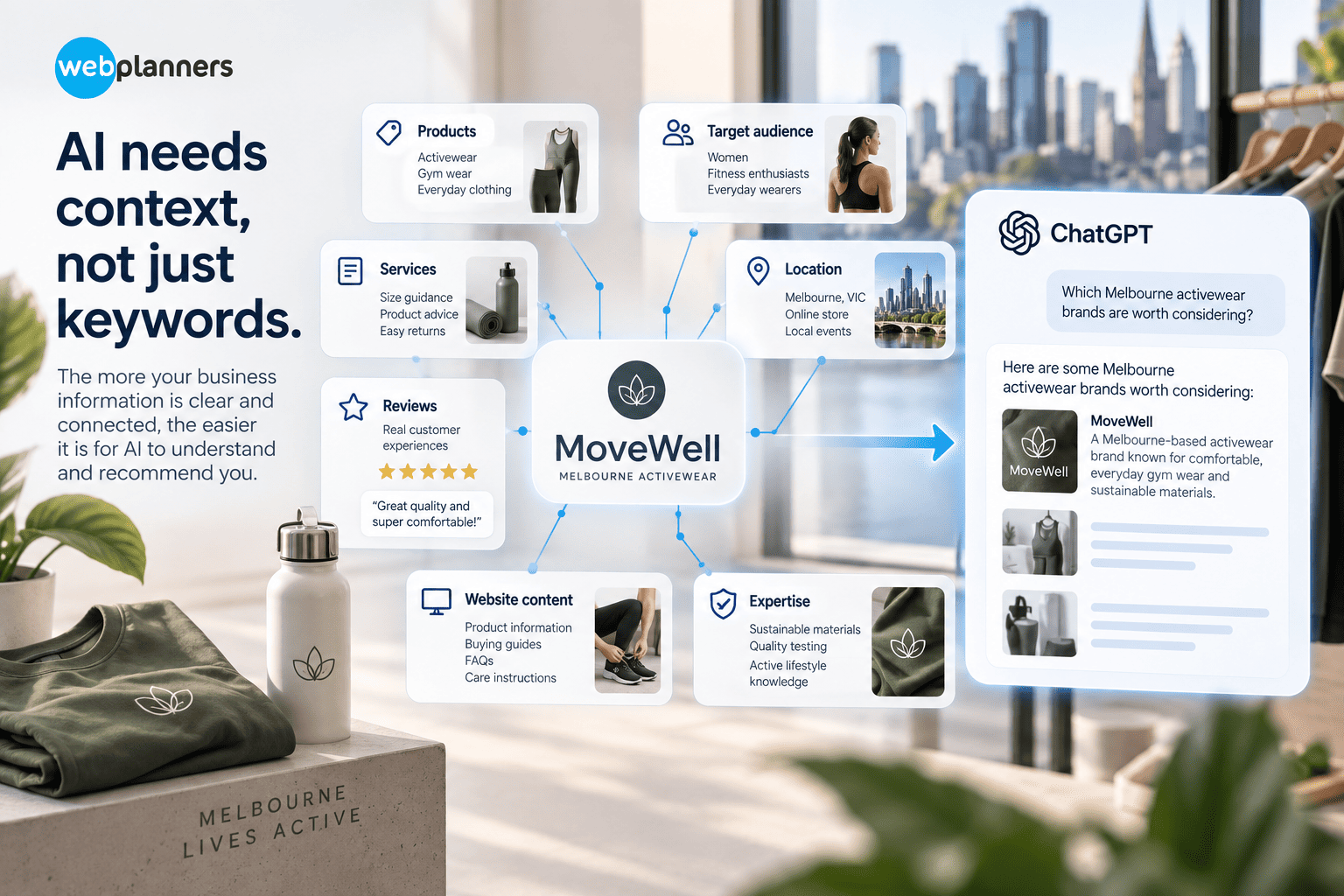
Now change the question.
Instead of:
“Which Melbourne activewear businesses should I consider?”
the customer asks:
“Which Melbourne activewear businesses offer comfortable clothing for everyday wear?”
The answer now depends on more specific information.
The website needs to communicate:
- What products are available
- Who they are designed for
- What makes them suitable
- What materials are used
- How the products differ
- What customers say about them
This is where useful content becomes important.
A product page can provide specifications. A category page can explain the range. Customer reviews can provide experience. A buying resource can answer common questions.
Together, those pages give both customers and search systems more context.
This is also where AEO fits. Instead of creating content around isolated keywords, businesses can answer the questions people ask before making a decision.
Where Do AI Overviews Fit Into This?
The AI search conversation is not limited to ChatGPT.
Google’s AI Overviews can provide an AI-generated response within Google Search, with links to web pages that support the information shown. Google says AI Overviews use the same foundational Search systems and can use multiple searches to find relevant information for more complex questions.
That creates another visibility opportunity.
A customer might search:
“What should I look for when choosing a Melbourne furniture store for a small apartment?”
An AI Overview may bring together information from several sources before presenting an answer.
Your business therefore needs to be relevant to the question, not just the keyword.
This is one reason a website with useful buying information, clear product or service pages, supporting evidence and strong technical foundations can have value beyond its traditional ranking positions.
Why Being on Page One is Not the Whole Story?
A business can rank well for:
“sofas Melbourne”
and still have limited visibility when a customer asks:
“Which Melbourne furniture businesses are good for small apartments?”
The first search is largely about finding a product or business.
The second involves evaluation.
The customer wants help understanding which option fits their situation.
This difference is important because AI search can bring together information about a business from multiple sources.
Webplanners has previously looked at this distinction through its work on AI search decline, where traditional Google visibility does not necessarily tell the full story about how a business appears in AI-driven search.
What Information Can Strengthen The Recommendation?
There is no published formula that guarantees an AI platform will recommend a business.
But businesses can make their information more useful and easier to interpret.
For example, a skincare business could provide:
- Detailed product information.
- Ingredient explanations.
- Usage instructions.
- Product comparisons.
- Information about different skin concerns.
- Genuine customer experiences.
- Expert or first-hand commentary.
- Clear information about the business.
A furniture business might need to provide:
- Dimensions.
- Materials.
- Delivery information.
- Assembly details.
- Product suitability.
- Room-size advice.
- Customer reviews.
A professional service business may need:
- Areas of expertise.
- Service information.
- Relevant experience.
- Qualifications.
- Case studies.
- Location details.
- Clear explanations of the process.
The information changes by industry because the customer’s decision changes.
That is also why E-E-A-T should be treated as part of the content and trust strategy, rather than as a separate SEO task. Evidence of experience, expertise, authority and trust gives customers more substance when assessing a business.
How Can You Test What AI Says About Your Business?
The simplest approach is to think like a customer.
Do not start with:
“Tell me about my business.”
Ask questions that involve an actual decision.
For a Melbourne homewares business:
“Which Melbourne homewares businesses are worth considering for a first apartment?”
“What should I look for when choosing furniture for a small living room?”
“Which Australian furniture brands offer products suitable for compact homes?”
“What are some Melbourne stores worth considering for modern homewares?”
Then record:
| Check | What to look for |
|---|---|
| Business mentioned | Is your business included? |
| Accuracy | Is the description correct? |
| Products/services | Are the right offerings recognised? |
| Location | Is Melbourne relevance understood? |
| Differentiation | Is your key point of difference visible? |
| Sources | Is your website cited? |
| Competitors | Which alternatives appear? |
Knowing what questions to ask ChatGPT about your own business can help you build a more useful test and see how accurately AI represents your business.
Run the same questions periodically. AI responses can change, so a consistent set of prompts gives you a better comparison than random testing.
What If AI Gets Your Business Wrong?
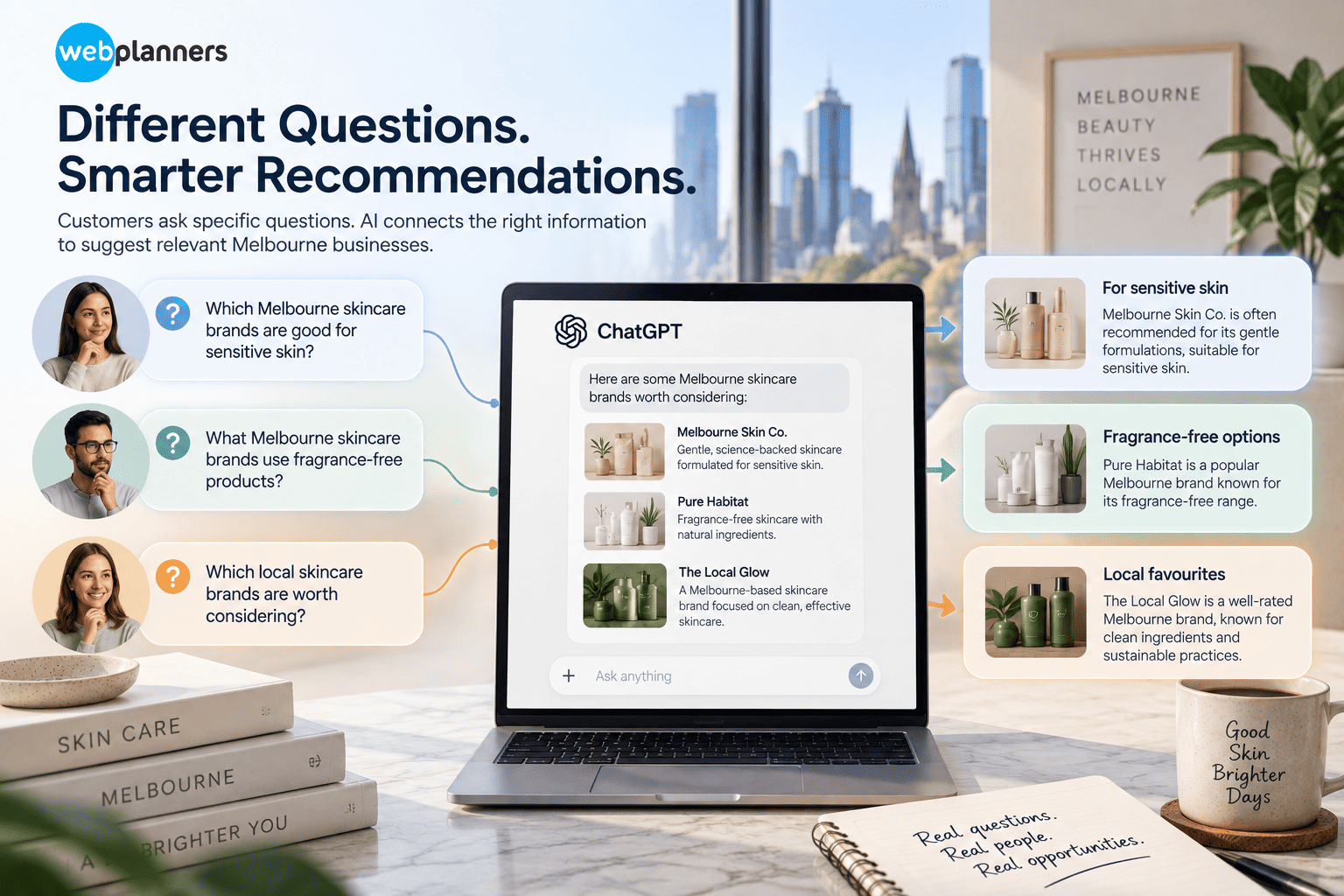
Start with the specific information that is missing.
If the products or services are incorrect, review the relevant pages.
If your point of difference is missing, make it clearer and support it with evidence.
If your Melbourne presence is unclear, review your local business information.
If competitors appear for questions where your business should be relevant, compare the information available about both businesses.
If AI mentions your business but gives inaccurate details, check for conflicting information across your website and other important online sources.
This process can also reveal gaps that traditional keyword tracking will not show.
For example, you might rank well for your main service but find that AI does not understand your specialist offering. That gives you a much more specific problem to address than simply trying to rank higher.
How AEO, GEO and AI SEO Fit Together
These terms do not need to become separate projects. They describe different parts of the same broader shift.
Think of the three as working across different parts of the search journey: SEO builds search visibility, AEO addresses customer questions, while GEO helps shape how your business is represented in AI-generated responses.
AI SEO brings these areas together with technical accessibility, useful content, entity clarity and ongoing visibility checks.
The practical goal is simple:
Make your business easier for customers and search systems to understand.
That means improving the information that already matters rather than producing content simply to target another AI-related keyword.
What Should You Measure?
AI visibility needs more than a one-time test.
Keep a simple record of:
| Metric | What to monitor |
|---|---|
| Brand mentions | Whether your business appears |
| Accuracy | Whether AI describes it correctly |
| Citations | Whether your website is referenced |
| Competitor mentions | Which alternatives appear |
| Product/service visibility | Whether relevant offerings are recognised |
| Local visibility | Whether your Melbourne connection is recognised |
| Website traffic | Visits from AI-related sources where measurable |
| Conversions | Enquiries or sales associated with that traffic |
Do not treat a single AI response as a ranking position. The value comes from looking for patterns over time.
Help AI Better Understand Your Business
Conclusion
Customers can increasingly ask AI to compare businesses, recommend products and help them make decisions.
That does not replace Google. It adds another layer to how people research before they buy.
For businesses, the priority is not to chase every new AI feature. It is to make the information that matters clear, accurate, useful and supported by genuine experience.
Want to know how AI currently represents your business? Webplanners can assess your entity signals and local visibility, then identify practical opportunities to strengthen your presence across Google and AI search. Get in touch with us to know how we can help you.
FAQs
Can a business appear in AI search without ranking first on Google?
Yes. AI responses are not simply a copy of traditional Google rankings. Different queries, sources and context can affect which businesses and information appear.
Do I need separate pages for every question customers ask?
No. Several related questions can often be answered naturally within a strong product, service, category or supporting content page. The focus should be useful information rather than creating large numbers of pages.
How often should I check how AI represents my business?
A monthly or quarterly check can provide a useful baseline. Use the same customer-focused questions and record mentions, accuracy, citations and competitors so you can identify changes over time.
The post What Happens When Customers Ask AI Which Melbourne Business to Choose? appeared first on Webplanners.
]]>The post The AI Search Visibility Scorecard: How to Audit Your Own Website This Weekend appeared first on Webplanners.
]]>That creates a useful question for any business owner:
Can AI search systems understand your business well enough to mention it when customers ask relevant questions?
You can get a practical first answer this weekend with a simple seven-part audit.
What this scorecard covers
You will assess:
- Business clarity.
- Customer question coverage.
- Expertise and trust.
- Topic and entity relationships.
- Technical accessibility.
- Original information.
- Actual AI visibility.
Give each area 0, 1 or 2 points, then add your total at the end.
Your website needs more than keywords to support AI search visibility.
Check whether:
- Your business and services are clearly explained.
- Your pages answer the questions customers actually ask.
- Your website shows real experience and expertise.
- Related services, topics and entities are connected logically.
- Search engines can access your important pages.
- Your content offers something more useful than generic competitor content.
- AI platforms accurately mention your business when you ask relevant questions.
The score will not predict whether an AI platform will cite your website. It gives you a practical way to identify gaps worth fixing.
1. Can AI Understand What Your Business Actually Does?
Start with your homepage.
Ask yourself:
If someone had never heard of this business, could they understand what we do within a few seconds?
Check for:
- Main products or services
- Target customers
- Location or service area
- Main areas of expertise
- Key differentiators
- Business and contact information
Then test your business in ChatGPT:
What does [business name] do?
Who is [business name] best suited for?
What services does [business name] provide?
Compare the answers with your actual business.
If important services are missing or the description is inaccurate, your website may need clearer information.
2 points: Clear and accurate
1 point: Partly clear
0 points: Confusing or incomplete
Audit Your Website For AI Search Visibility
2. Does Your Content Answer Customer Questions?
A service page should do more than describe what you sell.
Look at your main service and product pages and ask:
- Who is this for?
- What problem does it solve?
- How does it work?
- What does the process involve?
- What does it cost or what affects the price?
- What should a customer consider before buying?
- What alternatives might they compare?
This is where Answer Engine Optimisation (AEO) becomes relevant. Rather than focusing only on search terms, AEO considers the questions people ask and whether your website provides direct, useful answers.
2 points: Strong question coverage
1 point: Some useful answers
0 points: Mostly promotional content
3. Does Your Website Prove Your Expertise?
AI systems and customers have plenty of generic information available. Your website needs evidence that your business has genuine knowledge and experience.
Look for:
- Author names and credentials.
- Relevant qualifications.
- Years of experience.
- Case studies.
- Client results.
- Original research.
- First-hand observations.
- Industry experience.
- Clear business information.
For example, instead of saying “we sell premium skincare products”, a skincare brand could show its expertise through ingredient explanations, product comparisons, customer use cases, clinical or product testing information, and practical skincare advice.
This is where E-E-A-T principles can strengthen the overall quality of your website.
2 points: Strong supporting evidence
1 point: Some evidence
0 points: Little evidence
4. Are Your Topics And Entities Connected?
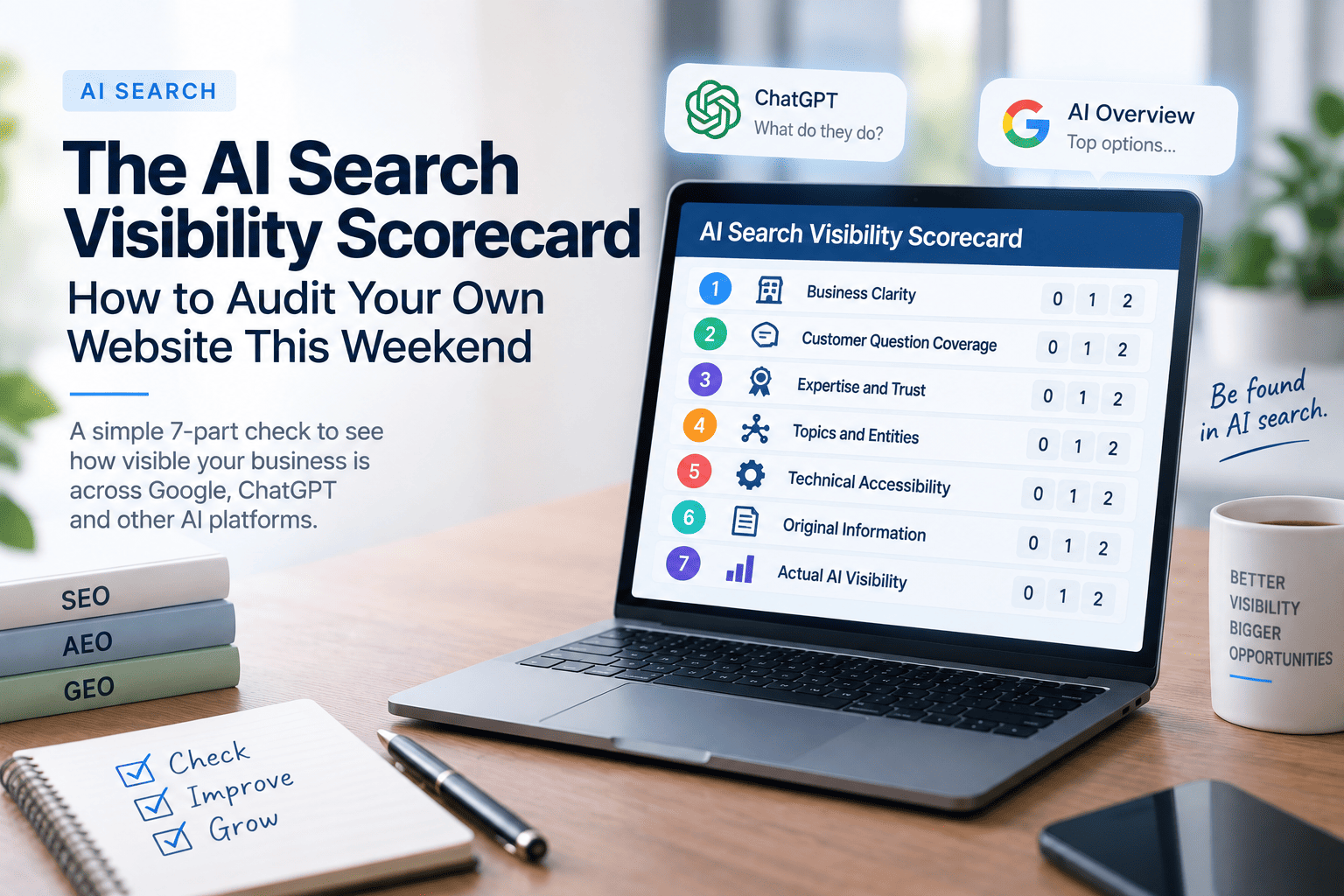
AI search needs context around your business.
For example, a B2C skincare brand might have related areas such as:
Skincare → Face Care → Moisturisers → Serums → Ingredients → Skin Concerns → Product Guides
Those relationships should make sense through your navigation, internal links and supporting content.
This is also where GEO fits into the wider search strategy. GEO focuses on how your business, services, products and expertise are represented within generative AI results.
If you want to assess this at a broader level, our AI search visibility by industry research looks at how visibility can vary between business sectors.
2 points: Strong topical relationships
1 point: Some connections
0 points: Little structure
5. Can Search Engines Access The Pages That Matter?
Now check the technical foundation.
Look at:
- Indexing
- XML sitemap
- Robots.txt
- Internal links
- Mobile performance
- Page speed
- Structured data
- Crawlable content
You do not need to conduct a full technical audit in one weekend.
Instead, focus on the pages that generate enquiries or sales. If an important service page is not indexed, loads poorly or has weak internal links, fix that before spending time producing more content.
This is one area where traditional SEO remains important for AI search.
2 points: Strong technical foundation
1 point: Minor issues
0 points: Significant issues
6. Does Your Website Offer Something Original?
Ask:
What information do we provide that a competitor could not simply copy from a generic AI prompt?
Look for opportunities to add:
- Case studies
- First-hand observations
- Original data
- Industry examples
- Expert commentary
- Product comparisons
- Customer questions
- Results from real projects
For example, a digital agency could publish what it found after auditing a group of websites, rather than publishing another generic explanation of what SEO means.
This gives customers a reason to trust the content and gives search systems more useful information to work with.
2 points: Strong original information
1 point: Some original material
0 points: Mostly generic content
7. What Does AI Actually Say About Your Business?
Now test the result.
Ask ChatGPT, Google and other AI platforms questions your customers might ask.
Try:
- Who are the leading [service] providers in Melbourne?
- What should I look for when choosing a [service] company?
- Which [product/service] is suitable for [specific need]?
- What are the best [service] providers for small businesses?
Record:
| Check | Result |
|---|---|
| Is your business mentioned? | Yes / No |
| Is the information accurate? | Yes / No |
| Is your website cited? | Yes / No |
| Are competitors mentioned? | Yes / No |
Your AI Search Visibility Score
Add your scores:
| Score | What it means |
|---|---|
| 12-14 | Strong foundations across the areas checked |
| 8-11 | Several areas need attention |
| 0-7 | Significant gaps may be present |
This is a Webplanners assessment framework, not an official Google or AI platform score.
The important part is not the number itself. It is knowing where the points were lost.
For example:
- Low business clarity: Improve core pages.
- Low question coverage: Add useful customer answers.
- Low expertise: Strengthen evidence and authorship.
- Low technical score: Address indexing and accessibility.
- Low AI visibility: Investigate how your business is represented across relevant queries.
How SEO, AEO and GEO Work Together
These areas have different roles.
SEO supports visibility in traditional search. AEO focuses on answering specific questions clearly. GEO focuses on representation within generative AI results.
They can sit within one broader AI SEO strategy rather than operating as completely separate activities.
For businesses with more complex requirements, Webplanners also provides Generative AI services covering areas such as AI-focused content, research and search visibility.
What If Your Website Looks Good But AI Still Does Not Mention You?
Don’t assume you need hundreds of new pages.
Prioritise the pages that are most important to your business.
Make sure to check:
- If important services are clearly explained.
- If supporting content answers the right questions.
- If your expertise is visible.
- If related topics are linked.
- If important pages are indexed.
- Whether external sources mention your business correctly.
It can also be useful to look at how your SEO strategy is related to your website experience. Well-designed websites should be easy for customers to locate and to understand the important information.
For a deeper technical or strategic review, an SEO Consultant can assess the issues across technical SEO, content, internal linking and search visibility rather than treating each problem separately.
What Should You Do After The Weekend Audit?
Do not try to fix everything at once.
Take your lowest-scoring section and identify the three pages or areas with the greatest business value.
Then create a simple priority list:
Issue → Page → Action → Measurement
For example:
Weak service information → Main service page → Add customer questions and supporting evidence → Monitor search and AI visibility
You can repeat the scorecard monthly or quarterly using the same questions.
That gives you a record of how your website’s visibility changes instead of relying on one-off AI searches.
Strengthen Your Website For AI Search
Conclusion
Traditional SEO still matters, but strong Google rankings do not automatically translate into visibility across AI search.
If customers are using AI platforms to compare businesses, find services and research products, your website needs to communicate its value clearly across both traditional and generative search.
Want to know where your business stands? Talk to the Webplanners team about an AI search visibility audit. We can assess your SEO, AEO and GEO foundations, identify the gaps and turn them into practical priorities for improving visibility across Google and AI search.
FAQs
Can AI search visibility change without changing my website?
Yes. AI platforms can change how they retrieve, select and present information. Competitor content and external sources can also change. That is why repeated testing with consistent customer questions is more useful than relying on one assessment.
Should every business create GEO content?
No. The content should reflect what customers actually need and what the business can credibly provide. GEO should support your wider search and content strategy rather than become a reason to publish large amounts of separate AI-focused content.
Can local businesses use the same scorecard?
Yes, but add location-specific questions to the AI testing stage. For example, a Melbourne business could test searches combining its service, suburb, city and customer needs. This can indicate how much AI platforms know about the business and its local relevance.
Does structured data guarantee AI citations?
No. Structured data can help search systems understand what’s on a page better, but it doesn’t guarantee that a page will be featured in an AI-generated response or that it will be cited.
Should I replace my existing SEO workflow with AI?
Not completely. AI can speed up research, content analysis and repetitive tasks, but human review remains important for accuracy, experience, business context and quality. The better approach is to improve the workflow with AI while keeping strategic and editorial oversight.
The post The AI Search Visibility Scorecard: How to Audit Your Own Website This Weekend appeared first on Webplanners.
]]>