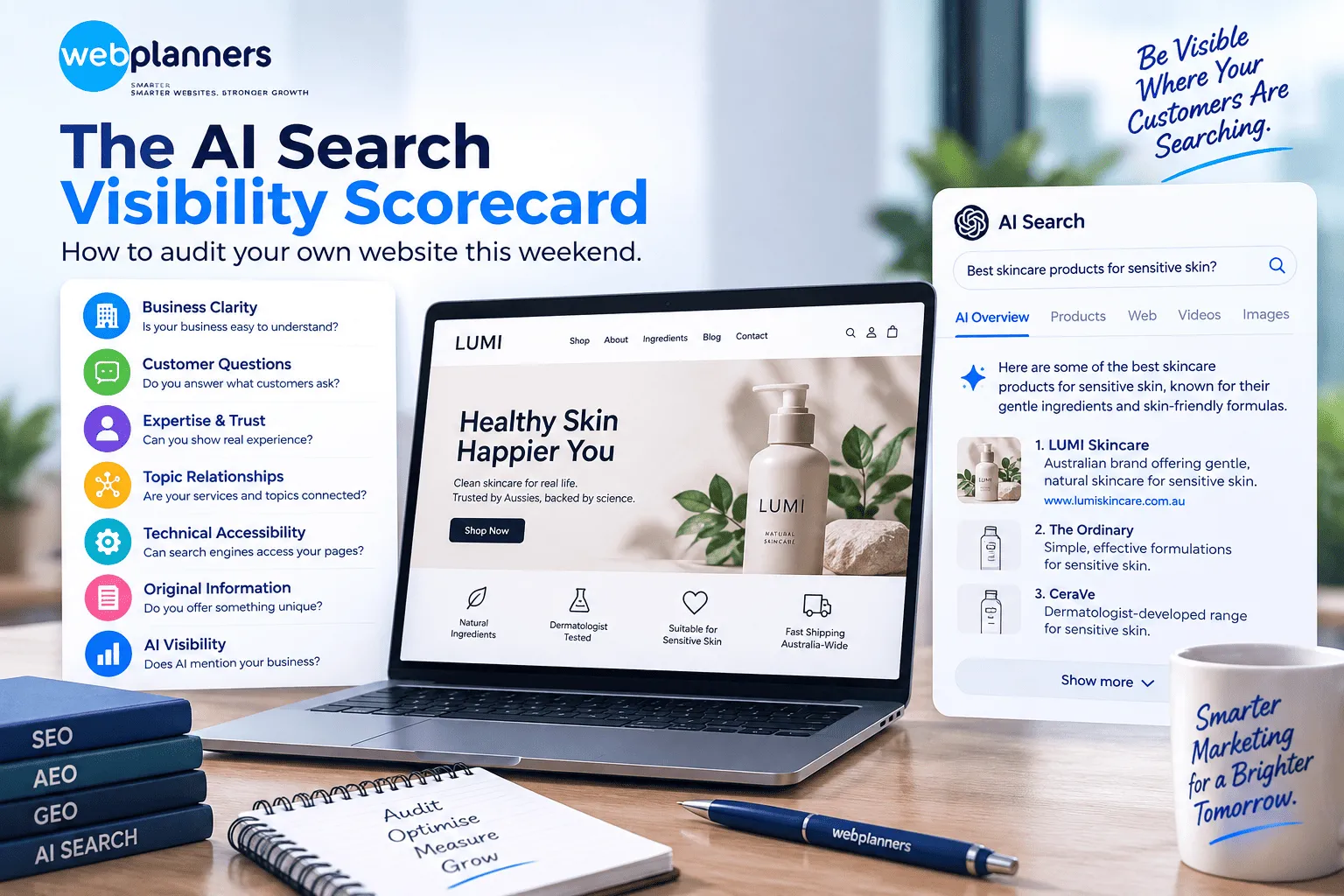
The AI Search Visibility Scorecard: How to Audit Your Own Website This Weekend
Ranking well on Google is no longer the only way to assess your website’s search visibility. Customers can now use Google AI Overviews, ChatGPT and other AI platforms to compare businesses, research products and ask questions before making a decision.
That creates a useful question for any business owner:
Can AI search systems understand your business well enough to mention it when customers ask relevant questions?
You can get a practical first answer this weekend with a simple seven-part audit.
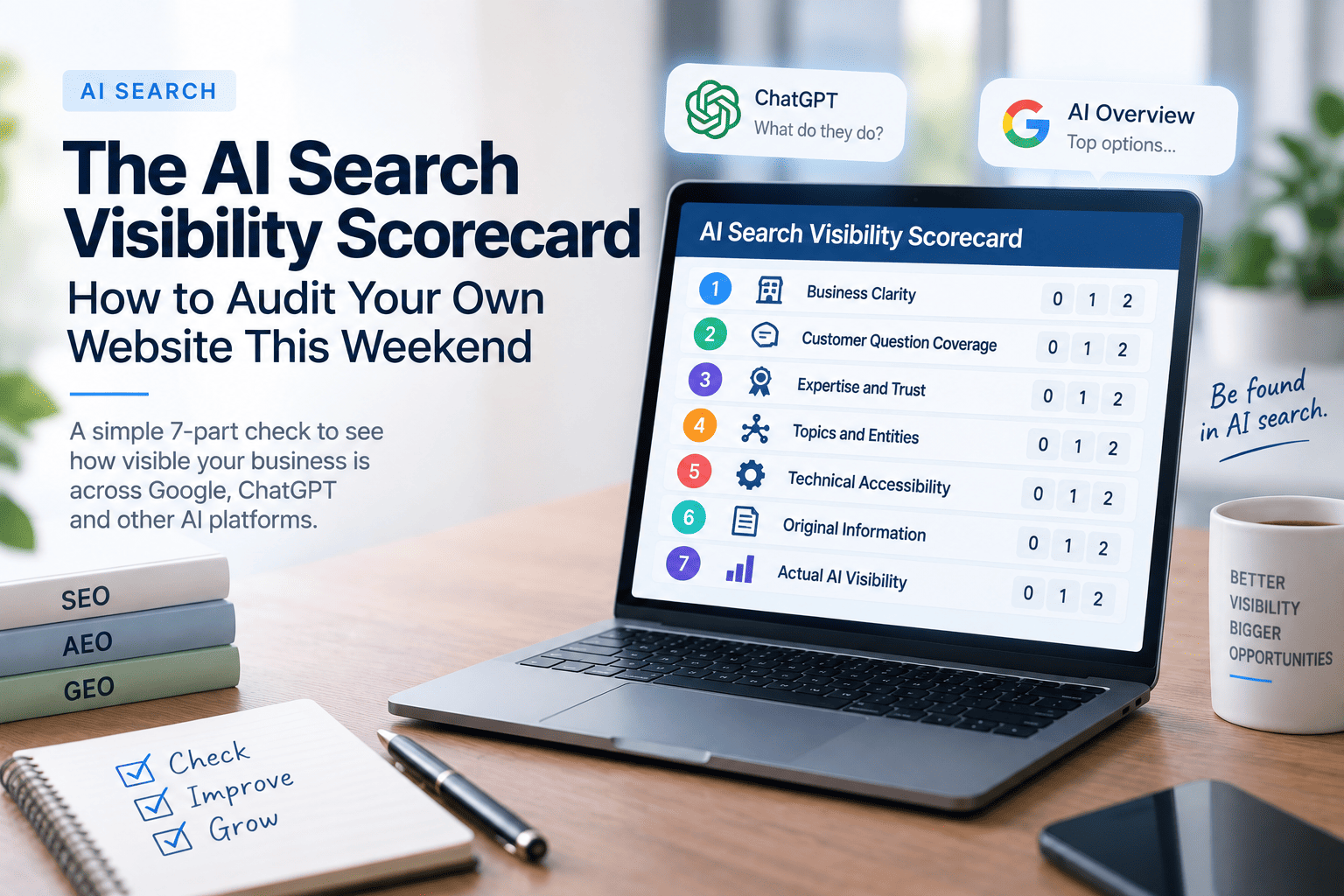
What this scorecard covers
You will assess:
- Business clarity.
- Customer question coverage.
- Expertise and trust.
- Topic and entity relationships.
- Technical accessibility.
- Original information.
- Actual AI visibility.
Give each area 0, 1 or 2 points, then add your total at the end.
Your website needs more than keywords to support AI search visibility.
Check whether:
- Your business and services are clearly explained.
- Your pages answer the questions customers actually ask.
- Your website shows real experience and expertise.
- Related services, topics and entities are connected logically.
- Search engines can access your important pages.
- Your content offers something more useful than generic competitor content.
- AI platforms accurately mention your business when you ask relevant questions.
The score will not predict whether an AI platform will cite your website. It gives you a practical way to identify gaps worth fixing.
1. Can AI Understand What Your Business Actually Does?
Start with your homepage.
Ask yourself:
If someone had never heard of this business, could they understand what we do within a few seconds?
Check for:
- Main products or services
- Target customers
- Location or service area
- Main areas of expertise
- Key differentiators
- Business and contact information
Then test your business in ChatGPT:
What does [business name] do?
Who is [business name] best suited for?
What services does [business name] provide?
Compare the answers with your actual business.
If important services are missing or the description is inaccurate, your website may need clearer information.
2 points: Clear and accurate
1 point: Partly clear
0 points: Confusing or incomplete
Audit Your Website For AI Search Visibility
2. Does Your Content Answer Customer Questions?
A service page should do more than describe what you sell.
Look at your main service and product pages and ask:
- Who is this for?
- What problem does it solve?
- How does it work?
- What does the process involve?
- What does it cost or what affects the price?
- What should a customer consider before buying?
- What alternatives might they compare?
This is where Answer Engine Optimisation (AEO) becomes relevant. Rather than focusing only on search terms, AEO considers the questions people ask and whether your website provides direct, useful answers.
2 points: Strong question coverage
1 point: Some useful answers
0 points: Mostly promotional content
3. Does Your Website Prove Your Expertise?
AI systems and customers have plenty of generic information available. Your website needs evidence that your business has genuine knowledge and experience.
Look for:
- Author names and credentials.
- Relevant qualifications.
- Years of experience.
- Case studies.
- Client results.
- Original research.
- First-hand observations.
- Industry experience.
- Clear business information.
For example, instead of saying “we sell premium skincare products”, a skincare brand could show its expertise through ingredient explanations, product comparisons, customer use cases, clinical or product testing information, and practical skincare advice.
This is where E-E-A-T principles can strengthen the overall quality of your website.
2 points: Strong supporting evidence
1 point: Some evidence
0 points: Little evidence
4. Are Your Topics And Entities Connected?
AI search needs context around your business.
For example, a B2C skincare brand might have related areas such as:
Skincare → Face Care → Moisturisers → Serums → Ingredients → Skin Concerns → Product Guides
Those relationships should make sense through your navigation, internal links and supporting content.
This is also where GEO fits into the wider search strategy. GEO focuses on how your business, services, products and expertise are represented within generative AI results.
If you want to assess this at a broader level, our AI search visibility by industry research looks at how visibility can vary between business sectors.
2 points: Strong topical relationships
1 point: Some connections
0 points: Little structure
5. Can Search Engines Access The Pages That Matter?
Now check the technical foundation.
Look at:
- Indexing
- XML sitemap
- Robots.txt
- Internal links
- Mobile performance
- Page speed
- Structured data
- Crawlable content
You do not need to conduct a full technical audit in one weekend.
Instead, focus on the pages that generate enquiries or sales. If an important service page is not indexed, loads poorly or has weak internal links, fix that before spending time producing more content.
This is one area where traditional SEO remains important for AI search.
2 points: Strong technical foundation
1 point: Minor issues
0 points: Significant issues
6. Does Your Website Offer Something Original?
Ask:
What information do we provide that a competitor could not simply copy from a generic AI prompt?
Look for opportunities to add:
- Case studies
- First-hand observations
- Original data
- Industry examples
- Expert commentary
- Product comparisons
- Customer questions
- Results from real projects
For example, a digital agency could publish what it found after auditing a group of websites, rather than publishing another generic explanation of what SEO means.
This gives customers a reason to trust the content and gives search systems more useful information to work with.
2 points: Strong original information
1 point: Some original material
0 points: Mostly generic content
7. What Does AI Actually Say About Your Business?
Now test the result.
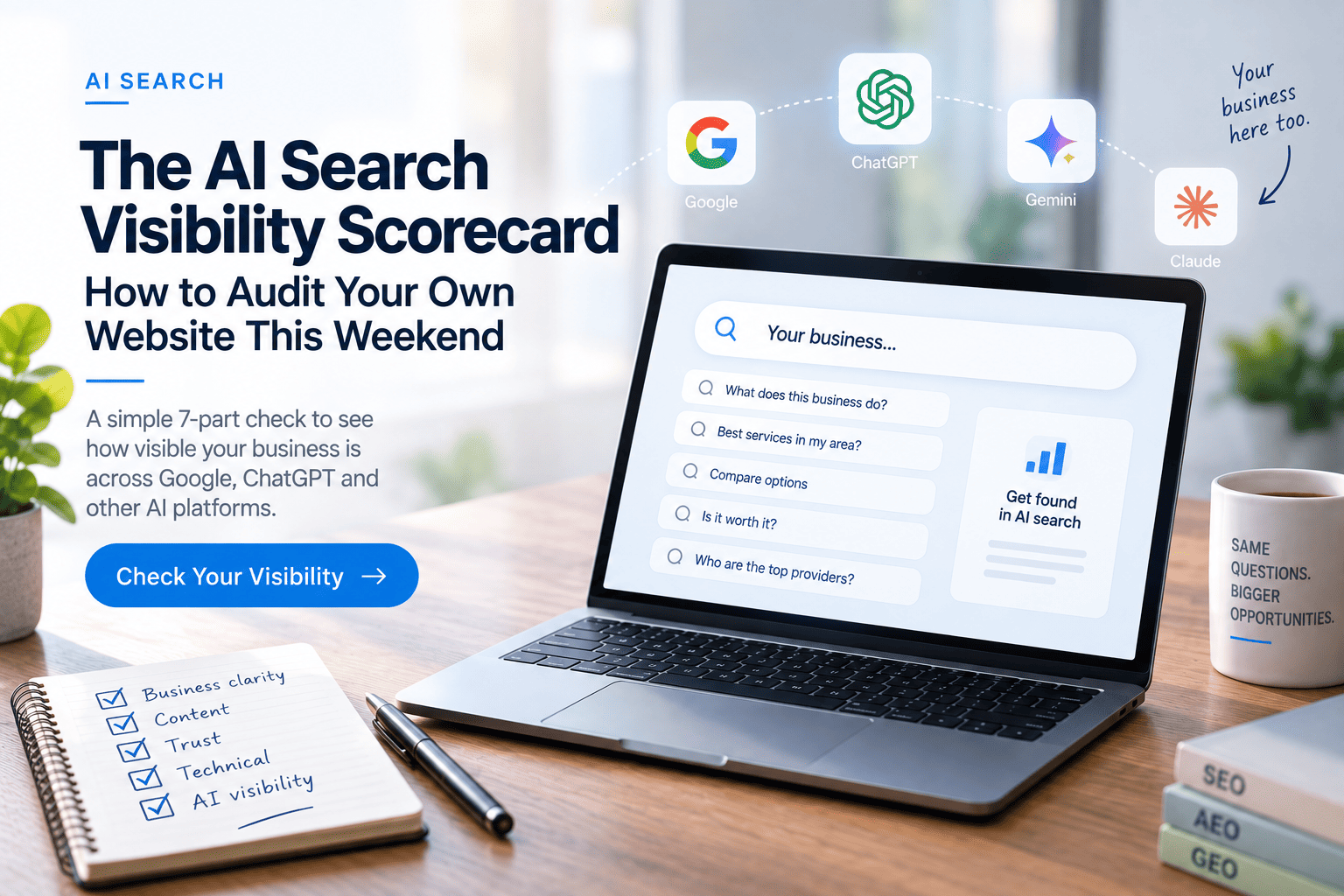
Ask ChatGPT, Google and other AI platforms questions your customers might ask.
Try:
- Who are the leading [service] providers in Melbourne?
- What should I look for when choosing a [service] company?
- Which [product/service] is suitable for [specific need]?
- What are the best [service] providers for small businesses?
Record:
| Check | Result |
|---|---|
| Is your business mentioned? | Yes / No |
| Is the information accurate? | Yes / No |
| Is your website cited? | Yes / No |
| Are competitors mentioned? | Yes / No |
Your AI Search Visibility Score
Add your scores:
| Score | What it means |
|---|---|
| 12-14 | Strong foundations across the areas checked |
| 8-11 | Several areas need attention |
| 0-7 | Significant gaps may be present |
This is a Webplanners assessment framework, not an official Google or AI platform score.
The important part is not the number itself. It is knowing where the points were lost.
For example:
- Low business clarity: Improve core pages.
- Low question coverage: Add useful customer answers.
- Low expertise: Strengthen evidence and authorship.
- Low technical score: Address indexing and accessibility.
- Low AI visibility: Investigate how your business is represented across relevant queries.
How SEO, AEO and GEO Work Together
These areas have different roles.
SEO supports visibility in traditional search. AEO focuses on answering specific questions clearly. GEO focuses on representation within generative AI results.
They can sit within one broader AI SEO strategy rather than operating as completely separate activities.
For businesses with more complex requirements, Webplanners also provides Generative AI services covering areas such as AI-focused content, research and search visibility.
What If Your Website Looks Good But AI Still Does Not Mention You?
Don’t assume you need hundreds of new pages.
Prioritise the pages that are most important to your business.
Make sure to check:
- If important services are clearly explained.
- If supporting content answers the right questions.
- If your expertise is visible.
- If related topics are linked.
- If important pages are indexed.
- Whether external sources mention your business correctly.
It can also be useful to look at how your SEO strategy is related to your website experience. Well-designed websites should be easy for customers to locate and to understand the important information.
For a deeper technical or strategic review, an SEO Consultant can assess the issues across technical SEO, content, internal linking and search visibility rather than treating each problem separately.
What Should You Do After The Weekend Audit?
Do not try to fix everything at once.
Take your lowest-scoring section and identify the three pages or areas with the greatest business value.
Then create a simple priority list:
Issue → Page → Action → Measurement
For example:
Weak service information → Main service page → Add customer questions and supporting evidence → Monitor search and AI visibility
You can repeat the scorecard monthly or quarterly using the same questions.
That gives you a record of how your website’s visibility changes instead of relying on one-off AI searches.
Strengthen Your Website For AI Search
Conclusion
Traditional SEO still matters, but strong Google rankings do not automatically translate into visibility across AI search.
If customers are using AI platforms to compare businesses, find services and research products, your website needs to communicate its value clearly across both traditional and generative search.
Want to know where your business stands? Talk to the Webplanners team about an AI search visibility audit. We can assess your SEO, AEO and GEO foundations, identify the gaps and turn them into practical priorities for improving visibility across Google and AI search.
FAQs
Can AI search visibility change without changing my website?
Yes. AI platforms can change how they retrieve, select and present information. Competitor content and external sources can also change. That is why repeated testing with consistent customer questions is more useful than relying on one assessment.
Should every business create GEO content?
No. The content should reflect what customers actually need and what the business can credibly provide. GEO should support your wider search and content strategy rather than become a reason to publish large amounts of separate AI-focused content.
Can local businesses use the same scorecard?
Yes, but add location-specific questions to the AI testing stage. For example, a Melbourne business could test searches combining its service, suburb, city and customer needs. This can indicate how much AI platforms know about the business and its local relevance.
Does structured data guarantee AI citations?
No. Structured data can help search systems understand what’s on a page better, but it doesn’t guarantee that a page will be featured in an AI-generated response or that it will be cited.
Should I replace my existing SEO workflow with AI?
Not completely. AI can speed up research, content analysis and repetitive tasks, but human review remains important for accuracy, experience, business context and quality. The better approach is to improve the workflow with AI while keeping strategic and editorial oversight.
Our Recent Blogs

Couldn't be happier with how things have gone since working with Webplanners. The team genuinely cares about getting results and has helped us stay ahead of the competition. Thanks for all the hard work, legends!
Webplanners has been a huge part of our digital growth. Managing multiple websites isn't easy, but they've made the whole process feel effortless. The results have exceeded our expectations.
The team has been great to work with and always keeps us in the loop. We've seen steady improvements over time and the whole process has been straightforward. Very happy with how things are going.