The post Google Business Profile Optimisation: The 2026 Checklist for Melbourne Businesses appeared first on Webplanners.
]]>Your Google Business Profile might be the first thing they see: your business name, category, reviews, opening hours, photos, location and website. That first impression can affect if they call, visit, ask for a quote or keep looking.
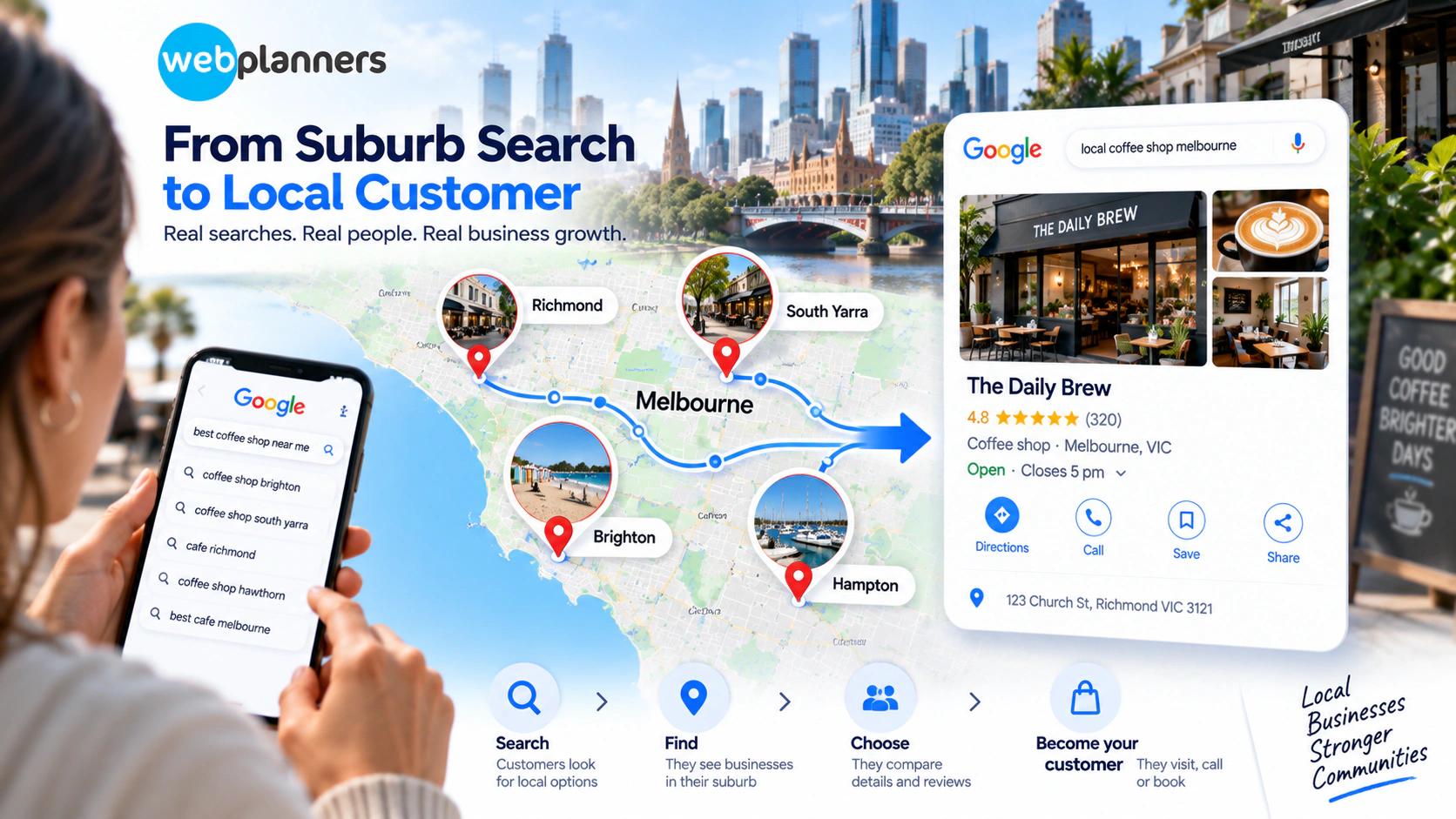
For a Melbourne business, this becomes even more important when searches become location-specific. A customer may search for a service in Brighton, South Yarra, Richmond or another nearby suburb rather than simply searching for the service and “Melbourne”.
A complete profile is a starting point. The real work is keeping your business information accurate, relevant and consistent with everything else customers find online.
Here is a practical 2026 checklist to review your profile and strengthen its role in your wider search strategy.
Why Google Business Profile Still Matters
Your Business Profile acts as a local touchpoint between your business, Google and potential customers.
It can display:
- Business category.
- Address or service area.
- Phone number.
- Website.
- Opening hours.
- Services.
- Photos and videos.
- Reviews.
- Business attributes.
Local visibility is based on how well your business matches the search, where the searcher is located and prominence of the business within the local market.
That means optimising your profile should be about being accurate and relevant, not just adding more keywords.
Improve Your Local Search Visibility
The 2026 Google Business Profile Checklist
1. Start With the Basics
Check every core business detail.
- Business name.
- Address or service area.
- Phone number.
- Website URL.
- Opening hours.
- Special trading hours.
- Primary category.
- Relevant business attributes.
Even small changes should be reflected across your important online listings.
If your website has one phone number, your Business Profile has another and an old directory listing has a third, customers may receive conflicting information.
2. Choose the Right Primary Category
Your primary category helps define your business. Select the category that best describes your main offering.
Add sub-categories where they belong, really. Don’t try to stuff every service or keyword you are trying to rank into categories.
The intention is to provide Google and customers a clear picture of the business.
3. Make Your Services Easy to Understand
Review the services listed on your profile.
Ask:
- Are the main services included?
- Are the descriptions clear?
- Are outdated services removed?
- Do the services match the website?
- Would a potential customer understand what they can contact you about?
For example, a Melbourne electrician should make its key electrical services clear rather than relying on one broad category to describe everything it does.
The same information should appear naturally across relevant service pages on the website.
4. Add Real, Useful Photos
Your photos should help customers understand the business before they contact you.
Depending on the business, consider:
- Exterior images.
- Interior images.
- Team photographs.
- Products.
- Completed projects.
- Equipment.
- Service-related images.
- Before-and-after photographs.
Good-quality, relevant images are more useful than uploading generic stock photography. Business Profile photos and videos can appear directly to customers across Search and Maps.
5. Keep Reviews Active and Genuine
Reviews give your customers insight into what it’s like to do business with you or an insight into your offerings.
Invite genuine customers to share their thoughts, and respond to reviews in a natural way.
A useful answer does not have to repeat keywords. It can validate the customer experience and add more context when appropriate.
Don’t consider:
- Buying of reviews.
- Making fake reviews.
- Use specific keywords when asking customers.
- Same answer to all reviews.
The quality and authenticity of the feedback from consumers is more important than trying to make every review look SEO focused.
6. Check Your Website Against Your Profile
Your Business Profile should make sense alongside your website. When your profile states you provide gardening services for residential, but your website only mentions commercial work, it makes the big picture a little less clear.
Review:
- Services.
- Locations.
- Contact information.
- Business description.
- Opening hours.
- Company name.
- Service areas.
This connects naturally with the work we covered in Melbourne Bayside SEO, where location relevance needs to reflect the areas a business genuinely serves.
For example, a business operating around Brighton, Hampton and Sandringham should have useful information about those areas where relevant, rather than adding suburb names simply to increase keyword coverage.
7. Review Your Google Maps Visibility
Do not only search for your business by name.
Try searches that a new customer might actually use:
- Service + Melbourne.
- Service + suburb.
- “near me” searches.
- Service + location.
- Category + suburb.
Check what appears around your business on Google Maps.
Look at the competitors appearing in the local results and compare their profiles with yours.
This can reveal gaps that a standard website ranking report may not show.
If your website receives organic traffic but your business remains difficult to find in Maps, the issue may require a closer look at your local signals.
8. Build Location Relevance Without Keyword Stuffing
Local content should sound like it was written for real customers.
If you serve Melbourne’s inner suburbs, for example, you can naturally mention relevant areas such as Richmond, South Yarra or Prahran when those locations genuinely form part of your service area.
A business serving other Australian markets may also operate in Brisbane, Adelaide or Sydney. The important point is to represent real service areas rather than creating location pages simply because those locations have search volume.
This is where location-based content, service pages and your Business Profile should work together.
9. Keep Your Local References Consistent
Your Business Profile is only one source of business information.
Review important references across:
- Website.
- Business directories.
- Industry listings.
- Review platforms.
- Social profiles.
- Local websites.
Check the basics first: business name, address, phone number, website and service information.
You do not need to list your business in every directory available. Focus on relevant and credible sources.
10. Look at What Customers Ask Before They Contact You
Local search is increasingly conversational.
Someone may search:
“Best family dentist near Brighton”
and then ask a follow-up question about emergency appointments, payment options or whether the clinic treats children.
Your website should provide useful answers to these questions where they are relevant to your customers.
This is also where AEO can naturally support your content strategy. Clear answers, useful page structure and direct information can make important information easier to understand across different search experiences.
11. Consider How Your Business Information Appears in AI Search
Customers can now use AI tools when researching local businesses.
They may ask for recommendations, compare providers or ask which business is suitable for a particular need.
That makes consistent business information more important beyond traditional Google results.
Work related to GEO can consider how a business is represented in generative search, while generative AI services can support businesses that want to incorporate AI into their wider digital marketing workflow.
The foundation remains the same: clear services, accurate locations, useful content and credible information about the business.
Build A Stronger Local Search Presence
Where AI Overviews Fit Into Local Search
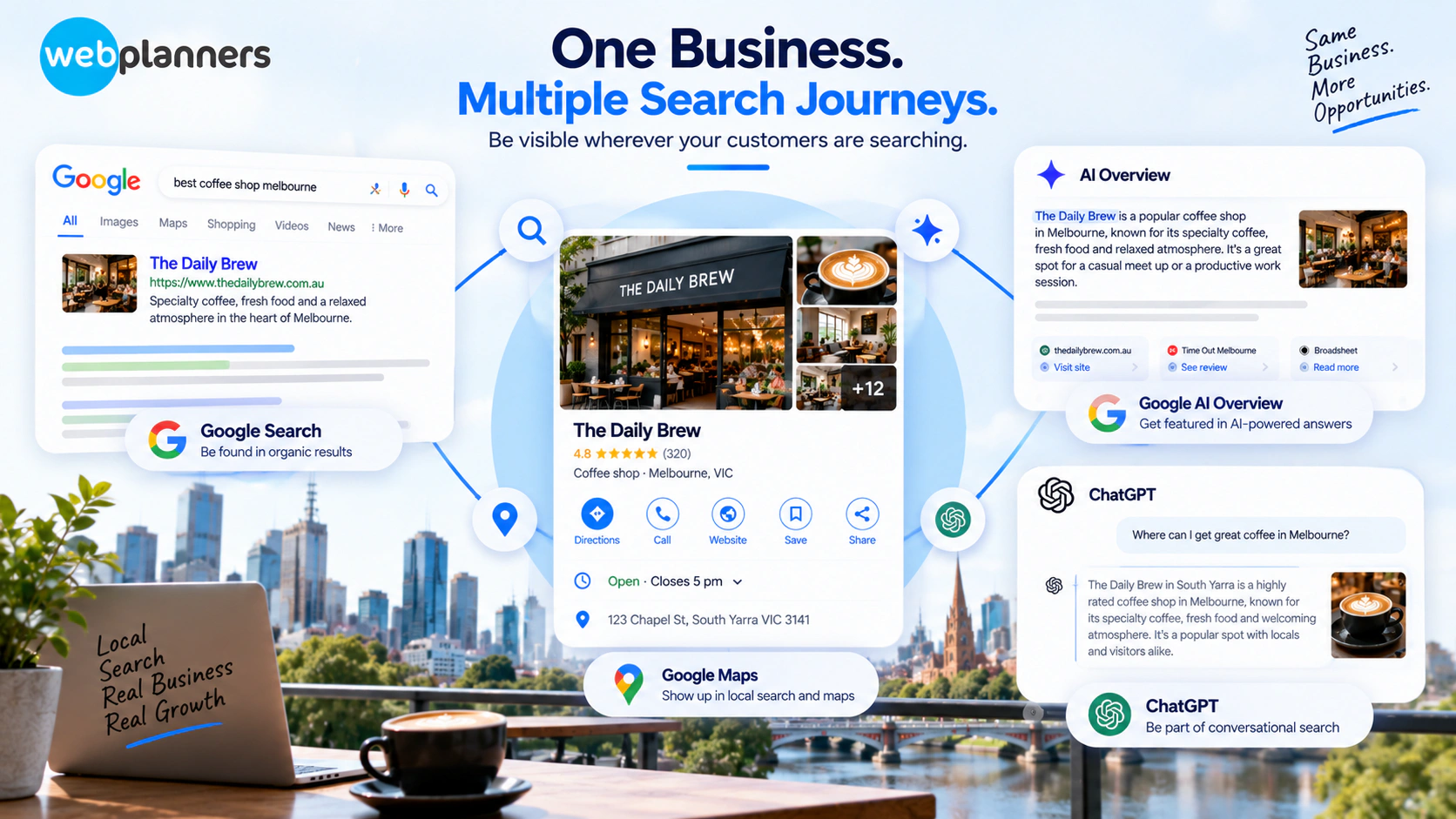
AI Overviews add another layer to the search experience. A customer may see an AI-generated summary before reaching the traditional organic listings. The response can include links to websites that provide supporting information.
For local businesses, this makes useful and well-structured information even more valuable.
Think about the information a customer may need:
What do you do? Where do you operate? Who do you serve? What makes you suitable?
Your website should answer those questions clearly.
There is no special Business Profile setting that guarantees visibility in an AI Overview. Instead, local information should form part of a broader SEO and content strategy.
Common Google Business Profile Mistakes
Some of the biggest problems are simple ones.
1. Using an inaccurate business category
Choosing a category because it has strong search demand rather than because it describes your business can create confusion.
2. Adding locations you do not genuinely serve
A list of suburbs does not automatically create local relevance.
3. Leaving old information online
Old phone numbers, outdated hours and discontinued services can create conflicting signals.
4. Uploading generic images
Photos should give customers useful information about the real business.
5. Treating reviews as keyword opportunities
Reviews should reflect genuine customer experiences rather than SEO instructions.
6. Setting up the profile and forgetting about it
Your business changes over time. Your profile should reflect those changes.
A Simple Monthly Review
You do not need to spend hours on your Business Profile every week.
A monthly check can cover:
- Business details.
- Opening hours.
- Categories.
- Services.
- New reviews.
- Review responses.
- Photos.
- Website information.
- Local search results.
- Competitor changes.
For a business operating across multiple areas, review the locations that actually matter commercially rather than checking every suburb in Melbourne.
Conclusion
Google Business Profile optimisation is not about filling every available field with keywords.
It is about giving customers and search systems a clear, consistent picture of your business: what you offer, where you operate, when customers can reach you and why they should consider you.
For Melbourne businesses, that local relevance can become even more specific at suburb level. Your profile, website, reviews, local references and useful content should all support the same business information.
AI-powered search adds another reason to keep that information clear. Customers may now encounter your business through traditional search, Maps, AI Overviews or conversational AI tools before they ever visit your website.
If your profile is complete but local enquiries are still below expectations, a deeper review can identify where the gaps sit.
At Webplanners, our local SEO strategy connects Google Business Profile optimisation with website content, technical SEO, local relevance and the wider search journey.
Want more customers to find your business in Melbourne? Get in touch with Melbourne’s trusted SEO company to discuss your strategy.
FAQs
How often should I update my Business Profile photos?
There is no scheduled time for every company. Make sure you are checking your images from time to time to replace any that are outdated or of poor quality. Companies with changing projects, products or premises have more reason to add fresh visuals.
Why does my business show up in Maps in one suburb but not another?
Local results are based primarily on relevance, distance, and prominence. A business may be very relevant to searches near its location, but not as visible farther away.
Does structured data help me get better rankings in Google Maps?
Structured data is useful for helping search engines understand information on your site, but should not be considered a direct ranking shortcut. It is valuable because it clearly communicates accurate information about your business and pages.
Is AI Search a replacement for Google Business Profile Optimisation?
No. AI search is just another form of customer research on a business. Your Business Profile is an important source of local business information, and your website and other online references provide additional context.
The post Google Business Profile Optimisation: The 2026 Checklist for Melbourne Businesses appeared first on Webplanners.
]]>The post How We Grew an RTO Client’s Organic Traffic by 658%: The Strategy Behind the Result appeared first on Webplanners.
]]>That was the position of one of our RTO resources clients.
The business had a relevant offering, but there was room to capture more of the searches its audience was already making. Instead of treating the campaign as a simple ranking exercise, we looked at the website from several angles: keyword opportunities, content quality, search intent, internal linking and authority.
The result was a 658% increase in organic traffic.
More importantly, the campaign shows what can happen when SEO activities work together instead of being handled as disconnected monthly tasks.
Webplanners increased organic traffic for an RTO resources client by combining targeted keyword research, useful content, stronger internal linking and relevant link building. Rather than relying on one SEO tactic, we connected these activities to improve the website’s search visibility and attract more relevant organic traffic.
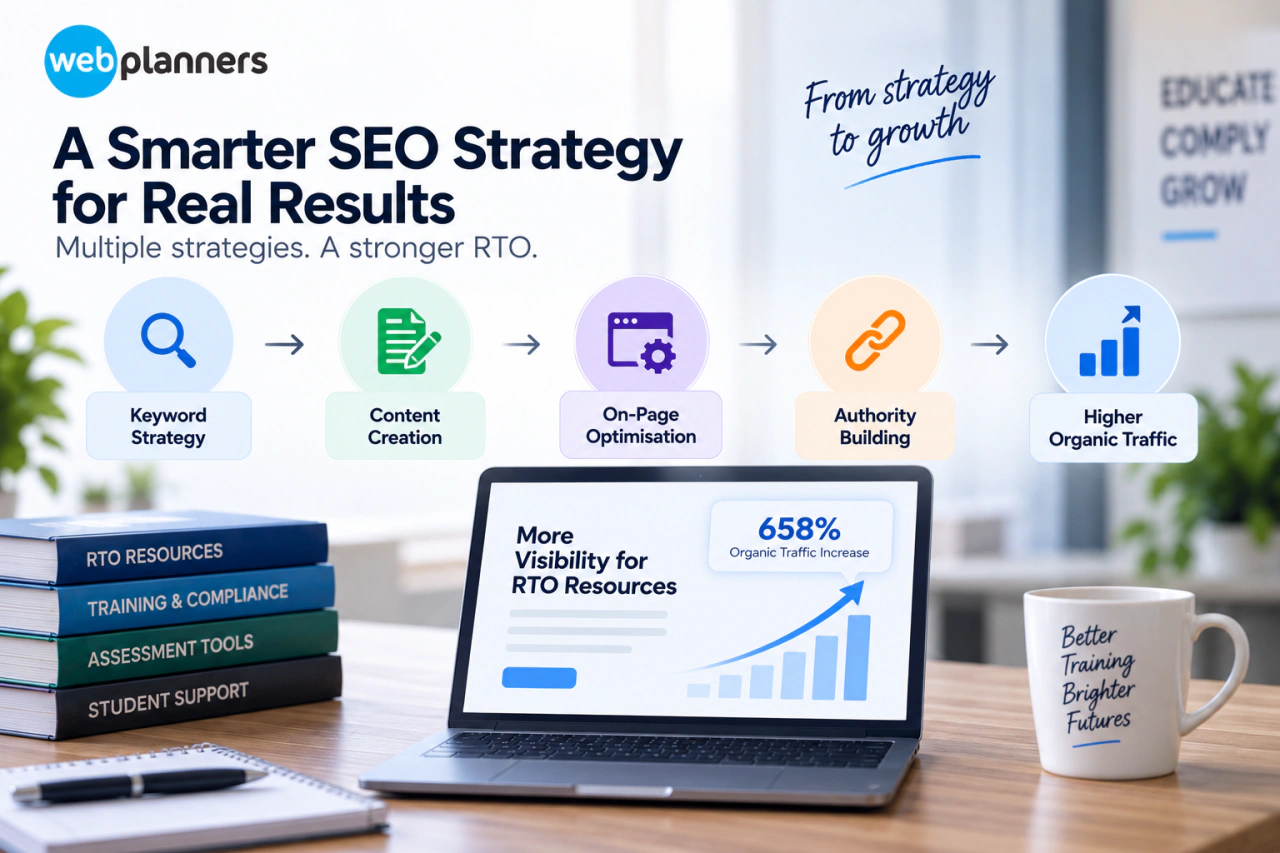
Key strategy: Keyword targeting → Content → On-page optimisation → Internal linking → Authority building → Organic growth.
Where the Campaign Started
The client operates in the RTO resources and vocational education space. Search behaviour in this market can be highly specific.
Potential customers may search for a particular resource, training requirement, documentation or solution rather than a broad industry term.
At first, our review highlighted a number of areas for improvement on the website:
- Some pages were not well aligned to search intent.
- There was not full use of content opportunities.
- The site had opportunities to increase its authority.
- Relevance of organic traffic needed to be assessed.
- The navigation between related pages could be improved.
- The search terms that mattered weren’t being targeted well.
This gave us a clear goal: to identify the right search opportunities, build useful content around them and strengthen the ability of the website to compete.
Turn Search Visibility Into Business Growth
The SEO Strategy We Used
1. Advanced Keyword Strategy
So we began with keyword research, but it wasn’t just about finding terms with a high search volume.
We looked at:
- Search intent.
- Relevant long-tail searches.
- Commercial opportunities.
- Related search terms.
- Competitor keyword gaps.
- Existing pages that could be improved.
- New topics that needed dedicated content.
This helped us create a stronger connection between the search query, the user’s intent and the most appropriate page.
For an RTO resources provider, that distinction matters. A highly relevant search from someone looking for a specific resource can be more valuable than a broad term that attracts visitors with no commercial connection to the business.
This is also the foundation of our SEO services in Melbourne, where we assess the actual search opportunity before deciding what work should be prioritised.
2. We Built Content Around Actual Search Demand
Once the keyword opportunities were identified, we looked at the content needed to address them.
The objective wasn’t to publish content simply to increase the number of pages on the website.
Each piece needed to have a reason to exist.
We focused on content that:
- Added useful context.
- Backed up key commercial pages.
- Expanded coverage of relevant topics.
- Matched the intent behind relevant searches.
- Answered actual questions and information needs.
Knowledge gained from first-hand experience can be a real game-changer for specialist businesses . Generic content rarely replicates the industry experience and knowledge that an RTO resources provider has.
Our approach to content strategy follows the same principle: content should serve the audience while supporting the wider organic search strategy.
3. We Improved the Relationship Between Pages
Creating useful content is only part of the work.
We also considered how pages connected with one another.Someone early in their research may like an information page. That resource or solution might be found on another page. Logical internal linking can connect those stages and provide clearer signals to search engines on the relationship of related content.
We worked on :
- Internal links in context.
- Relevant anchor text.
- Reduce isolated content.
- Connections between supporting and commercial pages.
- Upgrading important pages with relevant supporting content.
This helped turn individual pages into a more cohesive website rather than a collection of individual URLs.
4. We Strengthened Website Authority
Content is king, but authority also matters too as it connects to improving organic visibility. We acquired quality links that were relevant to help support the authority of the website.
It was not about building up a ton of links from anywhere and everywhere. We considered relevance, quality and context.
This was part of a wider campaign that included keyword optimisation and content development rather than doing link building as a stand alone activity.
5. We Measured Growth Through Business Relevance
The headline result was a 658% increase in organic traffic.
But we didn’t treat the traffic figure as the entire definition of success. For an RTO resources provider, attracting people who are genuinely interested in the products and resources matters more than generating visits from unrelated searches.
So the strategy considered whether organic visibility was moving towards relevant search demand and the client’s commercial objectives.
This is an important distinction. More traffic can look impressive. Relevant traffic is what gives that growth business value.
What Changed as a Result?
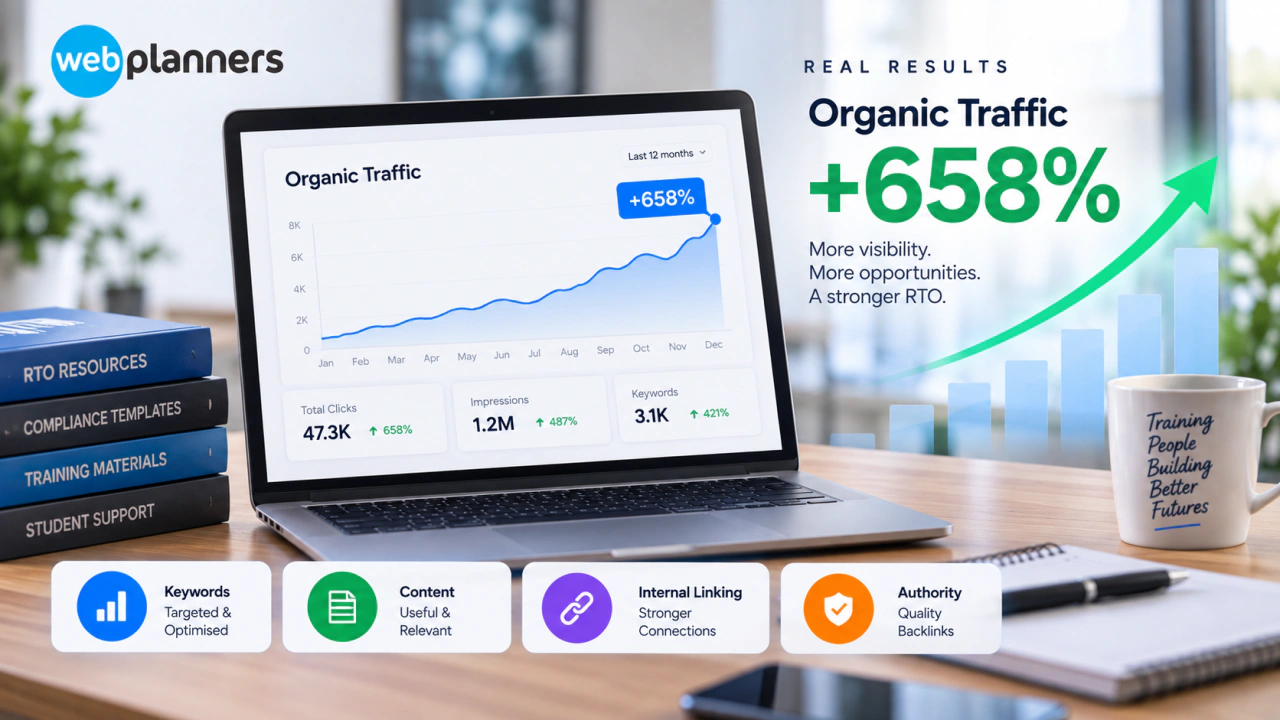
The campaign brought several SEO activities together:
| Area | What we focused on |
|---|---|
| Keyword research | Identifying relevant searches and search intent. |
| Content | Creating useful coverage around priority topics. |
| Internal linking | Building stronger connections between related pages. |
| Authority | Developing relevant, quality links. |
| SEO strategy | Keeping the work connected to business objectives. |
The result was a 658% increase in organic traffic for the RTO resources provider.
We have also seen substantial organic growth across other industries through different SEO strategies.
Our published case studies include businesses in areas such as retail, automotive, professional services and education, showing why we don’t apply exactly the same campaign structure to every client.
What Other RTOs Can Learn From This
The strategy behind this campaign isn’t a formula that every RTO should copy word for word.
The more useful lesson is how we approached the problem.
Start with real search behaviour
Understand the terminology customers actually use, including specific and long-tail searches.
Give important searches the right destination
A specific search should lead to a page that genuinely addresses the need behind that search.
Use your industry knowledge
RTOs have specialist knowledge, processes and experience. Bringing that into website content can make it more useful and distinctive.
Connect supporting content with commercial pages
A blog or resource page shouldn’t exist in isolation. Relevant internal links can help users move towards the information or solution they need.
Look beyond rankings
Rankings are important, but they should be considered in relation to organic traffic, relevant visitors, enquiries and other business outcomes.
How Modern Search Fits Into the Picture
SEO has also evolved past the standard blue link results. Search engines now have more direct answers and AI search experiences. Conversational systems can also provide suggestions and information to users.
That doesn’t mean traditional SEO is irrelevant. Strong technical foundations, useful content, clear site structure and relevant authority remain important.
We also consider newer search experiences where they make sense for a business. For example, Answer Engine Optimisation focuses on structuring useful information for answer-focused search experiences.
Separately, Generative Engine Optimisation addresses visibility within generative AI responses.
And for businesses looking at the wider use of AI within their search strategy, our generative AI services combine AI-assisted workflows with human review and strategic input.
These areas can support a modern SEO strategy, but they don’t replace the fundamentals that helped drive this RTO campaign.
Why We Don’t Use the Same SEO Strategy for Every Business
An RTO resources provider has a very different search market from a retailer, local service business or professional firm.
The starting point changes.
So do the competitors, search behaviour, content requirements and commercial priorities.
That’s why we begin by asking:
- What does the business sell?
- Who is searching for it?
- What are they searching for?
- Where is the website currently visible?
- Where are competitors gaining ground?
From there, we decide where the effort should go.
That could involve technical SEO, content, keyword research, internal linking, authority building or other work.
What Role Does AI Play in Our SEO Process?
We use AI to improve parts of the research and production workflow, but we don’t treat AI output as a finished SEO strategy.
AI can assist with areas such as:
- Keyword clustering.
- Topic research.
- Content gap analysis.
- Competitor research.
- Content briefs.
- Large-scale data analysis.
Our team then reviews the information, checks relevance and applies the business context.
That human-AI workflow is important because search strategy still requires judgement. AI can process information quickly, but it doesn’t automatically understand a client’s products, customers, competitive position or commercial priorities.
Build An SEO Strategy Around Real Search Demand
Conclusion
The 658% organic traffic increase was not the result of one shortcut. We combined keyword research, content, internal linking and authority building around the client’s actual search market. That is the bigger lesson from this campaign.
Good SEO starts with understanding the business and its customers, then deciding what the website actually needs.
If your RTO website isn’t attracting the organic visibility it should, get in touch with Webplanners.
As a leading SEO company in Melbourne, we will assess your current search performance and identify the opportunities that could have the greatest value for your business.
FAQs
Can an RTO increase organic visibility without publishing dozens of blogs?
Yes. More content isn’t always best. Better search intent alignment, on-page optimisation, internal linking and stronger topical coverage can offer significant opportunities within existing service and resource pages.
Should an RTO target broad education keywords?
Not always. Broad terms can be very competitive and may not indicate strong buying or enquiry intent. Commercial value can be found in specific searches for resources, solutions or information that an audience of RTOs requires.
How important are internal links for an RTO website?
This can be particularly useful when a site has many related resources and informational pages. Contextual links placed well help users move between related information and can give search engines a clearer understanding of how pages relate.
Can content produced by AI improve RTO’s SEO?
While AI may assist with research and content workflows, publishing AI-generated text alone doesn’t generate expertise or authority. RTO content must be accurate, relevant and business-specific and must be appropriately human-reviewed.
Should RTOs invest in local SEO as well?
That depends on your business model. Local SEO could be part of the broader strategy if the RTO caters for specific locations or depends on local searches. A national resource provider might have different priorities.
The post How We Grew an RTO Client’s Organic Traffic by 658%: The Strategy Behind the Result appeared first on Webplanners.
]]>The post Are You Ready for Google’s Page Experience Signals in 2025? appeared first on Webplanners.
]]>
Google has added several improvements to their search results pages over the years, from adding rich snippets to images, including comparison tools for products, and showing “Top Stories”. The latest change is a new user experience that Google calls “Page Experience.
When it comes to the user experience (UX) of search results, Google has been hard at improving things for searchers. Since 2015, Google has been testing what it calls “rich results” in search, and it’s now rolling out this new feature to all users. Rich results are designed to provide more information about a search result, including where the company is located, their social media presence, and more.
Why is this change happening?
In 2018, Google announced they were changing the way they evaluate content quality. We now know that they’re instead using a combination of machine learning models and human evaluators to determine page quality. This change was a direct response to the widespread practice of “cloaking.” Cloaking is when a website shows one version of a page to Googlebot and a different version to real users. This practice allowed sites to rank better than they otherwise would have been able to.
Google’s SERP layout has been changing at a rapid rate over the last few years. More recently, Google is pushing its “Knowledge Graph” and “Featured Snippets” in Google search results to provide users with more information at the top of the SERPs before clicking on a search result.
Google Search results are beginning to change at a more rapid pace than ever before, and there’s no sign of it slowing down. While there’s still plenty of time for you to make adjustments to your website to ensure it’s optimised for the new page experience, the first changes have already begun to roll out worldwide — with more updates in the works for future releases of the Google search algorithm.
Pages that are listed in Google Search results are often ranked based on the quality of their content. Content quality is ranked using hundreds of different signals. A few of these content quality signals are visible to users in the page experience — for example, factors like high-quality text, well-structured content, readable text, and responsive design.
Understand how page experience will affect the ranking
Search engines are working hard to display the right results for users. To accomplish this, Google is continually improving its ranking algorithms. One of the most recent updates focuses on how a page experiences when it is loaded by a user. This new ranking signal is specifically designed to measure how quickly webpage loads and whether it is easy to interact with and use.
Many considerations go into how the information on a page will be displayed in search results. The goal is to find a balance between respecting the design and structure of the page while also providing a helpful, readable experience.
If you have an online business or are in the eCommerce industry, you must optimise your website for Google search results. Optimising your website for the search engine is one of the most important things that you must do when it comes to improving your web presence.
Page experience Signals
Google has announced that in the future, it will take a different approach to rank pages. Google has announced that it will weigh seven different new signals to determine how to rank a page. While there are two parts to this update, both of which will increase machine learning, Google is not giving away details on specifics.
The page experience signal started to roll out in May, and for the first time, it will look at not just one factor of a page but seven key components instead.
Google has already confirmed that the ‘mobile friendly’ update is now over and that the mobile-friendly ranking signal will be incorporated into their core algorithm.
Google’s John Mueller said on Twitter that the page experience signal in mobile search would be updated to look at more than just content and links. He didn’t give specifics, but since Google confirmed that the algorithm is designed to stop websites from annoying users with intrusive ads and pop-ups, it could be that it considers a website’s full-page takeover ads to be a bad experience.
What is Google Search Console?
The new Google Search Console page experience report helps you understand how users interact with your pages in the SERPs. The revamped report is more comprehensive than ever and includes seven key components to help you identify problems
When will this go into effect?
According to Google, the page experience update is slowly rolling out to all users and will be ramping up to 100% by the end of August 2021.
7 Page-Experience Signals
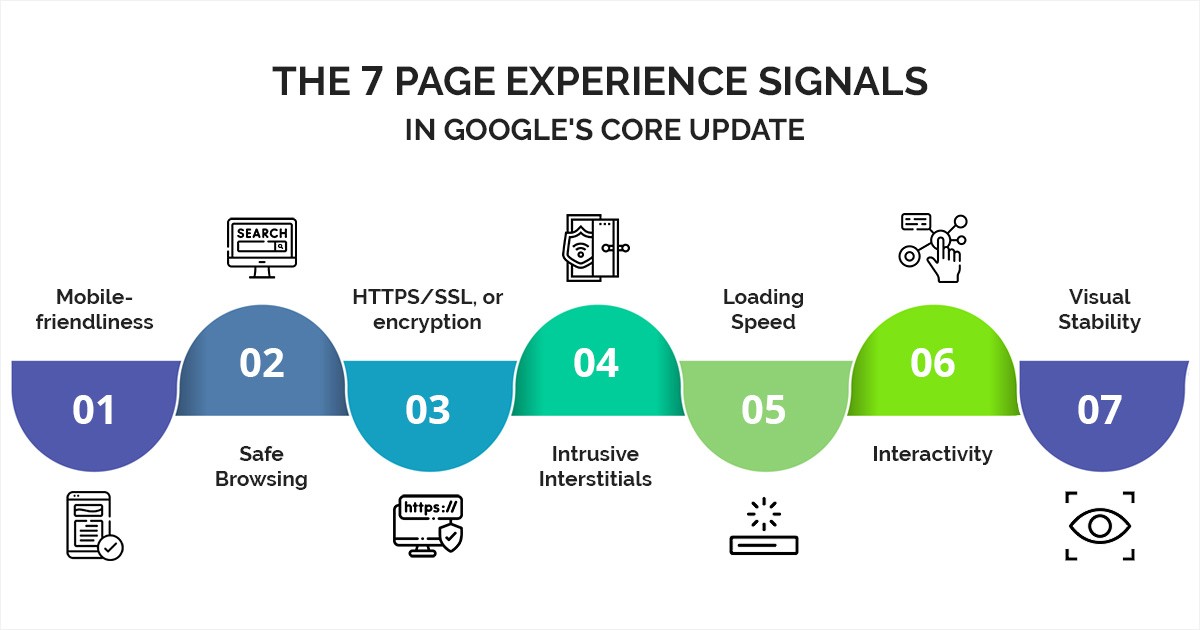
The page experience update will consider 7-page experience signals, including the three Core Web Vitals metrics: LCP, FID, and CLS.
The following signals are essential for delivering a good page experience in Google Search:
- Mobile-friendliness:
- Safe browsing
- HTTPS/SSL, or encryption
- Intrusive interstitials
- Loading speed, i.e. LCP (Largest Contentful Paint) – measures loading performance. To provide a good user experience, LCP should occur within 2.5 seconds of when the page first starts loading.
- Interactivity, i.e. FID (First Input Delay) – measures interactivity. To provide a good user experience, pages should have an FID of 100 milliseconds or less.
- Visual stability, i.e. CLS (Cumulative Layout Shift) – measures visual stability. To provide a good user experience, pages should maintain a CLS of 0.1. or less.
1. Mobile-friendliness
Mobile web pages and mobile web experiences have become increasingly important as more and more people use their mobile devices to access the web.
The characteristics of a mobile-friendly experience are much more than just having a responsive design. It’s about providing an optimised experience for that mobile user. When optimising your site to create a better mobile experience, it’s essential to consider the page experience signals that Google Home uses to determine how to handle your site on mobile devices.
2. Safe Browsing
One of the most critical parts of any online page experience is safe browsing. The threats of malware, phishing, fake sites, and other security risks pose some of the biggest dangers online users face. These threats aren’t just annoying or frustrating. They can lead to financial losses and identity theft — two things that nobody wants.
Google prioritises user safety by crawling websites for potential malware. It also weeds out content that contains potential social engineering or phishing.
3. HTTPS/SSL, or encryption
You’ve probably heard of HTTPS or SSL, but what is it, exactly? Is it essential for your website? HTTPS is the most common web encryption protocol, and it’s necessary to protect your online business.
If you’ve got an e-commerce website, then you’re probably aware of the importance of SSL. In fact, many web hosts have been pushing their clients towards using SSL certificates for years now, and for a good reason too — they help boost brand trust and security. But despite their benefits, not all businesses have made the switch over to HTTPS yet.
Websites that use HTTPS can buy SSL certificates to lift their search rankings. SSL is an integral part of Google’s page experience algorithm, as it ensures users have a secure browsing experience.
4. Intrusive interstitials
Google is against intrusive interstitials and will start punishing sites that use them. Interstitials are a scourge on the mobile web—they block you from accessing the content you want and are especially problematic in the middle of a conversion funnel.
As an example, Google has recently started penalising websites with intrusive interstitials. These types of pages force visitors to complete actions before they can access the content they want. As a result, Google has decided to penalise these types of pages in its mobile search results.
However, adverts that block the content we want to see is a growing problem. Google has decided that these overlays are not in the best interest of users and will soon penalise web pages with intrusive interstitials.
Some interstitials, such as cookie pop-ups or age verification requests, are necessary for safe browsing and won’t affect your performance.
5. Loading speed measured by Largest Contentful Paint (LCP)
The latest’ big thing’ in web performance monitoring is Largest Contentful Paint (LCP), a metric that can measure the amount of time it takes for the first piece of content to be displayed to your user. LCP is increasingly becoming the standard when evaluating user experience after Google adopted it in the PageSpeed Insights tool.
Loading speed is a crucial factor in the user experience. Studies have shown that if your site takes more than 3 seconds to load, your bounce rate will increase by nearly 200%. Google Analytics now includes a tool that measures this data, and it’s called “Largest Contentful Paint” (LCP). Now, Google is adding this metric to its rankings starting in June 2021.
A slow website is unacceptable to the average web user. It not only frustrates them, but it also causes them to lose trust and more importantly, it can hurt your business. It’s easy to underestimate the importance of your website’s loading speed. After all, it’s just a static page, right? Well, not quite. A website with a slow load speed impacts more than just your conversions; it can also affect your SEO.
With the new Google core update, a “good’ LCP will be 2.5 seconds or less for 75% of page loads.
6. Interactivity, measured by First Input Delay (FID) Page experience
According to Google Developers, FID “measures the time from when a user first interacts with a page to the time when the browser is actually able to begin processing event handlers in response to that interaction.”
In the past, web pages were presented in a non-interactive fashion — the initial view was static, and all of the user’s interaction had to be done through clicking links or buttons. We call these pages static, or ‘pre-loading. As more and more of our experiences move online, these old models are no longer sufficient. A new paradigm, where web pages provide an interactive user experience from the initial view, is rising in its place.
How quickly can you respond to a button tap? In the modern era of web design, many techniques have been implemented to increase interaction between users and websites. This is important as interactive websites are more engaging and keep visitors on the page.
Interactivity is a vital part of the web experience. We often talk about how a site’s UI can impact efficiency and its performance, an essential aspect of engagement. If your site feels slow, like it’s unresponsive to user input, people will quickly become frustrated and leave. Or worse, they won’t even click through in the first place.
In Google’s new page ranking algorithm, a good FID is 100 milliseconds or less.
7. Visual stability, measured by Cumulative Layout Shift (CLS)
To create a pleasant and optimised user experience, web designers need to make constant adjustments to every detail of their websites. These fine-tuning affect the stability of the design or layout, defined by how well a design or layout is perceived and understood across different devices, browsers, and screen resolutions.
Design is about more than how something looks. A solid design should be as visually stable as possible to ensure that the content is always seen and that the user experience is positive. An effective way to measure the layout stability of a web page is by using Cumulative Layout Shift (CLS) — a measurement of how much a Web page shifts after each design change.
Mobile websites are optimised for display on small screens. They’re also exactly the same way on desktop computers, even though the screens are entirely different. The layout has to adjust based on the screen size, and it has to do it immediately. Imagine you’re visiting a website to find information about a product. But as you scroll down, you notice some of the links aren’t fixed to the top of the screen.
According to Google Developers, “CLS measures the sum total of all individual layout shift scores for every unexpected layout shift that occurs during the entire lifespan of the page”.
In the future Google updates, visual stability will become more of a priority, with only minimal instability considered for ranking pages at the top of a SERP.
Final thought
If you want to get better at search engine optimisation (SEO) and understand what Google wants from your website, you need to understand page experience signals.
You can think of page experience signals as a way of measuring how effectively your web pages are converting visitors into customers.
The way Google interprets your page’s content is undergoing a radical change. In fact, the shift has been underway for a while now. But it’s only recently that Google officially announced its big move — namely that it would begin to use “page experience signals” to help determine how to rank pages in 2021.
Call on (03) 9510 0717 to learn what are Page Experience Signals and why you should care.
FAQs
How does Google Page Experience affect my business?
Google Page Experience has a significant impact on your business’s online visibility and performance. It directly influences your website’s rankings in search engine results. Websites that provide a positive user experience, as measured by Google’s metrics, are more likely to rank higher and attract more organic traffic.
Can a poor Page Experience negatively affect my business?
A poor Page Experience can have negative consequences for your business. If your website has slow loading speed, is not mobile-friendly, or contains intrusive ads, it can frustrate users and lead to higher bounce rates. This means potential customers may leave your site quickly without engaging or converting, resulting in missed opportunities and potential loss of revenue.
How can I improve my website’s Page Experience?
Improving your website’s Page Experience involves optimising various aspects of your site. Some steps you can take include improving loading speed by optimising images and enabling caching, making your website mobile-friendly and responsive, minimising the use of intrusive ads, ensuring easy navigation, and providing a seamless and interactive user interface.
Does Page Experience affect all types of businesses equally?
While Page Experience is beneficial for all businesses, its impact can vary depending on the industry and user behaviour. For example, businesses that heavily rely on online sales, such as e-commerce stores, may be particularly affected by a poor Page Experience, as it can directly impact conversions. On the other hand, industries where user experience is less critical, such as informational websites, may see a relatively lower impact.
Is it necessary to prioritise Google Page Experience?
Yes. With Google’s algorithm updates increasingly focusing on user experience, a positive Page Experience can help you rank higher, attract and retain more visitors, and ultimately lead to increased engagement, conversions, and business success.
The post Are You Ready for Google’s Page Experience Signals in 2025? appeared first on Webplanners.
]]>The post Ways To Embrace The Power Of Social Connection In 2020 appeared first on Webplanners.
]]>Social Media is the communication medium that allows brands and businesses to interact and engage prospects & customers through designed content opportunistically.

Businesses that delay social media marketing integration to their marketing mix are incurring huge losses.
The survival of any business and brand in the present scenario largely depends on how well they adapt and upgrade their existing business plans with the latest digital marketing trends.
It’s not just about the social presence and content plan; it’s more about improving customer experience, trustworthiness, and authenticity.
It is high time that businesses should understand the influence of social media and the power of relevant & targeted content that allows a brand to hook users and stand out.
Here are our top reasons to unfold the good of Social Media as a business:
Social Media is Inescapable:
Agree or not, we are all hooked to it. Be it Facebook, Instagram, Twitter, Snapchat, LinkedIn or any other platform. Given its rapid, time-sensitive nature, social media never sleeps. From a business point of view, we’re looking at increasing reliance on social methods: from hashtags on effective campaigns to barcode scanning apps etc.
It’s Free
Not exactly. Social Media is free, but social media marketing is not. Most of the social media platforms are free to download and register. And most importantly, it costs us time. It takes time to engage in, and this is where many businesses lose momentum, they need to understand that social media marketing is a medium to long term strategy, on the whole, there are no shortcuts, and you need to be committed to it.
Social Media provides exposure.
Social Media is the best platform to grow your brand. As a business owner or a digital marketer, your main objective should be to get your brand in front of your customers and promote it as well. Your clients are spending quality time on the internet and social media, surfing for things they like or are interested in. Having your brand present in these spaces gives you valuable visibility.
You will outperform competitors.
Thoughtful advertising will increase your reach and will create brand awareness. If your brand or website shows up in more search results, it will be more recognisable. You will set you apart from your competition and everyone else.
You can enhance your targeting.
You will be able to define who can see your ads! you can base it on interests, demographics, locations, etc. Defining your buyer persona will help you become more intentional and reach who you want to buy into your brand.
Social Medial provides customer insights.
Knowing who exactly is your ideal target audience will give you more confidence in your digital interactions. And Social Media provides you with that information. You can look at the reports and find out which ad type interacted more. Does video work better or images? What do people respond to? Results, reports and collected data can answer all these questions. If you know what your audience like more, you can create more of such ads.
It’s the future.
Who would want to be left behind, no one, right? Every day more and more people are embracing the power of social media. It is the wave, and if you don’t jump on board NOW, you are severely lagging way behind your competition and everyone else.
Today every business, big or small, in any industry must include social media and social media marketing to their existing marketing mix. Paying for social media marketing advertisements will definitely boost your reach, drive-in quality leads and increases your revenue.
The post Ways To Embrace The Power Of Social Connection In 2020 appeared first on Webplanners.
]]>The post Why Google My Business optimisation is crucial for every business? appeared first on Webplanners.
]]>
Why is Optimisation crucial for businesses?
Every business in this world needs a Google My Business listing. Why? Simply put, it offers all crucial business details to Google and your local consumers. It also provides a rich local search presence.
The details that you provide in your Google My Business profile are used in several different ways by the search engine. From populating the highly visible knowledge panel which appears to the right of the search results and to settling Google Maps, providing voice search results, and assisting with Google app search results.
Google My Business is a free, quick, and easy to use tool, and once it’s done, you can begin the Google My Business optimization process to improve your local search presence. To manage your Google My Business profile, you do not need any expertise or professional qualification.
Google My Business profile tells Google everything that it needs to know to accurately list your business in the right place at the right times and for the right keywords. GMB is of utmost importance if you aim to target local consumers and for your local listing.
How to Optimise Google My Business?
Make sure your NAP is accurate (NAP) – To ensure a strong foundation that basics need to be accurate. Here in GMB basic means Name, Address, and phone number. For GMB, this means a quick check that your business details are correct, totally up-to-date, and entirely consistent with your other local business citations.
Claim your Google My Business short name – Once you verify your Google My Business account, the next job on your Google My Business optimisation process is to claim your short name. It is a short or custom name, designed to make it easier for local search users to find your business. Your short name can be something either associated with your business name or the name that customers commonly use to refer to your business.
Write the perfect business description – Google allows you to add a 750-character description to your GMB profile as part of your Google My Business optimisation work. This text should describe your business in an engaging, authentic manner, but it shouldn’t reference things like sales or promotions and should not be stuffed with keywords or links. Treat it as your business listing.
Choose an appropriate category and sub-category – The category and sub-category you choose while optimising your Google My Business profile plays a vital role. Especially for your local search rankings. The category tells Google which searches your business could be relevant for.
Upload amazing photos – A picture may be worth a thousand words, but it could also be worth a few additional brownie points when optimizing your GMB listing.
Generate, monitor, and respond to reviews – For local businesses, the beauty of reviews is in the influence they have on the purchase process. Users are smart these days. Before making a purchase decision, a consumer reads an average of 10 online reviews before they feel they are able to trust a local business – so generating positive reviews can have a direct impact on sales.
Use Google Posts to boost conversions and showcase brand personality – There’s a feature within GMB called Posts, which is crucial to your Google My Business optimization efforts. Posts are essentially tiny blog posts that can be used to give a short news update, share an offer, publish details of an upcoming event, or showcase a product.
Add your social media profiles to your Google My Business profile – Part and parcel of optimizing a GMB profile are ensuring it is as complete and up-to-date as possible. As we have seen throughout, there are some serious search visibility benefits to be had if you complete your profile information, often update and make the most of the myriad GMB features.
Investigate GMB features specific to your industry and use them – Google offers a plethora of features for its users to facilitate them to easily use it to their potential. As the hub of Google’s local search and local business efforts, GMB is packed with features. Many features and tools are specific to various industries. Investigate the ones that could be of your use. For example, features like- make a call, book an appointment, etc.
Final thought!
Knowing why and how to optimize Google My Business brings in plenty of benefits for local business owners – with a promise of greater local search visibility, more reviews, and enhanced information for local consumers.
The post Why Google My Business optimisation is crucial for every business? appeared first on Webplanners.
]]>The post Why Small Businesses Can’t Ignore Social Media Marketing in 2025 appeared first on Webplanners.
]]>Most small businesses run on stringent marketing budgets and are very careful about what type of marketing strategies they should invest in. It becomes crucial especially when you have a limited marketing budget. Spending wisely is the only intelligent decision.
Social media is one of the versatile platforms that small business owners must use for marketing. It is one of the most cost-effective marketing strategies that you can use to reach the target audience and boost sales over time. That’s the reason why 97% of marketers ae using social media to reach their audience.
The point where small business owners and marketers get discouraged is seeing how big players in the industry are pushing thousands and thousands of dollars into Facebook ad Campaigns & other Paid campaigns and posting every minute on Twitter. But the fact of the matter is – you need to start now. Every step count and will take you closer to your business goal.
Small business social media marketing strategies actually have an advantage over big companies. Why? Social media effectiveness boils down to engagement. If a business doesn’t engage with its customers, chances are it won’t have success in social media marketing.
Using social media as a marketing tool can help you grow your brand and pad your wallet. If you’re not taking advantage of social, you’re missing out on a fast, inexpensive, and effective way to reach almost half the world’s population.
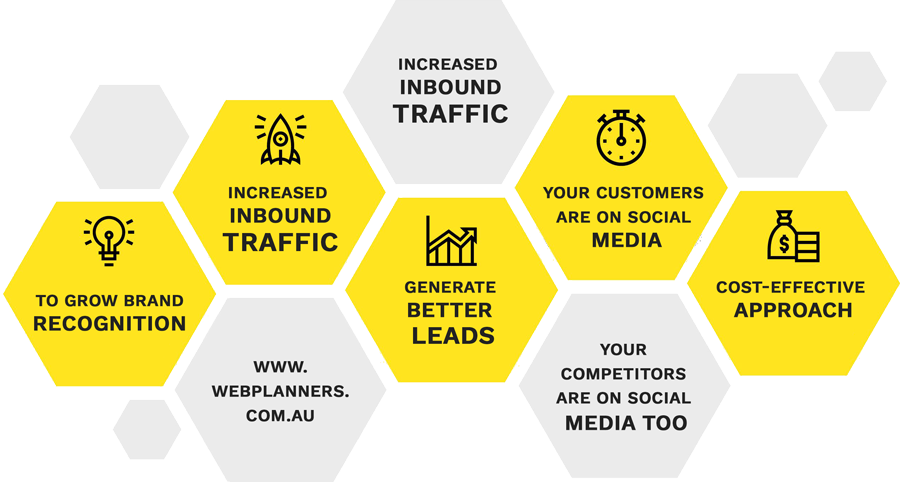
Following are a few reasons as to why small businesses need social media marketing now:
To Grow Brand Recognition
Social media marketing will make it easy to spread the word about your products, services, vision and mission. With nearly half of the world’s population using social media platforms, they’re a natural place to reach new and highly targeted potential customers.
It helps you improve visibility, and thus increase recognition for your brand. Your business social media profiles present new opportunities to share your content and really present your brand’s voice and personality.
Increased Inbound Traffic
Using social media and linking it to your website will increase your traffic tremendously. Social media posts and ads are key ways to drive traffic to your website.
Sharing great content from your blog or website to your social channels is a great way to get readers as soon as you publish a new post. Each piece of content that you post to your social media profiles is another opportunity to bring new visitors to your site.
This makes marketing through social media an excellent strategy to complement your search engine optimization efforts.
In order to get the most inbound traffic possible, it’s important that you consistently publish content that is engaging and adds value for your target audience.
Generate Better Leads
Most brands rely on search engine optimization and PPC ad traffic to find and engage new leads. However, marketing through social media can be an excellent outlet for bringing in new consumers. Connecting with your target audience can be easy if you are active on the channels that they use most often.
If you aren’t already on social media, you could be missing out on an important chance to connect with your customers and engage new leads. Lead generation is such an important benefit of social media for business that many social networks offer advertising formats specifically designed to collect leads.
Your Customers are on social media
Like we said earlier, nearly 3.8 billion people use social media. Hence, your small business should market through social media because your customers are spending time on these channels. With so many consumers using social media every day, this presents a great opportunity for small businesses who want to reach their online audience.
Cost-Effective Approach
Many small businesses can’t afford a radio, TV or billboard ad campaign, but they can surely afford to use social media & digital marketing techniques to reach out and engage with ideal audiences.
Most of your social media results will come from investing time in creating and publishing content as well as having conversations with your fans and followers. The good news is that even just a few hours a week can have significant results.
Depending on your goals and the scope of your campaign, it is relatively inexpensive to run paid ads on social media channels like Facebook and Twitter. No matter how small your budget is, you are still able to make an impact on these channels to reach and convert new leads.
Your Competitors are on Social Media Too
No matter what you are selling, what industry you are in or what your target market is, chances are high that your competitors are already present and involved on social media channels.
If you want to remain competitive in the digital marketplace, it’s vital that you start working toward building a presence on social media. Social media content allows you to not only show a little bit of your brand personality, but it also presents an effective outlet for demonstrating your industry expertise and knowledge. This is one of the best ways to set yourself apart from the competition and bring in more relevant online traffic.
Keep Your Customers Up-to-date
Social media is one of the best and easiest ways of keeping your customers updated with your new products or upcoming events. If your business makes a huge announcement about a new product or an exciting event, it’ll catch on and get people excited.
Here are some stats to support the fact that small businesses need social media marketing:
- Nearly 50% of the world’s population uses social media. That’s over 3 billion users worldwide. (Statista)
- Each person spends an average of 2 hours and 22 minutes on social networks and messaging. (Globalwebindex)
- 54% of social browsers use social media to research products. (GlobalWebIndex)
- 73% of marketers believe their social media marketing efforts are somewhat working for their business.
- 321 million new people joined social media in 2019, which brought the total from 3.48 billion to 3.8 billion social media users (an increase of 9%) in 2020. (Hootsuite)
- 71% of consumers who’ve had a good social media service experience with a brand are likely to recommend it to others. (Ambassador)
- 73% of marketers believe that their efforts through social media marketing have been “somewhat effective” or “very effective” for their business. (Buffer)
- Social networks are the biggest source of inspiration for consumer purchases with 37% of consumers finding purchase inspiration through the channel. (PWC)
- Social media is the most relevant advertising channel for 50% of Gen Z and 42% of millennials. (Adobe)
- 50% of consumers say that seeing user-generated content would increase their chances of buying products through a brand’s social media. (Curalate)
Final Thought!
There are plenty of benefits, we just highlighted the most basic ones for small businesses to get started with. If you’re still on the fence about adopting social media marketing for your business, hopefully, the benefits of social media marketing mentioned above has put you on the right path!
If you need any help building your social media presence, creating a plan and strategy and delivering an effective execution, Webplanners is here to help. Our team knows just what it takes to build and maintain a thriving social media audience for small businesses.
The post Why Small Businesses Can’t Ignore Social Media Marketing in 2025 appeared first on Webplanners.
]]>The post Top 7 Social Media Marketing Tools to Use in 2025 appeared first on Webplanners.
]]>Facebook, Twitter, Pinterst, Instagram, LinkedIn, Whatsapp, Wechat, Snapchat, Youtube and the whole lot! Connecting with your customers on social media is the best way to build brand loyalty and communicate your product offerings directly. However, how can anyone find the time and energy to manage all these channels by themselves?
Social media- the global marketing stage
Social media is a two-way platform and for it work you need to use it and use it effectively. Besides from the quality of your content, if you’re a small business that owns multiple social media accounts with an established or growing customer base, posting consistently and frequently is key to keeping your customers engaged with your brand and products.
Yeah, we get it… it takes too much time and energy logging in and out of each account, formatting each social media post correctly, and remembering to post on time.
Here at Webplanners, we have compiled a list of awesome social media tools you should use to help you save time and energy, helping you manage your social media channels better (some of these we use ourselves).
Picking the right social media tools for your business
As a small business ourselves, we understand the struggle of having to manage client work, our own work and then to have to expend time and energy on managing our image and potential customers on social media. So we use CRM or customer relationship management tools to help streamline the whole process.
The tools you’ll see below are often referred to as social media scheduling tools. Essentially all your social media accounts are set in one place so when you send out one post, it formats to send out into different channels.
1. Hubspot
Source: https://commons.wikimedia.org/wiki/File:HubSpot_Logo.png

Website here: https://www.hubspot.com/
We understand that building marketing campaigns needs dedication and creativity. Imagine being able to manage your emails, blog posts, landing pages, all your social media accounts, sales figures, marketing reports and your websites all in one place. This is what Hubspot can do (There is a reason why Hub is in its name).
Hubspot’s design and functionality is a tad technical however anything technical is supported by short online video lessons to help you understand why you use it and how to use it. They have an incredible support system to help you through any and every kind of issue you may encounter.
For free users, it is a prioritizing tool that doesn’t let necessary meetings and interactions slip away from your mind. Apart from the regular stuff like scheduling posts, monitoring the insights you can also measure and compare different channels and campaign results too.
Hubspot mainly specialises in CRM, Marketing, Sales and Services. Check out their pricing and services page here: https://www.hubspot.com/pricing/service
They even have an academy to teach you about all the ins and out of understanding and operating your business digitally such as SEO, Social media, Blogging etc.
Price range: Free – $3,000 + (depending on the package)
Bottom line: Hubspot is a bit more technical but the trade-off is that you have more control and freedom to manage different aspects of your business. It is mainly for start-ups, small – large businesses and agencies. They have a range of free CRM (customer relationship management) tools, but the real kicker is when you pay a monthly subscription to any of their packages that is relevant to where you want to improve efficiency.
2. SocialOomph

Website here: https://www.socialoomph.com/
SocialOomph is an affordable and user-friendly CRM and social media management tool. Although the website doesn’t seem modern, the features sure are. Apart from an awesome name, the tools it offers helps you manage better relations with your social media followers such as offering:
- Auto DM (direct messages) being sent to new followers
- Auto follow new followers
- Deleting all your tweets and direct messages
- Auto unfollow
- Email reply digest
- Schedule your tweets
Apart from Twitter focused features, it can track keywords, promote profiles, and monitor social media activity, manage blogs and more.
Price: Free – $17.79 p/fortnight. Check out their pricing here: https://www.socialoomph.com/
Bottom line: More Twitter focused with an easy and free auto features to help you get started and noticed. It is relatively cheap and good for businesses or people with a budget. All in all, it requires minimal effort to bring maximum results.
3. Buffer
Source: https://buffer.com/press
Website here: https://buffer.com
Trusted hugely by big brands and businesses, Buffer is known for its simple interface and clean functionalities.
Tired of handling multiple login accounts and their passwords?
Buffer gets you rid of it. In one place you can do it all – schedule posts for later, analyse performance and share content. Also, it’s a brilliant platform for people new to social media services.
Pricing: Free – $399. Check out their pricing page and services here: https://buffer.com/pricing
Bottom Line: What makes buffer different is they are a social media content management platform. For example, they have features such as an RSS feed, link shortening and analytics to help optimise your social media and analyse posting results.
4. Hootsuite
Source: http://www.stickpng.com/img/icons-logos-emojis/tech-companies/hootsuite-logo
Website here: https://hootsuite.com/plans
One of the most popular marketing tool, Hootsuite helps in better finding, managing and monitoring of social media sites.
You can also schedule on the go with their mobile phone app or work simultaneously in a team on the same account too!
The best part is you can filter the conversation in multiple languages by keywords and tags to know the reviews of consumers. Also it allows you to keep track on your social media ROI in efficient ways.
Pricing: Free – $675 – Custom Pricing. Click here for their pricing page: https://hootsuite.com/plans
Bottom Line: Hootsuite has some features that helps it stand out as a social media manager. Besides the standard scheduling and management, Hootsuite also features its intuitive mobile app, collaboration feature and has customised analytics.
5. SproutSocial
Source: https://charitycatalogue.com/resource/sprout-social/
Website here: https://sproutsocial.com/
Sprout Social is a social media engagement and management tool that is data driven.
Having on-call insight and knowledge about how your posts ran is important for businesses to know whether what they are doing is working or not.
With the kind of data Sprout Social offers, it helps you create stronger and loyal customer relationships through more confident and quick decision making.
Pricing: starting at $99 – $249. Check out their pricing page here: https://sproutsocial.com/pricing/
Bottom Line: Although Sprout Social is a social media management too, it features are more focused towards data and analytics. Definitely a game changer to workflow and allows you to address issues and make decisions with confidence.
Conclusion
With these social media marketing tools, managing individual social media account and tasks are a thing of the past.
All these easy and streamlined marketing tools will likely to save you time, energy and effort either for free or with a bit of a cost.
Regardless, it’s time you work smarter, not harder. Before you decide on a tool, be sure to do extensive research on it to see if it fits your organisation or not.
The post Top 7 Social Media Marketing Tools to Use in 2025 appeared first on Webplanners.
]]>The post How to Handle Bad Google Reviews Like a Pro appeared first on Webplanners.
]]>
We say that one of the worst possible things to find on the Internet is probably a bad review about your business.
But, don’t panic!
You can’t make an omelette without a few broken eggs, so negative reviews don’t define your business.
In this blog, you will learn about how you should be dealing with negative Google reviews.
Have you heard or seen this before?
“Worst retail shop. EVER!”
“The staff were rude, arrogant and unfriendly. Don’t shop there!”
”Dry and undercooked food. I would leave negative star ratings if I could”
by Dissatisfied Customers
Even among a sea of good reviews, one bad review can feel like the end of the world for a lot of business owners – especially when they haven’t had to deal with it before.
But here’s the kicker, even the most well-known brands aren’t immune to getting the occasional bad review.
Over 93% of millennial searching for you prefer to read these reviews before they even consider shopping with you or going to your restaurant.
And a shocking 94% of these people will avoid trading with businesses that have negative reviews.
And because we are an SEO company, we know that the implications of these negative reviews actually factor in to how well you’re ranking on Google’s Search Engine Results Page (SERP).
How much exactly?
Review signals account for 10.3% of your overall ranking factors.
But alas, don’t be afraid.
If you truly trust in your business, and you’re just getting the occasional negative review, then it won’t necessarily affect you too much.
The only time you should be concerned is when majority of the reviews are bad – in which case, we suggest looking inwards.
Let’s move on from that, though.
You’ve gotten one bad review, now what?
Part of our SEO services include analysing how businesses react to these negative comments.
And now, while responding to the review might not really do much to rectify the impact on your SEO – the way you respond to it determines not just these customers perception of you, but also the future prospects that will read these reviews.
In short terms, don’t be that person that hurls insults at people giving their honest opinion about your business.
This is no way to get these customers back on your side, and plus, you’ll scare all the new ones off as well.
And while the seemingly safest and easiest option is just to ‘let it be’ – leaving those remarks with no replies only means that you don’t have a chance to change this person’s mind, or to show future customers that you care about improving your products or services.
The correct way to respond is to apologise.
Show the customer that you care about their feedback, and that you’ll continue improving to hopefully keep their business in the future.
This means you might potentially have the unsatisfied customer returning, and you’ll also have new potential customers coming to you due to your professionalism.
What are the stats?
- 54% of people do online local searches on Smartphone.
- 55% of these people take a conversion call within an hour and 84% after 5 hours.
- Every positive star rating brings you 9% of increase in revenue.
- 52% of customers expect a reply within 7 days of their writing, 1 in 4 expects in 3 days, while 24 people wants the response in a day.
- 78% of people fall for the business who responds to them believing that the company cares for its consumers.
In the world of business, it is expected that despite your best efforts, you’ll always have someone somewhere leaving a bad review.
And as a business owner, you need to handle this with a lot of patience and care.
There is a very thin line between getting back to the customers and managing your reputation.
Everyone knows that piling on the positive feedback from customers is the road to success,
but to take even more of an edge, you must also be responding well to the negative ones.
Why do you receive the negative reviews?
You think your business is doing great, but you suddenly get a bad review on your wall, page or website.
What gives?
- Customers might be having a bad day
- A sneaky competitor might be doing it
- Customer is prone to leaving unconstructive remarks (i.e. The Classic Internet Troll)
Your business is simply not the right fit for them
So, you got a bad Google Review on the page. Now, what?
- Convince the customer with logical reason
The first thing you should focus on when you receive a negative review is how to retain the customer.
If you are a large or small business, losing a customer can harm you both financially and through your reputation.
You should aim to provide the solution their after as soon as possible.
Calmly address their complaints and inform them how you can resolve the primary issue.
After you’ve resolved the issue and have yourself a happy customer, you can potentially ask them to revise, remove or update their original review.
A customer can at any time do these actions on their reviews and change their ratings – and usually most reviewers are ready to do so if they’re satisfied with the business’ response.
2. Understanding Google’s policies – Flag violated, fake or incorrect review
Customer- 1 star rating
“I ordered a desktop for myself.
First it took longer to come than expected and now it crashes after every download.
I thought maybe the condition of desktop will make up for the late delivery. But it just made me more furious.”
IT Service Business- “Hi ‘customer name’
We are sorry to hear about your computer’s delivery and functionality problems. J
ust to inform you, we aren’t actually the company that deals with desktops or delivery. We are ‘TechnoSpa’ an IT services company.
But perhaps, we could help you solve the glitches.
Let us know.
Thankyou. “
Now this is where a false and irrelevant customer came and mistook you for someone else.
Violations can be any of the following-
- Reviews with violent, hateful or inappropriate remarks
- Irrelevant or off-topic
- Reviews that are spam
- Reviews that has advertising context.
These comments tarnish your brand image without any fault to do with you.
Make sure that you’re taking action as promptly as possible.
Understand the Google policies, read them well and tag the flag to the review.
If things don’t go well and the review is not brought down contact the support associates.
3. Lower the bad reviews with masses of positive reviews and ratings.
From our experience, it’s a lot easier for people to leave bad reviews that good ones.
Due to a heightened emotional state – they simply don’t care about your solutions anymore or any ramifications to your business.
But what you need to understand here is that a negative review in the 100 positive reviews will never be noticed or given much attention.
So, the idea is to keep reviews flooded with happy customers. And how do you do that? YOU ASK THEM!
As a SEO & digital services provider in Melbourne, we encourage a lot of our clients to get reviews from their happy customers.
However, sometimes they are simply too busy.
Rather than pestering them day in and day out into leaving you a review, you should try to schedule some time in every month to collect reviews from various customers.
And try to understand that customers usually prefer different methods of communication – so try to make reviewing easier for them.
This might be including a link to your page and sending your message through text or email, and so forth.
4. Reply quickly!
One way to keep on top of things is setting out a time in the day where you can look through reviews and reply.
This will allow you to resolve issues quickly, and reduces the impact that any negative review may have.
Keep a reminder of when the review comes, by allowing your system to create a notification.
5. Reply correctly
Customer: “Your management wasn’t working in coordination with our family”
Business: “We apologise, but we tried our best to serve you.
Maybe there was congestion from your side, and you didn’t inform us in time so things couldn’t be arranged promptly.”
A big no! Don’t play the blame game.
Any customer or the spectators would dislike the company for just defending the accusation and not resolving it.
There are ways to reply to your customers:
- Avoid writing to people when you aren’t in the mood. Don’t let emotions taint your response.
- Hundreds and thousands and more of customers are going to read it, so be realistic and add thought to it.
- Thanks them for doing the favour of taking out time and reviewing your service.
- Be precise, kind, short and concise in response.
- Stand for what’s right and take the ownership for your business and service. Customers look forward to such strong dedication.
- Don’t bribe the customers with freebies and extras. It seems you are hiding your flaws behind ‘superficial’ offers.
6. Change the style of working in the business.
It’s dangerous for any business to be too resistant to changes. For them, a single negative review won’t influence them to change the types of services they offer or to adopt new ones. But that’s not how any business should work – especially digital companies. Show your customers that you’ll listen to them by adapting your services to suit their needs more.
7. Fight reviews with humour
Fighting fire with fire isn’t necessarily the way to go – especially on social media.
More often that not you’ll come across as rude or impolite.
Some of the best responses that we’ve seen involve humour.
This isn’t to say you’re meant to degrade the commenter or reviewer – but simply acknowledge the issue, but try to reduce the tension within posts.
Whatever it is, a smart tactics or a fun strategy, just make sure you have addressed the negative feedback, and tried to put your business in the best light possible.

Final words
Don’t let your business’ reputation crumble due to a few bad reviews.
View it as an opportunity to adapt and modify your business to be even better for your customers.
And remember, it’ll be impossible to please everybody – but you should still try set the record straight when it comes to these negative reviews.
The post How to Handle Bad Google Reviews Like a Pro appeared first on Webplanners.
]]>The post Facebook’s 2018 New Year’s Resolution Update: The advertising shakedown appeared first on Webplanners.
]]>

Facebook’s new direction has shaken up the complete user and business experience:
‘More happiness and less promotion’.
On 11th of January 2018, Facebook made their first official announcement regarding their 2018 update.
The update highlights changes to current promotional business practices and revamps how content will reach end users.
Gone are the days when a business could just promote their product, service or brand without any ramifications.
Now, Facebook requires a lot more requirements that need to be fulfilled before your content can reach your intended audience effectively.
These new implications have businesses, investors and marketers alike scrambling to understand how their promotional strategies will change in 2018 on this social media platform.
“I expect the time people spend on Facebook and some measures of engagement to go down”
Mark’s work philosophy has always been directed at how Facebook’s news feed will operate.
Working with communities, conducting surveys and academic research with Universities has him concluding that a major change needed to take place in Facebook’s news feed.
This was predominantly due to concerns in mental and social health users face when ‘passively consuming’ content on Facebook.
As a result, his new goal is to increase the mental well-being and social relationships by taking your news feed and prioritizing content you’d deem as more personal, such as things that are happening within your circle of friends and families.
For companies and brands this means it may be harder for your content to have engagement and reach.
The fallout of this recent update has caused the loss of investor confidence and Facebook’s share price to drop up to 4.5% on Friday losing out on 3.3 billion dollars.
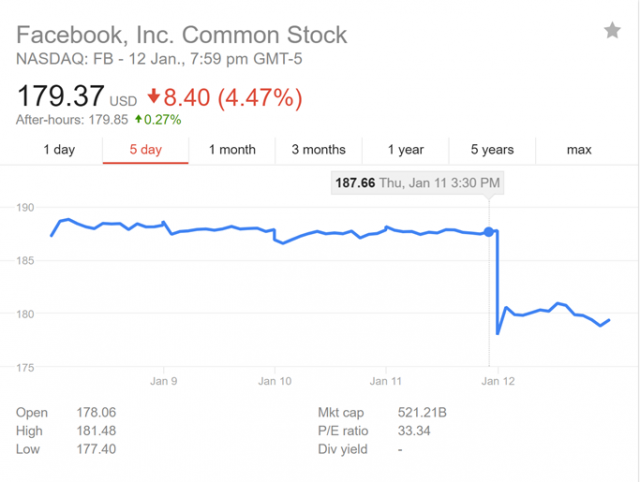
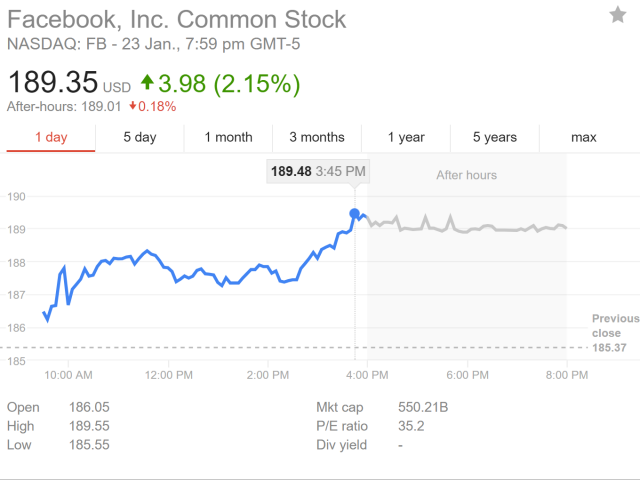
Update: Facebook’s stocks have bounced back and is higher than it has ever been!
What seemed like a loss was only short term, indicating investor’s support for Mark’s new direction.
Here is a list of Facebook New Year’s resolution updates:
Facebook will not prioritize likes as a measure of quality content anymore.
Before the update it was and still is common for business practices to buy likes and use them as a measure of traffic and engagement for your page and posts.
However, with the new update rolling out, the ‘like’ economy on Facebook is in in decline in favour for comments.
The more frequent people write meaningful comments and the longer it is, the more likelihood your content posts get gain more exposure.
While news and videos will still appear, except the ones shared and interacted by your friends and family will be prioritized.
Mark’s concern regarding people’s mental health and building better social relationships is the one of the main drivers to the changes to the prioritisations of your news feed.
The change the news feed algorithms will still show news and videos however, the ones shared and engaged by your family and friend’s circles will be prioritized on your page.
It also raises the question to whether this aid or prevent the spread of fake news and bad content.
Posts from family and friends will get more priority on your news feed compared to those from companies, and celebrities.
Extending from the last point, posts from companies and celebrities selling to you their products and services get second fiddle to what your family and friends posts.
Especially in a highly saturated and competitive attention economy on Facebook, content and posts that lack heart and soul won’t get as much priority on exposure.
How will this affect your business and advertising?
Facebook is weeding out all the businesses who don’t promote quality and meaningful content:
If your business just pushes people to buy products or you keep creating promotional content without any context, then Facebook algorithms won’t prioritize your content.
Businesses and their promotional content now have to provide value and meaning in their posts to the users for it to have an optimal amount of reach and engagement.
Here are some examples from Facebook of what not to do:

.

.
Your Facebook page is an important destination for users:
It’s where they make a first impression of your business and where they will decide to follow, share and engage with your content.
The more often that this engagement happens, the more reach your messages will have.
Understand the discovery process and communications that happens when people land on your page:
Your Facebook page is like your home, so make it as welcoming and tailored to the user experience as possible.
If you want them to keep visiting then tidy it up, make it look appealing and offer value to keep them coming back.
What to do now?
Facebook has given some advice on what not to do and how to be effective with your posts.
- Do not just promote or sell content
- Do give context and value to your posts
- Do not have too much lettering or words on your image.
- Use Facebook’s ad boost for a more focused promotional campaign
Keeping in mind the points above, the way Facebook has played their cards, considering investment into paid advertising on Facebook will become essentially the most effective way to have the best reach and exposure to the right people.
Conclusion
Facebook’s new update has made their stance clear, it wants you to spend less time on Facebook and for the time you do spend on Facebook will be meaningful and full of value.
This update is as surprising and new to us as it may be to you.
If you are a business that relies on Facebook’s advertising platform then it’s time to sit down with your marketing team and rethink your strategy and approach to advertising.
 hbspt.cta.load(3445577, ‘cbcfbf16-99d1-495a-ac57-1c49ae929e59’, {});
The post Facebook’s 2018 New Year’s Resolution Update: The advertising shakedown appeared first on Webplanners.
]]>The post 7 Instagram Updates and Tips You Need to Know in 2025 appeared first on Webplanners.
]]>As of 2018 Instagram the mobile sharing social platform amassed up to 800 million monthly active users.
With the population in the United States of America being roughly 324 million in 2017, this means that the number of users on Instagram is more than double the population of people in the U.S.A. Wow.
Though it may be hard to visualise, the numbers are there, and in 2018 getting likes and followers for your business on Instagram has never been easier.
What updates do I need to know for 2018?
Instagram’s latest updates brings in more dynamic ways for users and businesses to interact and connect with each other.
The philosophy here seems to be a renewed emphasis for businesses to be on point with their branding game, as well as to produce and manage the quality of their content… Not just the promotional ones.
Without any further ado, here are the recent updates on Instagram you may need to know for 2018:
- Ability to Follow Hashtags:
- Rights Manager Enabled:
Like Facebook, Instagram allows you to protect your video content.
According to Instagram, when this feature is enabled it ‘will begin to monitor and block actions in Feed, Explore and in Live, but not in stories for both private and public Instagram accounts’.
What this means for your business is no longer do you have to worry or waste time and money in finding and filing copyright claims on users who steal your video content.
Because Instagram does this all for you automatically, you’d have better workflow on Instagram and be anxiety free when it comes to posting videos.
For more details on how it works, check out Facebook’s post.
- You can archive your Instagram stories and highlight them too!
Instagram Stories is a way to connect directly to your followers with events that have happened for 24 hours.
On Instagram Stories, businesses may advertise through this channel, attaching links to images and videos for their followers to click.
With the new updates, in 2018 you can archive your stories for more than 24 hours and if you choose to, you can save it! These stories can also be posted cross platform to Facebook as well.
Instagram highlights is an add-on to this. Stories that usually disappear after a certain period of time can now be highlighted permanently on your profile page until you remove them.
Think of these like mini trailers for your business, who you are, what you do, how you do them. Using these highlights really enhances the user experience on your profile and makes them feel more connected to your brand.
For more info on story highlights check out this post.
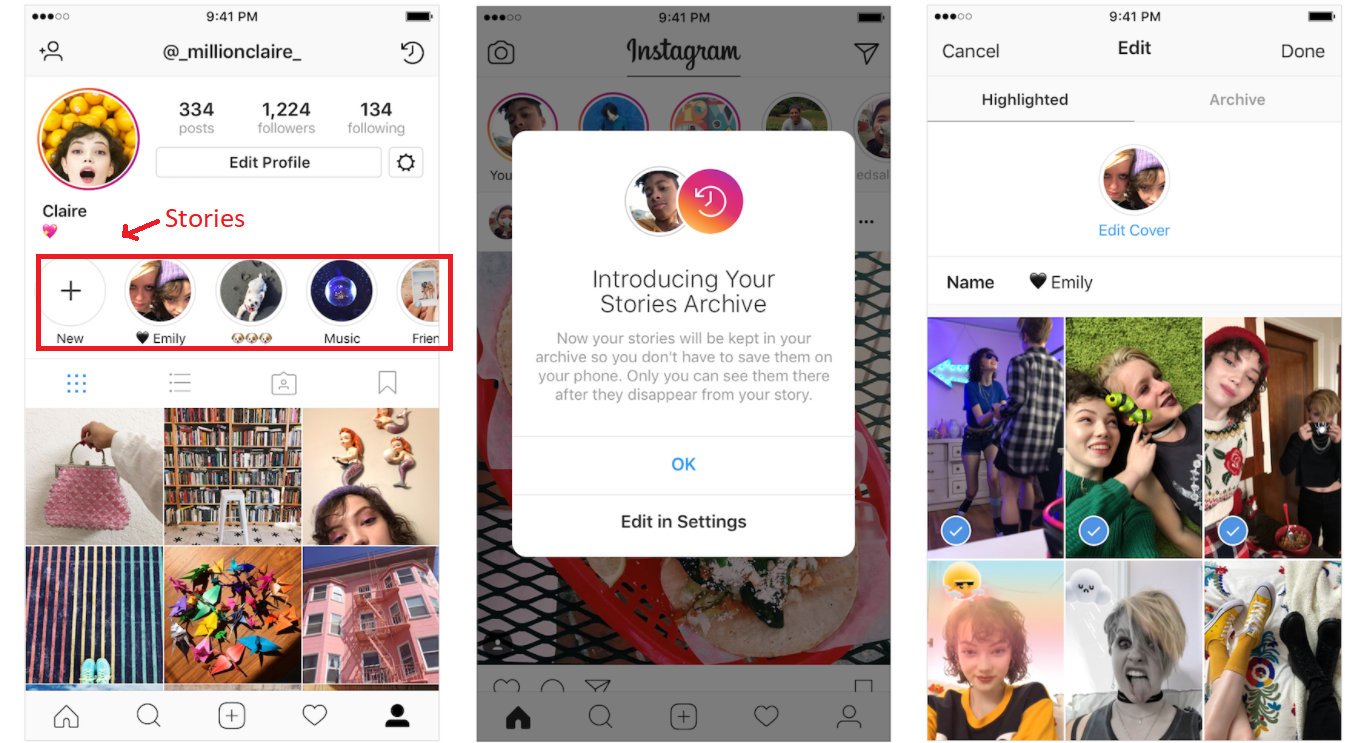
Tips and Tricks around Instagram
Instagram has an abundance of tools to help get your brand noticed. However, if that is as far as it goes, not much will come from it.
Engaging your followers and encouraging user generated content through little gestures in your posts goes a long way.
Some ideas may be: asking questions on posts, a photo contest, video contest etc. It doesn’t stop there, you should be active and take time to establish a dialogue with them, interacting with them through replying to comments and provide offerings etc.
An example here by an art page ‘surelysimpleblog’ has great content and engages her audience with small gestures and giveaway.

2. Aesthetic and Your Brand Story
Your profile page is like the front cover of the book in which Instagram users will judge you.
As a result, it is important to establish and remain consistent with the aesthetics of your posts.
Be as original and as creative as you can, but the most important thing is to remain consistent. It may seem unfair, but like I said at the start of this article, 800 million active users.
Saying there is a lot of competition is an understatement, so to get people to like your photos and then follow you, you should have a branding story people can relate to and or enjoy.
Give them a reason to stay, but also a reason to keep coming back.
Check out ‘Vans’ Instagram page, you can see the aesthetic is nice and consistent as well as the brand story being about self-expression through shoes.
3. Connect Your Accounts
Did you know? – Facebook owns Instagram.
Yes, the whole platform.
What this means for businesses is that it is important to (if you haven’t already done so) connect your Facebook account to your Instagram account.
The benefits of this move are that your posts cross over and so do your followers.
Posts from Instagram can be posted onto Facebook simultaneously, potentially leading your Instagram followers to your Facebook page and vice versa.
For more info on account conversion check out this post.
4. Promoting Posts
Like Facebook, boosting your promotional posts on Instagram helps you extend your reach and be more targeted with your posts.
The business manager tools on Instagram helps businesses manage their promotional posts to target the right people for their posts.
Some boosted posts may encourage likes, follows, leads to your Facebook page, encourage sales or even encourage you to send an inquiry.
For more info on Promotional Posting click here.
5. Instagram Insights
Finally, drum roll please… Analytics!
Even if you aren’t good with numbers and graphs, Instagram’s analytics provides businesses with actionable insight through their user-friendly reports.
It highlights what posts are doing well, in addition to information on what kind of people are following you.
Knowing the stats on the demographic, behaviors and response of your audience, you can cater posts to be more relevant that engages the audience with your content.
For more info on Instagram Insights click here.
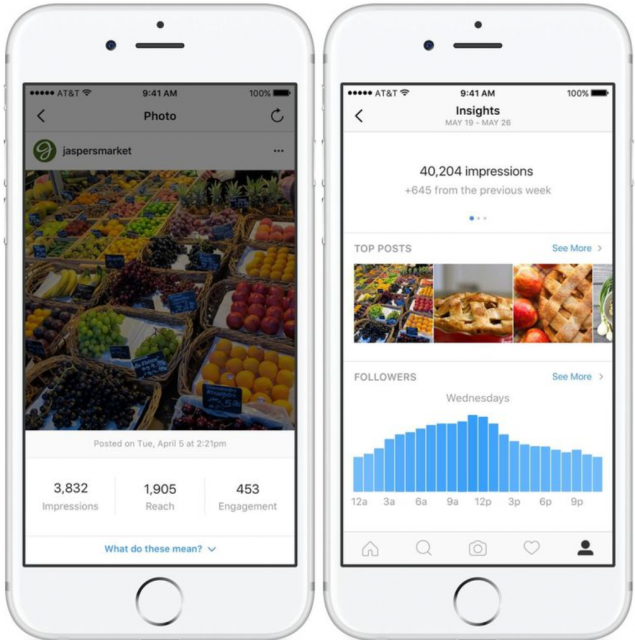
Conclusion
With all these new updates and tools for users and businesses to play around with, 2018 will be an exciting time.
We hope this has helped give you insight into Instagram updates as well as tips and tricks you need to know for your 2018 social media marketing strategy.
hbspt.cta.load(3445577,’cbcfbf16-99d1-495a-ac57-1c49ae929e59′,{});
The post 7 Instagram Updates and Tips You Need to Know in 2025 appeared first on Webplanners.
]]>