The post Melbourne Bayside SEO: How Local Businesses Can Win Suburb-Level Searches appeared first on Webplanners.
]]>They want someone who serves Brighton, understands the area, can reach them when needed and has enough local credibility to trust.
That small difference in the search query can change which businesses appear.
For businesses operating across Melbourne’s Bayside suburbs, this makes local search more specific than simply trying to rank for “Melbourne”. The opportunity is to build visibility around the places your customers actually live and search.
Why Suburb-Level Search Matters
Local searches often combine a service with a location.
Think:
- Physiotherapist in Hampton.
- Accountant in Sandringham.
- Builder in Beaumaris.
- Café in Brighton.
- Electrician in Black Rock.
The search tells Google something useful: where the customer wants the service.
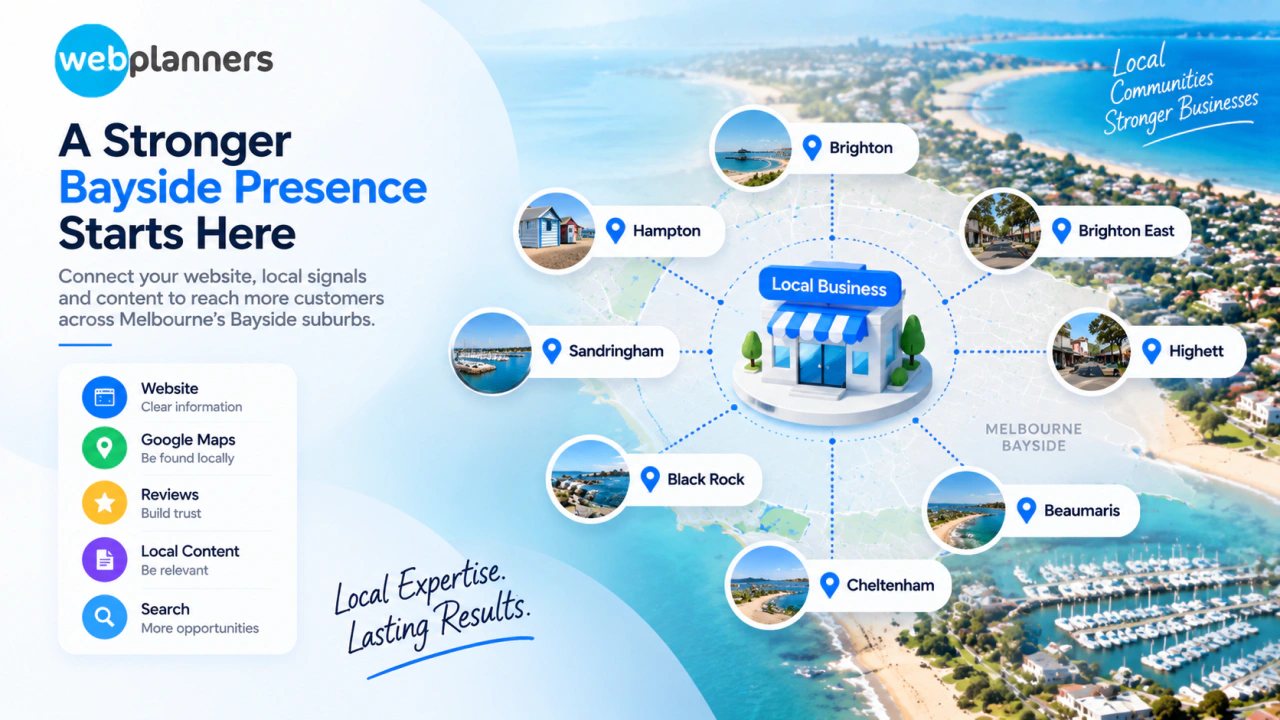
Bayside businesses can therefore benefit from understanding the suburbs that matter to their actual service area, including Brighton, Brighton East, Hampton, Hampton East, Sandringham, Black Rock, Beaumaris, Highett and Cheltenham.
The important part is not mentioning every suburb on every page. It is showing genuine relevance to the locations the business serves.
Build Stronger Suburb-Level Visibility
What Does Local SEO Mean for a Bayside Business?
Local SEO helps businesses be more relevant for searches tied to their geographic location.
This could be the website, Google Business Profile, reviews, local citations and other signals that help search engines get an understanding of the business.
For example, if a business caters to Hampton and Sandringham, it should clarify:
What services it provides.
- Where it operates.
- How customers can contact it.
- Which locations it genuinely serves.
- What experience it has in those areas.
This is where support from a local SEO company in Melbourne can become valuable, particularly when a business needs to coordinate its website, map presence and wider local signals.
Start With Your Real Service Area
Before creating suburb pages, look at where you actually do business.
A local business may serve:
Brighton → Hampton → Sandringham → Beaumaris
while another may operate across a much wider section of Melbourne.
Those businesses need different strategies.
Creating pages for suburbs you do not serve simply because they have search volume can produce thin, repetitive content. It also gives potential customers little reason to trust the page.
Instead, ask:
- Which locations generate customers?
- Which locations are commercially important?
- Where do we genuinely provide the service?
Those answers should shape the location strategy.
Build Useful Location Pages
A strong suburb page should do more than replace one suburb name with another. Suppose a property maintenance business works across Brighton and Beaumaris.
A Brighton page may talk about the services their clients in Brighton typically ask for, and a Beaumaris page may talk about the services and property types relevant to that area.
The pages can still deliver core business information but each should provide a credible reason for a customer to visit.
Useful location content can include:
- Services available in the area.
- Relevant customer questions.
- Areas or neighbourhoods served.
- Local project experience.
- Practical service information.
- Clear contact options.
This creates a better experience for both the customer and the search engine.
Google Maps Is Part of the Picture
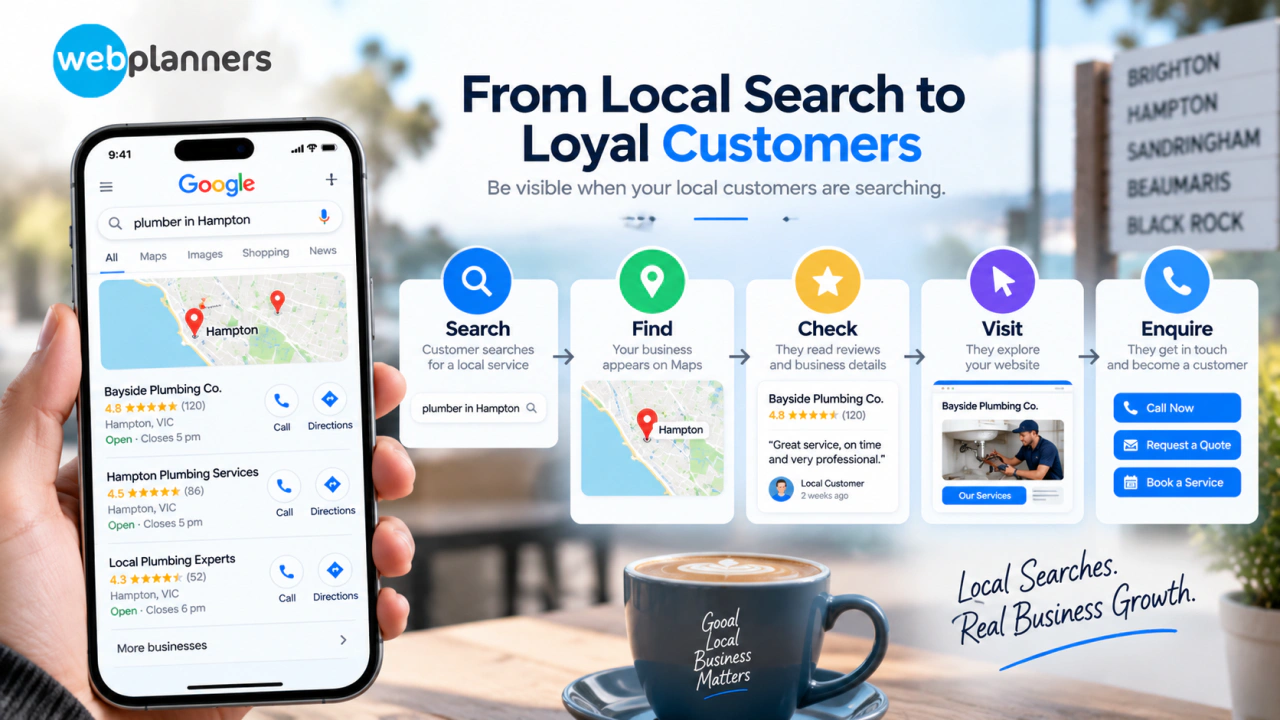
Local search does not stop at the website. A customer may search for a service and immediately see a map pack containing business names, locations, reviews, opening hours and other information.
That makes your Google Business Profile an important part of local visibility. Your business information should be accurate and consistent, including:
- Business name.
- Address or service area.
- Phone number.
- Business category.
- Opening hours.
- Services.
- Photos.
- Reviews.
- Website.
If your website performs well but your business information is incomplete or inconsistent across local listings, you may still miss valuable map-based searches.
We’ve previously looked at the issue, where we discussed why your business may be invisible on Google Maps, including the factors that can affect local map visibility.
Local Signals Should Agree With Each Other
Search engines use information from different places to understand a business.
Imagine your website says your business operates in Hampton, your business profile lists a different service area and several directories contain an old phone number.
That creates an inconsistent picture.
For a Bayside business, it is worth reviewing important local references and checking that the core information matches.
This includes:
- Website details.
- Google Business Profile.
- Relevant directories.
- Industry listings.
- Social profiles.
- Review platforms.
Quality and relevance matter more than trying to appear everywhere.
Don’t Stuff Suburb Names Into Your Content
This is one of the easiest ways to make local content feel unnatural.
A page that repeatedly says:
“Best service in Brighton, Brighton service provider, Brighton services and Brighton business…”
doesn’t become more useful because the location appears more often.
Search engines are better at understanding context than simple repetition suggests.
Instead, use location naturally alongside the service, customer needs and genuine business information. For example:
We offer residential electrical services in Brighton, Hampton and the surrounding Bayside suburbs and can schedule appointments for homeowners and property managers.
That communicates location, service and audience without forcing the keyword into every sentence.
Internal Linking Can Strengthen the Local Structure
Suburb pages should not sit alone. If your website has a main service page, supporting location pages and useful educational content, contextual internal links can help users move between related information.
For example, a Brighton service page could link to the main service page when discussing the broader offering. A useful local information page could then link back to the relevant service.
This gives visitors a clearer pathway through the website, and helps search engines understand how the pages are related to one another.
Reviews Add Local Context
Reviews are useful because they give potential customers proof from people who have already dealt with the business.
Reviews can also provide natural context around services and customer experiences for local businesses.
For local businesses, reviews can also provide natural context around services and customer experiences.
Local context is more helpful in a review like: “The team arrived at our Brighton property and completed the work quickly” than a generic review like “Great service”
Businesses should avoid creating fake reviews or ask customers to include specific keywords.
The priority should be genuine customer feedback.
What About AI Search and Local Visibility?
Local businesses now have another consideration: people can ask AI systems questions in conversational language.
Instead of searching:
“best landscaper in Brighton”
someone might ask:
“Who provides reliable landscaping services around Brighton for a large residential garden?”
The underlying business information still needs to be clear.
AI-powered search can benefit from information that clearly establishes:
- What the business does.
- Where it operates.
- Who it serves.
- What services it provides.
- Why the business is relevant.
This is one reason we increasingly consider AI alongside established search practices, without treating it as a replacement for the fundamentals.
For instance, AEO can support content designed around clear, answer-focused queries, while GEO addresses visibility within generative AI responses. The underlying local information still needs to be accurate.
AI Overviews and Local Search
Google’s AI-powered search experiences could change how users interact with search results.
Rather than immediately scanning a list of websites, a user might see a summary generated by AI and then choose where to look next.
For a local business, this makes clear and trustworthy information increasingly useful.
That means your website should communicate the basics well:
Service + location + expertise + supporting information.
There is no shortcut that guarantees inclusion in an AI Overview. Strong local foundations still matter, and our AI SEO services keep AI search visibility in mind as part of a broader strategy.
Turn Local Searches Into More Business Opportunities
A Practical Bayside SEO Checklist
Before you add more suburb pages, check out these aspects:
- Service area: Do your pages reflect your actual service area?
- Business profile: Is your Google Business profile up to date?
- Location pages: Does each page have valuable information?
- Reviews: Is the feedback from customers genuine?
- Internal links: Are related service and location pages linked naturally?
- Local references: Are your business information consistent?
- Content: Is your website providing real answers to real customer questions?
- AI Visibility: Is your business information clear enough for modern search engines to understand?
This gives you a better starting point than simply adding more suburb names to the website.
Conclusion
Bayside businesses don’t need to rank for every suburb in Melbourne. They need to be visible where their customers are actually searching.
That means understanding the service area, creating genuinely useful location content, maintaining accurate business information and building a website structure that connects services with the locations they serve.
For a business targeting Brighton, Hampton, Sandringham, Beaumaris, Black Rock or nearby suburbs, the strongest strategy is usually based on relevance rather than repetition.
At Webplanners, we use this principle when developing local SEO strategies: start with the business, understand its customers and locations, then build the search strategy around genuine opportunities. Get in touch with us to know how we can help your business grow online.
FAQs
Do I need separate pages for Brighton, Hampton and Sandringham?
Not automatically. Separate pages make sense when each location represents a meaningful service area and you can provide useful, location-specific information. Otherwise, one strong service-area page may be more appropriate.
Can a service-area business rank in suburbs where it has no physical office?
It can appear for relevant local searches, but local visibility depends on several factors. Businesses should accurately represent their service areas rather than creating the impression that they have physical premises where they do not.
How many Bayside suburbs should a local business target?
There is no useful fixed number. Start with the locations that matter commercially and where the business genuinely provides services. Search demand, competition and actual customer distribution can then help determine priorities.
Should I put suburb names in every page title?
No. Only use location words if they are truly descriptive of the page and relevant to the search intent. Adding every suburb to every title makes pages cluttered and repetitive.
Does local SEO only mean Google Maps?
No. Local SEO can include organic website visibility, Google Business Profile, local content, reviews, citations, location pages and other local signals. Maps are critical, but only one piece of the larger strategy
The post Melbourne Bayside SEO: How Local Businesses Can Win Suburb-Level Searches appeared first on Webplanners.
]]>The post How We Grew an RTO Client’s Organic Traffic by 658%: The Strategy Behind the Result appeared first on Webplanners.
]]>That was the position of one of our RTO resources clients.
The business had a relevant offering, but there was room to capture more of the searches its audience was already making. Instead of treating the campaign as a simple ranking exercise, we looked at the website from several angles: keyword opportunities, content quality, search intent, internal linking and authority.
The result was a 658% increase in organic traffic.
More importantly, the campaign shows what can happen when SEO activities work together instead of being handled as disconnected monthly tasks.
Webplanners increased organic traffic for an RTO resources client by combining targeted keyword research, useful content, stronger internal linking and relevant link building. Rather than relying on one SEO tactic, we connected these activities to improve the website’s search visibility and attract more relevant organic traffic.
Key strategy: Keyword targeting → Content → On-page optimisation → Internal linking → Authority building → Organic growth.
Where the Campaign Started
The client operates in the RTO resources and vocational education space. Search behaviour in this market can be highly specific.
Potential customers may search for a particular resource, training requirement, documentation or solution rather than a broad industry term.
At first, our review highlighted a number of areas for improvement on the website:
- Some pages were not well aligned to search intent.
- There was not full use of content opportunities.
- The site had opportunities to increase its authority.
- Relevance of organic traffic needed to be assessed.
- The navigation between related pages could be improved.
- The search terms that mattered weren’t being targeted well.
This gave us a clear goal: to identify the right search opportunities, build useful content around them and strengthen the ability of the website to compete.
Turn Search Visibility Into Business Growth
The SEO Strategy We Used
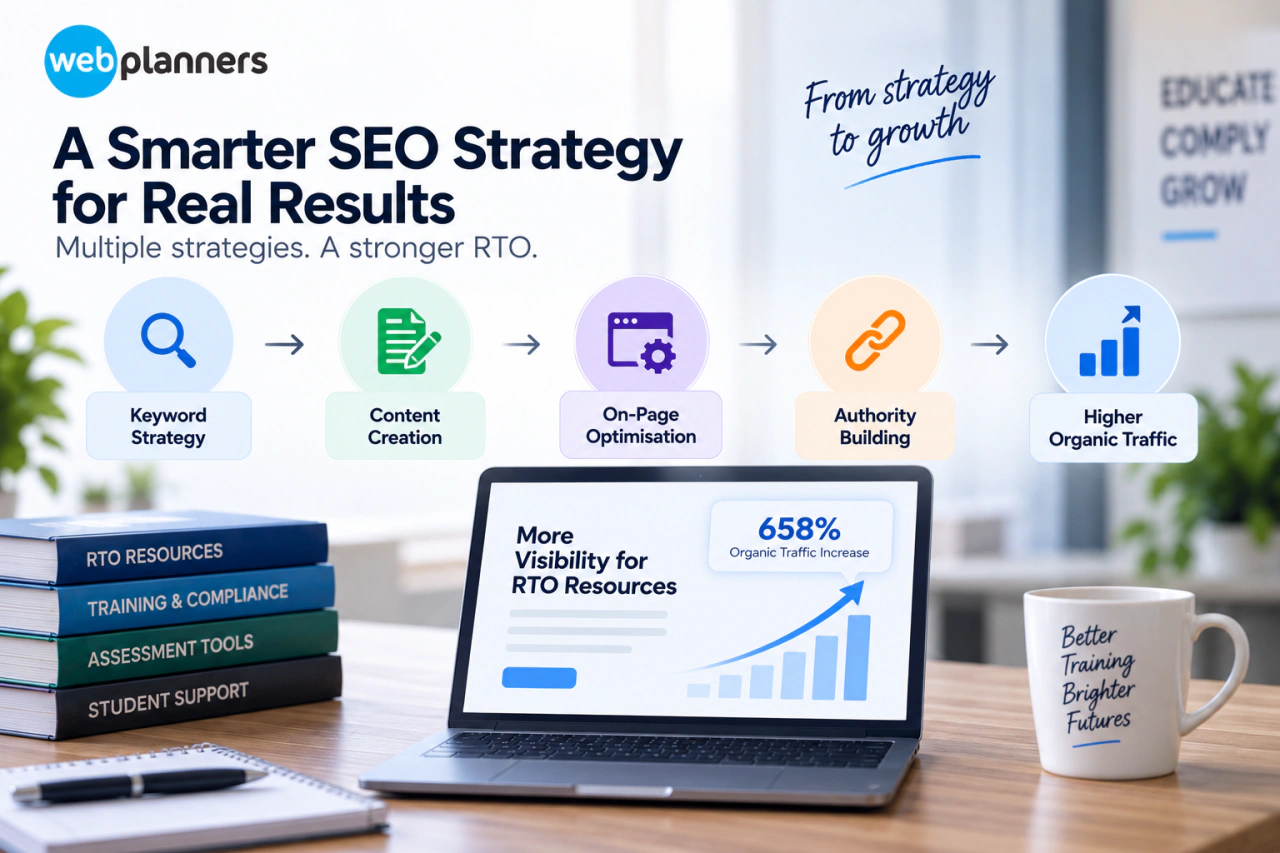
1. Advanced Keyword Strategy
So we began with keyword research, but it wasn’t just about finding terms with a high search volume.
We looked at:
- Search intent.
- Relevant long-tail searches.
- Commercial opportunities.
- Related search terms.
- Competitor keyword gaps.
- Existing pages that could be improved.
- New topics that needed dedicated content.
This helped us create a stronger connection between the search query, the user’s intent and the most appropriate page.
For an RTO resources provider, that distinction matters. A highly relevant search from someone looking for a specific resource can be more valuable than a broad term that attracts visitors with no commercial connection to the business.
This is also the foundation of our SEO services in Melbourne, where we assess the actual search opportunity before deciding what work should be prioritised.
2. We Built Content Around Actual Search Demand
Once the keyword opportunities were identified, we looked at the content needed to address them.
The objective wasn’t to publish content simply to increase the number of pages on the website.
Each piece needed to have a reason to exist.
We focused on content that:
- Added useful context.
- Backed up key commercial pages.
- Expanded coverage of relevant topics.
- Matched the intent behind relevant searches.
- Answered actual questions and information needs.
Knowledge gained from first-hand experience can be a real game-changer for specialist businesses . Generic content rarely replicates the industry experience and knowledge that an RTO resources provider has.
Our approach to content strategy follows the same principle: content should serve the audience while supporting the wider organic search strategy.
3. We Improved the Relationship Between Pages
Creating useful content is only part of the work.
We also considered how pages connected with one another.Someone early in their research may like an information page. That resource or solution might be found on another page. Logical internal linking can connect those stages and provide clearer signals to search engines on the relationship of related content.
We worked on :
- Internal links in context.
- Relevant anchor text.
- Reduce isolated content.
- Connections between supporting and commercial pages.
- Upgrading important pages with relevant supporting content.
This helped turn individual pages into a more cohesive website rather than a collection of individual URLs.
4. We Strengthened Website Authority
Content is king, but authority also matters too as it connects to improving organic visibility. We acquired quality links that were relevant to help support the authority of the website.
It was not about building up a ton of links from anywhere and everywhere. We considered relevance, quality and context.
This was part of a wider campaign that included keyword optimisation and content development rather than doing link building as a stand alone activity.
5. We Measured Growth Through Business Relevance
The headline result was a 658% increase in organic traffic.
But we didn’t treat the traffic figure as the entire definition of success. For an RTO resources provider, attracting people who are genuinely interested in the products and resources matters more than generating visits from unrelated searches.
So the strategy considered whether organic visibility was moving towards relevant search demand and the client’s commercial objectives.
This is an important distinction. More traffic can look impressive. Relevant traffic is what gives that growth business value.
What Changed as a Result?
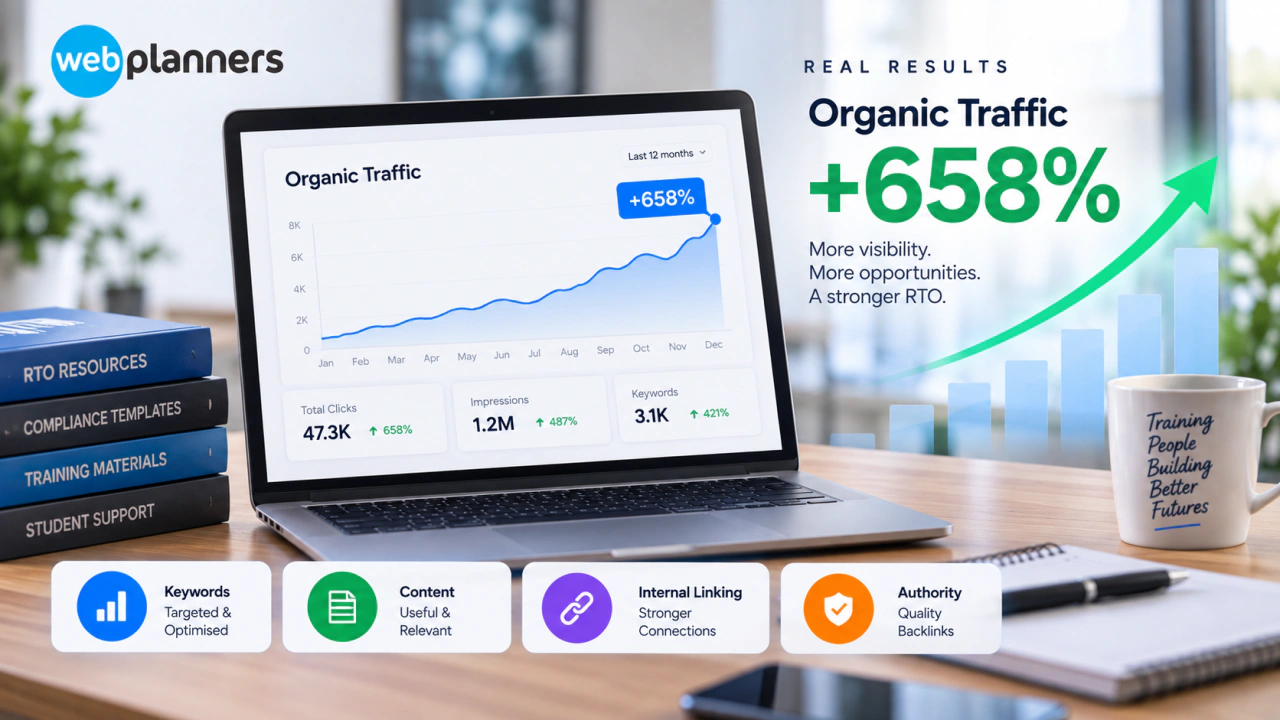
The campaign brought several SEO activities together:
| Area | What we focused on |
|---|---|
| Keyword research | Identifying relevant searches and search intent. |
| Content | Creating useful coverage around priority topics. |
| Internal linking | Building stronger connections between related pages. |
| Authority | Developing relevant, quality links. |
| SEO strategy | Keeping the work connected to business objectives. |
The result was a 658% increase in organic traffic for the RTO resources provider.
We have also seen substantial organic growth across other industries through different SEO strategies.
Our published case studies include businesses in areas such as retail, automotive, professional services and education, showing why we don’t apply exactly the same campaign structure to every client.
What Other RTOs Can Learn From This
The strategy behind this campaign isn’t a formula that every RTO should copy word for word.
The more useful lesson is how we approached the problem.
Start with real search behaviour
Understand the terminology customers actually use, including specific and long-tail searches.
Give important searches the right destination
A specific search should lead to a page that genuinely addresses the need behind that search.
Use your industry knowledge
RTOs have specialist knowledge, processes and experience. Bringing that into website content can make it more useful and distinctive.
Connect supporting content with commercial pages
A blog or resource page shouldn’t exist in isolation. Relevant internal links can help users move towards the information or solution they need.
Look beyond rankings
Rankings are important, but they should be considered in relation to organic traffic, relevant visitors, enquiries and other business outcomes.
How Modern Search Fits Into the Picture
SEO has also evolved past the standard blue link results. Search engines now have more direct answers and AI search experiences. Conversational systems can also provide suggestions and information to users.
That doesn’t mean traditional SEO is irrelevant. Strong technical foundations, useful content, clear site structure and relevant authority remain important.
We also consider newer search experiences where they make sense for a business. For example, Answer Engine Optimisation focuses on structuring useful information for answer-focused search experiences.
Separately, Generative Engine Optimisation addresses visibility within generative AI responses.
And for businesses looking at the wider use of AI within their search strategy, our generative AI services combine AI-assisted workflows with human review and strategic input.
These areas can support a modern SEO strategy, but they don’t replace the fundamentals that helped drive this RTO campaign.
Why We Don’t Use the Same SEO Strategy for Every Business
An RTO resources provider has a very different search market from a retailer, local service business or professional firm.
The starting point changes.
So do the competitors, search behaviour, content requirements and commercial priorities.
That’s why we begin by asking:
- What does the business sell?
- Who is searching for it?
- What are they searching for?
- Where is the website currently visible?
- Where are competitors gaining ground?
From there, we decide where the effort should go.
That could involve technical SEO, content, keyword research, internal linking, authority building or other work.
What Role Does AI Play in Our SEO Process?
We use AI to improve parts of the research and production workflow, but we don’t treat AI output as a finished SEO strategy.
AI can assist with areas such as:
- Keyword clustering.
- Topic research.
- Content gap analysis.
- Competitor research.
- Content briefs.
- Large-scale data analysis.
Our team then reviews the information, checks relevance and applies the business context.
That human-AI workflow is important because search strategy still requires judgement. AI can process information quickly, but it doesn’t automatically understand a client’s products, customers, competitive position or commercial priorities.
Build An SEO Strategy Around Real Search Demand
Conclusion
The 658% organic traffic increase was not the result of one shortcut. We combined keyword research, content, internal linking and authority building around the client’s actual search market. That is the bigger lesson from this campaign.
Good SEO starts with understanding the business and its customers, then deciding what the website actually needs.
If your RTO website isn’t attracting the organic visibility it should, get in touch with Webplanners.
As a leading SEO company in Melbourne, we will assess your current search performance and identify the opportunities that could have the greatest value for your business.
FAQs
Can an RTO increase organic visibility without publishing dozens of blogs?
Yes. More content isn’t always best. Better search intent alignment, on-page optimisation, internal linking and stronger topical coverage can offer significant opportunities within existing service and resource pages.
Should an RTO target broad education keywords?
Not always. Broad terms can be very competitive and may not indicate strong buying or enquiry intent. Commercial value can be found in specific searches for resources, solutions or information that an audience of RTOs requires.
How important are internal links for an RTO website?
This can be particularly useful when a site has many related resources and informational pages. Contextual links placed well help users move between related information and can give search engines a clearer understanding of how pages relate.
Can content produced by AI improve RTO’s SEO?
While AI may assist with research and content workflows, publishing AI-generated text alone doesn’t generate expertise or authority. RTO content must be accurate, relevant and business-specific and must be appropriately human-reviewed.
Should RTOs invest in local SEO as well?
That depends on your business model. Local SEO could be part of the broader strategy if the RTO caters for specific locations or depends on local searches. A national resource provider might have different priorities.
The post How We Grew an RTO Client’s Organic Traffic by 658%: The Strategy Behind the Result appeared first on Webplanners.
]]>The post Mastering Melbourne’s Digital Marketplace with E-Commerce SEO appeared first on Webplanners.
]]>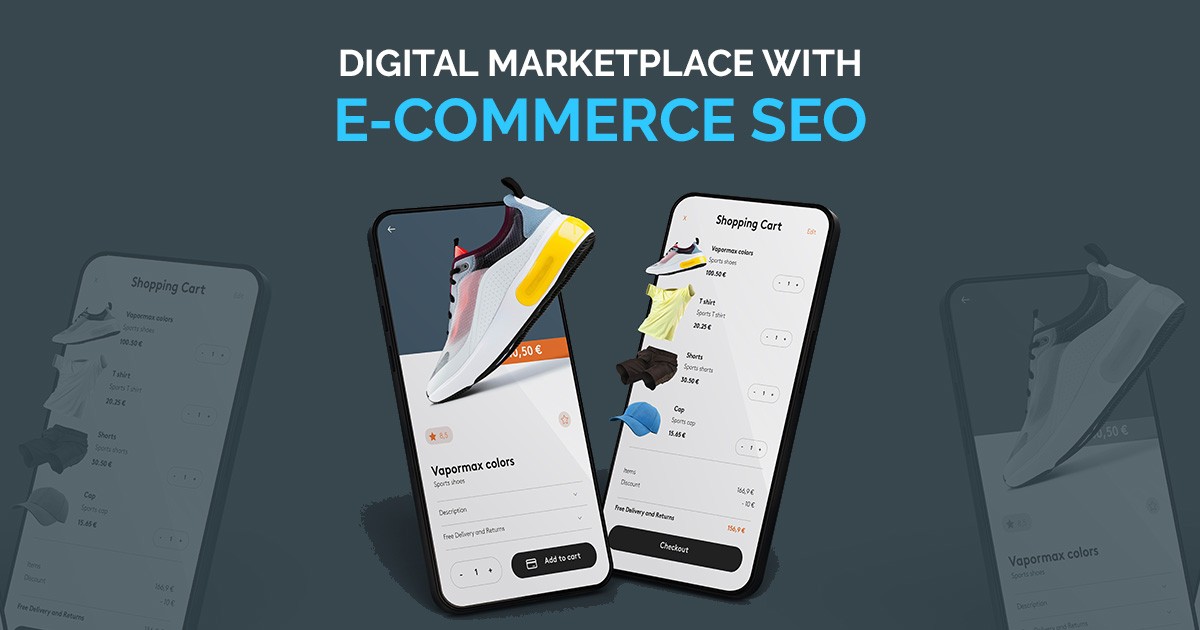
The internet marketplace has become a vital part of the city’s economic fabric in Melbourne, where culture meets commerce and innovation meets tradition. For this reason, mastering the art of SEO is not an option for e-commerce enterprises trying to succeed in this volatile industry – it is a requirement.
Therefore, today we’re going to dig deep into the benefits of SEO for e-commerce and how it may drive traffic to your online business. We’ll also discuss how Melbourne-based e-commerce businesses can grow their online presence by utilising local SEO strategies, with a special emphasis on services provided by companies such as Webplanners.
The Power of SEO for E-commerce in Melbourne
Increased Visibility and Organic Traffic
Visibility is critical in the expansive digital domain. E-commerce SEO is a strong approach for increasing the exposure of your online store on search engines such as Google, Bing, and Yahoo. When potential customers search for items or services connected to your company, a well-optimised website is more likely to rank towards the top of the search results, resulting in organic traffic.
Boosting Credibility and Trust
Customers are more inclined to trust websites that rank high on search engine results pages. SEO enhances not just the ranking of your website, but also its reputation. You may gain the confidence of your audience by employing SEO recommended practises such as improving meta tags, increasing site performance, and providing high-quality content. This enhances their chance of choosing your e-commerce business over competitors.
Locally Relevant Audience Targeting
Local SEO is a game changer for Melbourne-based e-commerce companies. By optimising your website for local search, you can ensure that your company appears in search results when users look for the products or services you provide. This focused strategy not only boosts the likelihood of gaining local clients, but it also forges a better bond with the community.
Improved User Experience
The user experience of any e-commerce website is vital to its success. SEO entails improving your site’s many aspects, such as page speed, mobile compatibility, and overall site structure. These enhancements improve the user experience by lowering bounce rates and improving the possibility of turning visitors into clients.

Driving Customers to Your E-commerce Site
Keyword Optimization
Keyword optimization lies at the core of effective e-commerce SEO. Researching and incorporating relevant keywords into your product descriptions, meta tags, and content helps your website align with the search queries of potential customers. Utilise tools like Google Keyword Planner to identify high-performing keywords with local relevance.
Compelling Product Descriptions and Content
Engaging and informative product descriptions not only improve your SEO but also encourage users to explore your website further. Craft compelling content that not only showcases your products but also provides valuable information that meets the needs of your target audience. Regularly updating your blog with relevant content can also contribute to improved SEO.
Mobile Optimization
Because mobile devices are becoming more popular, optimising your e-commerce site for mobile is no longer optional. Because Google prioritises mobile-friendly websites in their ranks, mobile optimisation is an essential component of e-commerce SEO. Make sure your website is responsive and delivers a consistent experience across all devices.
Local Citations and Google My Business
For Melbourne-based e-commerce companies, local rankings and a complete Google My Business page are important. Check that the information about your firm is up-to-date and consistent across internet listings. Encourage satisfied customers to leave good feedback on your Google My Business page, which will help with your local SEO efforts.
Maximising Potential with Local SEO in Melbourne
Understanding Melbourne’s Digital Ecosystem
Melbourne boasts a unique digital ecosystem shaped by its diverse population and vibrant business scene. To unlock the maximum potential of e-commerce SEO, businesses must understand the local market trends, consumer behaviours, and cultural nuances. Tailoring your SEO strategy to align with the preferences of the Melbourne audience can give you a competitive edge.
Leveraging Local Influencers and Partnerships
Collaborating with local influencers and businesses can significantly enhance your e-commerce SEO. Melbourne has a thriving community of influencers across various niches. Partnering with them for product reviews, collaborations, or sponsored content can amplify your online presence and drive traffic to your e-commerce site.
Participating in Local Events and Festivals
Melbourne is famous for its exciting events and festivals. Participating in or sponsoring local events provides an excellent opportunity to increase brand visibility and generate local buzz. Create SEO-optimised content around these events, leveraging relevant keywords and hashtags to capture the attention of the local audience.
Harnessing the Power of Social Media
Social media is important in today’s digital world, and Melbourne citizens are frequent users of sites such as Instagram, Facebook, and Twitter. By incorporating social media into your SEO strategy, you may increase your reach and engagement. To cultivate a loyal consumer base, create shareable content, conduct targeted social media marketing, and communicate with your audience.
Webplanners: Local Expertise for E-commerce SEO in Melbourne
To navigate the intricacies of e-commerce SEO in Melbourne, partnering with a local SEO agency like Webplanners can be a game-changing decision. Webplanners, based in Melbourne, specialises in providing tailored SEO services for businesses looking to dominate the digital marketplace.
Local Expertise and Understanding
Webplanners bring a deep understanding of the Melbourne market, allowing them to tailor their SEO strategies to the specific needs and preferences of the local audience. Their competent team stays up to date on the newest trends and developments in the digital scene, ensuring that your e-commerce firm stays ahead of the competition.
Comprehensive SEO Services
Webplanners offers a wide range of services to increase the visibility and performance of your e-commerce site, including keyword research and on-page optimisation, as well as off-page tactics and local SEO. They work together with customers to develop customised tactics that align with company goals and audience preferences.
Data-Driven Approach
Analytics and performance indicators are used by WebPlanners to continually update and improve their SEO methods. This iterative process ensures that your e-commerce site adapts to new algorithms and remains competitive in a digital environment that is always evolving.
Proven Track Record
Webplanners has a proven track record of success in guiding Melbourne-based businesses to reach and surpass their SEO goals. Client testimonials and case studies highlight their experience in delivering measurable results, cementing their position as a top resource for e-commerce SEO in the region.
Mastering the Melbourne E-commerce Landscape
To flourish, e-commerce enterprises need to leverage the power of SEO. SEO is a comprehensive approach which can maximise the potential of your online shop by increasing exposure and reputation, targeting local customers, and improving user experience. Businesses can brand themselves as industry leaders by identifying and responding to the unique features of Melbourne’s online marketplace.
Local companies’ knowledge, such as Webplanners‘, may have a significant influence for Melbourne-based e-commerce enterprises trying to better their SEO game. Webplanners, with our extensive knowledge of local customers and established track record, is a trusted partner to help businesses navigate the complexities of SEO and shine as leaders in the digital race.
Suggested Read: 5 Easy Steps to Improve Your Content for Search Engine Success
The post Mastering Melbourne’s Digital Marketplace with E-Commerce SEO appeared first on Webplanners.
]]>The post Why Is Digital Analytics the Key to Online Success in 2025? appeared first on Webplanners.
]]>Unearthing the Marvels of Digital Analytics
Picture this: You’re at the helm of an online business, sailing across the vast ocean of the internet. You have a dazzling website, top-notch products or services, and an eager crew (a.k.a. your team) ready to steer the ship. But wait! How do you know if you’re heading in the right direction? How can you chart your progress and steer clear of potential storms (a.k.a. pitfalls)?
Enter Digital Analytics, the celestial compass guiding you through the treacherous seas of the digital world. It empowers you to know who visits your website, where they come from, and what they do while there. With this wealth of information, you can make informed decisions to optimise your online presence and ensure a smooth voyage to success!
The Backbone of Decision-Making: Data-Driven Insights
Imagine you’re a wizard, and data is your magical potion. Data-driven insights are the secret recipe for your online business triumph. As the wisest wizards know, using gut feelings to make decisions is like trying to brew a potion with a blindfold on – it’s a recipe for disaster! Digital Analytics arms you with precise data, showing you what strategies work and which ones need a little more fairy dust.
Don’t underestimate the power of data! Let’s say you run an e-commerce website selling enchanted wands. By analysing your website’s data, you discover that most of your wand sales happen during the full moon (no surprise there!). Armed with this revelation, you decide to launch special full-moon sales events, and voilà – your wand sales skyrocket and your business thrives under the silvery glow!
The Perks of Playing Detective with Analytics
Sherlock Holmes had his magnifying glass, and you have Digital Analytics! Playing detective with analytics can unearth astonishing revelations about your online business. Ever wondered why your website’s bounce rate is as high as a beanstalk? Or perhaps you’re puzzled by the sudden drop in your conversion rates, leaving you scratching your head like a curious Cheshire Cat?
Fear not! Digital Analytics is here to solve the mystery. It allows you to delve into the heart of the matter, revealing why visitors bounce off your website like ping-pong balls or why they abandon their carts at the last minute. Armed with this knowledge, you can tweak your website, smooth out the user experience, and leave your visitors spellbound, ensuring they return like loyal subjects to a noble king!
The Journey from Good to Great: Optimisation
Remember the story of Goldilocks and the Three Bears? She tested everything until she found what was “just right.” Similarly, in the digital realm, optimisation is the key to finding that sweet spot where everything clicks like magic. Digital Analytics enables you to optimise your website, content, and marketing strategies for maximum impact.
With Digital Analytics by your side, you can perform A/B testing to see which version of your website design is preferred by visitors. It’s like having a potion that lets you peer into the minds of your audience! You can also analyse the performance of your marketing campaigns, discovering which platforms are enchanting your audience and which ones are casting duds.
The Power of Predictive Analytics: Gazing into the Crystal Ball
As the ancient seers gazed into crystal balls to glimpse the future, so does Predictive Analytics peer into the digital ether, foreseeing what lies ahead for your online business. Predictive Analytics uses past wisdom to predict future trends and outcomes. It’s like having a Time-Turner from Harry Potter, allowing you to make decisions today that will shape your success tomorrow.
By analysing historical data, Predictive Analytics can forecast which products or services will be in high demand, so you can prepare your inventory and marketing strategies accordingly. No more rushing to catch the tail of a trend! You’ll be riding the wave of popularity with grace and finesse like a surfing champion ruling the digital waves!
The Dance of Data Privacy and Customer Trust
Ah, data privacy! It’s like guarding the entrance to the Forbidden Forest, keeping your customers’ secrets safe from prying eyes and potential harm. While Digital Analytics offers a treasure trove of insights, handling data ethically and responsibly is essential. Trust is the foundation of any successful relationship, and the same holds true for your customers.
Respecting data privacy is not only morally right but also legally imperative. You don’t want to end up in a quagmire of legal trouble, do you? So, while you’re busy waltzing through data analytics, ensure you’re following the latest regulations like a law-abiding citizen.
Conclusion
Digital Analytics is the enigmatic wizard that holds the keys to the kingdom of online business success. It illuminates the path, reveals hidden opportunities, and transforms your business from a humble cottage to a grand castle. By harnessing the power of data, you can make informed decisions, optimise your strategies, and create a magical experience for your customers.
So, dear online business pioneers, it’s time to don your wizard robes and embrace the mystique of Digital Analytics. Let it be your guiding star as you embark on this thrilling adventure through the digital realm. Remember, the quest for online business success is no easy feat, but with Digital Analytics as your trusted companion, victory is within reach!
Embark on this journey today and unleash the full potential of your online business. With Digital Analytics as your ally, you’ll rise above the competition like a phoenix soaring high in the digital skies!
Suggested Read: Understanding the Timeframe of SEO Results: How Long Does It Take?
The post Why Is Digital Analytics the Key to Online Success in 2025? appeared first on Webplanners.
]]>The post Should You Hire a Local Digital Agency in 2025? appeared first on Webplanners.
]]>
In today’s digital age, businesses need to have a strong online presence to succeed. Digital marketing has become a crucial aspect of any business strategy, but it can be overwhelming for business owners to navigate on their own. That’s where a local digital marketing agency in Australia can help.
This article will explore the six benefits of using a local digital marketing agency in Australia.
- In-depth knowledge of the local market
A local digital marketing agency in Australia understands the nuances of the local market. They deeply understand the target audience, local trends, and cultural preferences. This knowledge allows them to create tailored marketing strategies that resonate with the local audience, leading to higher engagement and conversion rates.
- Personalised approach
Working with a local agency means you get personalised attention and a customised marketing plan that aligns with your business goals. They will take the time to understand your unique needs and challenges, enabling them to develop a strategy that is specifically designed for your business. This personalised approach ensures that your marketing efforts are targeted and effective.
- Quick and efficient communication
One of the key advantages of working with a local digital marketing agency is the ease of communication. Being in the same time zone and speaking the same language eliminates any potential language barriers or delays in communication. You can expect quick responses to your queries and timely updates on your marketing campaigns, ensuring a smooth and efficient working relationship.
- Local industry connections
A local digital marketing agency in Australia has established connections within the industry. They have relationships with local influencers, bloggers, and media outlets that can help amplify your brand’s reach. Leveraging these connections can lead to strategic collaborations and partnerships that can significantly boost your brand’s visibility and credibility.
- Insights into local competition
Understanding your competition is crucial for staying ahead in the market. A local digital marketing agency has valuable insights into the local competition landscape. They can analyse your competitors’ strategies, identify their strengths and weaknesses, and develop a competitive advantage for your business. This knowledge allows you to make informed decisions and stay one step ahead of your competitors.
- Support the local economy
You are supporting the local economy by choosing a local digital marketing agency. Small and medium-sized businesses are the backbone of the Australian economy, and partnering with a local agency helps fuel their growth. It allows you to contribute to the local business ecosystem and build strong community connections.
Partnering with a local digital marketing agency in Australia offers numerous benefits. From their in-depth knowledge of the local market to their personalised approach and industry connections, they can help your business thrive in the digital landscape. Additionally, the ease of communication and support for the local economy make them an attractive choice for businesses looking to enhance their online presence.
So, if you’re looking to take your digital marketing efforts to the next level, consider working with a local agency in Australia.

Why Choose Webplanners as your Local Digital Marketing Agency in Australia?
Choosing Webplanners as your local digital marketing agency in Australia brings a host of compelling advantages that set us apart as a trusted partner in driving online success. With a deep understanding of the Australian market landscape, we offer tailored solutions that resonate with local audiences.
Our team of experienced professionals blends creativity and technical expertise to craft data-driven strategies that yield tangible results. We prioritise transparency, ensuring our clients are well-informed about their campaigns’ progress through regular reporting and communication.
- Local Expertise: Webplanners boasts a deep understanding of the Australian market, enabling us to create strategies that resonate with local audiences, ensuring your digital campaigns align with cultural nuances and consumer preferences.
- Tailored Solutions: Our team of seasoned professionals crafts personalised strategies that cater to your unique business goals. We understand that a one-size-fits-all approach doesn’t work, and our customised solutions reflect this commitment.
- Proven Results: With a track record of successful campaigns, we deliver tangible results that drive growth. Our data-driven approach ensures that your investment translates into increased website traffic, higher conversions, and enhanced ROI.
- Comprehensive Services: From SEO and PPC to social media management and content marketing, Webplanners offers a comprehensive suite of services that covers every aspect of your digital presence. This holistic approach means you can consolidate your digital efforts under one roof.
- Transparency and Communication: We believe in keeping our clients informed every step of the way. Regular reporting and open communication ensure you’re always in the loop about your campaign’s progress, making us a trustworthy partner in your digital journey.

Our commitment to staying ahead of industry trends and technologies ensures that your strategies are always cutting-edge. With a client-centric approach and a proven track record, Webplanners is the optimal choice to propel your brand forward in the dynamic world of digital marketing.
Suggested Read: Understanding the Timeframe of SEO Results: How Long Does It Take?
The post Should You Hire a Local Digital Agency in 2025? appeared first on Webplanners.
]]>The post Nurturing Creativity Amidst the Digital Agency Hustle appeared first on Webplanners.
]]>
The rise of digital agencies has become increasingly evident, and with it comes the newfound importance of creativity. As one of the marketing agencies in Melbourne, we have experienced several struggles and we deduced that it is essential to understand and embrace the power of creativity and its impact on successful marketing campaigns.
Digital agencies have emerged as powerful players in the marketing industry, offering a wide range of services to assist businesses in reaching their target audience and achieving their goals. Like Webplanners, these agencies leverage digital platforms, innovative technologies, and creative strategies to create impactful and engaging campaigns that resonate with consumers.
That said, creativity plays a crucial role in capturing the attention of the ever-distracted and digitally savvy consumer. With the influx of content bombarding individuals every day, businesses must find unique and captivating ways to stand out from the crowd. This is where a digital agency’s creativity shines.
By infusing creativity into marketing strategies, digital agencies can craft compelling content, visuals, and experiences that not only capture attention but also leave a lasting impression on consumers. From eye-catching social media posts to visually stunning website designs, creativity is the driving force behind captivating an audience and establishing brand identity.
All the mentioned points actually highlight the growing importance of creativity in the field of marketing. In a fast-paced, technology-driven world, businesses need to harness the power of creativity to capture attention, establish brand identity, and build meaningful connections with their audiences – and that is essential for staying ahead of the competition and delivering impactful and successful marketing campaigns.
Understanding the challenges faced by digital agencies
Before we talk more about the relevance of creativity with the success of a digital marketing agency, let us discuss the elephant in the room – the challenges and struggles.
With constantly evolving technology and changing consumer behaviours, these agencies need to stay on top of the latest trends and strategies to create successful campaigns for their clients.
One of the main challenges faced by digital agencies is the need to constantly adapt and learn in order to keep up with the ever-changing digital landscape. They must stay updated on the latest algorithms and best practices for search engine optimization (SEO), social media marketing, pay-per-click (PPC) advertising, and other digital marketing techniques. This requires continuous training and a commitment to staying ahead of the curve.
Another challenge is the high level of competition in the digital marketing industry. With so many agencies vying for clients’ attention, it’s important for digital agencies to find ways to stand out and differentiate themselves. This can be achieved through offering unique services, providing exceptional customer service, and showcasing a successful track record of delivering results.
Managing client expectations is also a challenge faced day to day by marketing agencies. Clients often have high expectations for their campaigns and may expect immediate results. However, digital marketing is a long-term strategy that requires patience and continuous optimisation. This is why it is important to effectively communicate this to clients and set realistic goals and expectations from the start.
The role of creativity is the key to success
In a world where consumers have grown accustomed to the noise of traditional advertising, creativity acts as a beacon of authenticity. By pushing boundaries, thinking outside the box, and embracing innovative approaches, businesses can differentiate themselves and connect with their target audience on a deeper level. This connection is pivotal in establishing brand loyalty and cultivating long-lasting relationships.
Furthermore, creativity in digital marketing is not limited to visuals and design. It also extends to messaging and storytelling. Digital agencies understand the importance of crafting narratives that resonate with consumers’ emotions and values. By telling a compelling story, brands can create a sense of empathy and relatability, thus building trust and authenticity.

Creating a culture that fosters creativity and innovation
Digital marketers know that creativity is the lifeblood of their industry. It’s what sets them apart from the competition and helps them create impactful campaigns that resonate with their target audience. In order to foster this creativity, digital marketing agencies must maintain a good culture that promotes and celebrates innovative ideas.
1.Encouraging a growth mindset
This means having a belief that skills and abilities can be developed through dedication and hard work. By instilling this mindset within the team, digital marketers are more likely to take risks, think outside the box, and explore new strategies and ideas.
2.Providing autonomy and freedom
When individuals feel that their opinions are valued and respected, they are more inclined to contribute their ideas and expertise towards common goals. This synergy can result in the generation of unique and impactful strategies that benefit clients and drive success for the agency.
3.Creating a collaborative environment
A collaborative environment allows digital marketers to pool their expertise and knowledge, working together to come up with unique solutions and strategies that can give their clients a competitive edge. By leveraging the diverse perspectives and skills of team members, agencies can develop innovative marketing campaigns that resonate with their target audience and drive meaningful results.
4.Celebrating and rewarding creativity
When agencies prioritise celebrating and rewarding creativity, they create an environment where team members feel encouraged to think outside the box and take risks. This not only empowers individuals to come up with unique ideas but also creates a sense of ownership and pride in their work. Recognizing and honouring creative thinking boosts morale and motivates employees to continue pushing boundaries.

Building a foundation for innovative excellence
It is imperative for businesses to build a strong foundation for innovative excellence. By embracing and implementing effective SEO strategies, businesses can truly thrive and make a significant impact in the online landscape.
1.Investing in continuous learning and development
This means keeping a close eye on emerging technologies, platforms, and techniques that can help you reach your target audience more effectively. Whether it’s staying updated on the latest social media algorithms or understanding the power of artificial intelligence and data analytics, being willing to learn and adapt is crucial in this field.
2.Embracing experimentation and risk-taking
Trying new approaches and stepping out of the comfort zone is essential for growth and discovering what truly works. By taking calculated risks, digital marketers can push boundaries and uncover innovative methods that may not have been explored before.
3.Incorporating creativity into performance evaluations and goals
This can be achieved by setting objectives beyond mere numbers and metrics and considering the creative approach, originality of ideas, and the ability to think outside the box.
By recognising and rewarding creative thinking in performance evaluations, businesses encourage their digital marketers to push boundaries and explore new avenues for growth.
Nurturing creativity in day-to-day operations
Nurturing creativity allows digital marketers to break through the noise and capture the attention of their target audience in refreshing and exciting ways. It enables them to find unique solutions to challenges, whether it’s developing a new marketing campaign, creating engaging content, or designing user-friendly websites.
1.Design thinking and ideation sessions
By adopting design thinking principles and conducting ideation sessions, we can tap into their creative potential, develop innovative solutions, and connect with their audience on a more meaningful level.
2. Cross-functional collaboration and brainstorming
By bringing together experts from different departments, such as marketing, design, development, and content, a diverse range of perspectives is gathered. This collaborative approach brings together individuals with unique skill sets and experiences, sparking creativity and innovation in brainstorming sessions.
The importance of nurturing creativity in the digital agency hustle
Nurturing creativity within a digital marketing agency is vital. It fuels innovation, fosters collaboration, and sets brands apart from the competition. By valuing and encouraging creativity, digital marketers can unleash their full potential and achieve remarkable results for their clients.
Suggested Read: Turn your Blog Content into an Organic Search Conversion Funnel
The post Nurturing Creativity Amidst the Digital Agency Hustle appeared first on Webplanners.
]]>The post 9 Tips to Master the Instagram Algorithm in 2025 appeared first on Webplanners.
]]>
The Instagram algorithm is constantly evolving, and in 2023 it will be more important than ever to stay ahead of the curve. As a business or individual user, understanding how to hack the algorithm can give you an edge over your competition. The overall purpose of the algorithm is to keep people engaged and on the platform, so if you can create content that does this, you’ll be rewarded with higher visibility.
There are several ways to hack the Instagram algorithm in 2023.
- Instagram Post frequency and consistency
- Push Harder on Reels
- The Unipeg Strategy
- Value your Audience
- Hashtag and Caption Quality
- Create Carousels
- EngageYour Audience with Stories
- Use the correct Formatting
-
Instagram Post frequency and consistency
Posting frequently and consistently is essential for growing your Instagram account. The more you post, the faster you can grow your audience. However, it’s important to be consistent with your posting schedule.
If you post 10 times one day and then only twice the next, the Instagram algorithm won’t like that. It wants to see a consistent pattern of posts. A good starting point is to post once a day, every day.
You may be tempted to do more than that, but it’s best to take things slow and gradually increase your posting frequency as you gain more followers.
Consistency is key when it comes to growing an Instagram account, so make sure you stick to a regular schedule of posts in order to maximise your growth potential.
-
Push Harder on Reels
Reels have become an essential part of Instagram’s growth in recent months. With the success of TikTok, Instagram has been quick to jump on the bandwagon and offer its own version of short-form videos. It’s hard to say whether this trend will last, but for now, it’s important to focus your energy on creating engaging Reels content.
- The goal is to stop the scroll and capture people’s attention with creative content that stands out from the rest.
- The great thing about Reels is that you can take what you already know about creating content for TikTok and apply it to Instagram as well.
- You don’t need to reinvent the wheel when it comes to producing content – just use what works and double down on Reels!
- Experiment with different ideas, formats, and styles until you find something that resonates with your audience.
With a little bit of creativity and effort, you can create content that will help you stand out from the crowd and grow your following on Instagram.
-
The Unipeg Strategy
The Unicorn Strategy is a simple yet effective way to grow an Instagram account from zero to millions of followers. It involves “imitation is the sincerest form of flattery”, or in other words, following the trends.
This strategy can be broken down into three easy steps:
- look at someone else’s account that you want to be like,
- analyse their top-performing posts and
- think about how you can create it better.
By looking at someone else’s successful account, you can get an idea of what kind of content works best for your target audience. You can then use this knowledge to create your own unique content that stands out from the rest.
Additionally, by analysing their top-performing posts, you can gain insight into what type of content resonates with your audience and tailor your content accordingly.
Finally, by thinking about how you can create it better than the original post, you can ensure that your content stands out from the crowd and attracts more followers.
-
Value your Audience
Treating your audience like gold is essential when it comes to building a successful Instagram presence.
- It’s important to respond to every like, comment, and DM you receive to show your followers that you value their engagement.
- Take the time to visit their profiles and interact with their content as well. This will not only help you create genuine relationships with your followers, but it will also get the Instagram algorithm working in your favour.
- It’s easy to forget that there’s a person behind every username and comment on Instagram, but it’s important to remember this when interacting with your audience.
- People get excited when brands (even small, local brands) interact with them, so make sure you take the time to engage with them in meaningful ways.
Doing so will encourage them to like, comment, and share more of your content which will ultimately help grow your following and keep users engaged on the platform longer.
-
Hashtag and Caption Quality
When it comes to hashtags and captions on Instagram, quality is critical. The algorithm rewards posts that use relevant hashtags and engaging and exciting captions. To ensure your posts get the most visibility, it’s essential to research trending hashtags and focus on using five of them for each post.
- It’s also a good idea to switch up the hashtags you use every 30 days so that you can track which ones are performing best.
- This will help you refine your hashtag strategy over time and ensure that your content reaches the right audience.
- Additionally, make sure your captions are well-written and creative, and provide value to your followers.
- Captions should be concise yet informative, as this will help draw people in and encourage them to engage with your content.
By following these steps, you can maximise the reach of your posts and build a strong presence on Instagram.
-
Create Carousels
Instagram carousels are a great way to engage your audience and provide value. They allow you to post multiple images or videos in one post, which can be used to tell a story or expound on thought in more detail.
To create an effective carousel, it’s important to make sure that the images flow together smoothly and that there is a clear connection between them.
- You can also use carousels to showcase diversity in your feed by mixing them with other posts, such as Reels.
- When creating carousels, it’s important to avoid posting disjointed pictures that don’t have any connection between them.
- Instead, focus on telling a story from start to finish or providing more detail about a particular topic.
- This will help ensure that your audience is engaged and interested in what you have to say.
Using carousels gives you additional opportunities to earn likes and comments from your followers, so make sure you take advantage of this feature!
-
Engage Your Audience with Stories
Instagram Stories are a great way to nurture your audience and build relationships with them.
- By creating stories that are interesting and engaging, you can draw in new followers and keep existing ones coming back for more.
- Stories also play an important role in the Instagram algorithm, so it’s important to use them strategically to get the most out of your content.
- When creating stories, think about what kind of content your followers would be interested in seeing.
- You can post behind-the-scenes footage, share tips or advice related to your industry, or even just give a glimpse into your day-to-day life.
- Whatever you choose to post, make sure it’s something that will capture their attention and keep them engaged.
This is a great way to foster relationships with your audience and build loyalty over time.
-
Use the Correct Formatting
Using the correct formatting for your Instagram content is essential for getting the most out of your posts. Not only does it make your content look more professional, but it also helps to ensure that Instagram’s algorithm will favour your content.
If you don’t use the proper sizing, the algorithm could penalise you and have a lower reach than you would otherwise.
When creating a square or vertical image, there are specific sizes that Instagram recommends.
- For static square images, they suggest 1080px x 1080px (1:1).
- For stories and reels, they suggest 1080px W x 1920px H (9:16).
By following these guidelines, you can ensure that your content looks great and has a better chance of being seen by more people.
Proven tips for getting the Instagram algorithm to work in your favour:
- First, use hashtags strategically to increase your reach and engagement.
- Second, post consistently and optimally when your followers are most active.
- Third, focus on creating quality content that resonates with your audience and encourages them to interact with it.
- Fourth, use stories to engage with your followers and build relationships with them.
- Fifth, experiment with different posts, such as videos or polls, to keep things fresh for viewers.
- Sixth, leverage influencers who have a large following on Instagram to help promote your content.
- Seventh, take advantage of features like IGTV or Reels for longer-form content that can help boost engagement levels even further.
- Finally, use analytics tools such as Panoramiq Insights, Squarelovin, io, and Keyhole to track performance metrics and optimise the future.
Conclusion!
The Instagram algorithm doesn’t work in the way that it used to. It’s gone from being a chronological timeline to being a shadow of its former self. Thankfully, there are ways around the algorithm, and you can use them to your advantage. Some are simple, others are not, but all of them can help get you the desired results.
So there you have it!
A few helpful tips to put Instagram in your favour. Remember that no top bar is the same, and what works well for friends might not pull a ton of viewers on your profile. But if you apply these settings to your account and see what works and doesn’t, you can adjust as needed until you find that sweet spot.
Suggested Read: How the Facebook Algorithm Works in 2023?
The post 9 Tips to Master the Instagram Algorithm in 2025 appeared first on Webplanners.
]]>The post Stop Sweeping it Under the Rug – Uncovering your Niche Advantages Even in Dull Markets appeared first on Webplanners.
]]>
In the world of business, finding a niche market can be the difference between success and failure. A niche market is a specialised segment of a larger market that has unique needs, preferences, or characteristics. Companies that cater to a niche market can differentiate themselves from competitors and build a loyal customer base.
In today’s competitive environment, targeting a niche market can be a smart and profitable move for businesses. A niche market offers the potential for greater profits due to decreased competition and a more focused ability to target customers efficiently. A company will also have fewer competitors in a niche market, leaving them with the opportunity to charge higher prices than their competitors as well as offer specialised products or services that appeal to their specific customer base. Furthermore, focusing on a niche market allows for better understanding of customer wants and needs, meaning that companies can not only cater to their customers better but also develop stronger relationships with those customers over time.
What to take into consideration when choosing your target audience for your niche market:
Companies need to determine exactly which types of customers they want to serve and concentrate on strategically positioning themselves in the marketplace so that they become the go-to provider in that particular segment. It is important for businesses to research what kind of needs are not currently being met in the industry and find ways they can provide unique offerings or solutions. It is also essential for companies operating in a niche market to understand their specific competitors’ strengths and weaknesses so they can maximise the benefits of entering this segment while minimising threats from competing brands.
Targeting a niche market requires commitment, creativity, research and patience but it can pay off by allowing companies to capitalise on an untapped segment of potential consumers as well as stand out from conventional competitors who serve larger markets.
Take note though that in some industries, it can be challenging to identify a niche market, particularly in dull or oversaturated markets. But rather than getting discouraged over it, businesses can uncover their niche advantages in even the most boring of markets.

Here’s what you can do:
The first step to uncovering niche advantages is to identify the unique needs and preferences of the target market. In a dull market, it may be challenging to differentiate between products or services. However, by conducting market research and analysing customer feedback, businesses can uncover the pain points and unmet needs of their target audience. For example, a dry-cleaning business may seem like a dull market, but by identifying the unique needs of its customers, such as quick turnaround times, convenience, or eco-friendliness, the business can differentiate itself from competitors and attract a loyal customer base.
The second step is to leverage technology and innovation to improve the customer experience. In dull markets, customers may be accustomed to a certain level of service or quality. However, by introducing new technologies or processes, businesses can exceed customer expectations and differentiate themselves from competitors. For example, a landscaping company may seem like a dull market, but by using drone technology to provide detailed property assessments, the company can offer a unique service that sets it apart from competitors.
The third step is to build a strong brand identity that resonates with the target market. In dull markets, businesses may struggle to differentiate themselves from competitors, but by creating a unique brand identity, businesses can build a loyal customer base. This can be achieved through branding, marketing, and storytelling. For example, a furniture store may seem like a dull market, but by telling the story of how its furniture is sustainably sourced and handcrafted by local artisans, the business can build a strong brand identity that resonates with environmentally conscious customers.
Businesses in dull or oversaturated markets should not give up on finding their niche advantages. By identifying the unique needs and preferences of their target market, leveraging technology and innovation, and building a strong brand identity, businesses can differentiate themselves from competitors and build a loyal customer base. The key is to stop sweeping it under the rug and start uncovering the opportunities that exist within even the most mundane of markets.
Inbound Marketing Services Melbourne
If all of these is a bit too much to handle, you can always avail of inbound marketing services from a reputable company in Melbourne.
Webplanners is a digital marketing agency that specialises in inbound marketing for businesses looking to differentiate themselves in dull or oversaturated markets. With years of experience in the industry, we have helped numerous businesses find their niche advantages and build a loyal customer base.
By providing value to customers through informative content, engaging social media posts, and personalised experiences, businesses can build trust and credibility with their target audience through inbound marketing.
Let us help you uncover your business’ niche advantage and build a loyal customer base. Contact us today for a consultation.
The post Stop Sweeping it Under the Rug – Uncovering your Niche Advantages Even in Dull Markets appeared first on Webplanners.
]]>The post How Facebook’s 2025 Algorithm Impacts You appeared first on Webplanners.
]]>
The Facebook algorithm is constantly evolving, and in 2023, it’s more important than ever to understand how it works. The algorithm determines what content is seen by users, so if you want your posts to be seen, you need to know how to make the algorithm work for you.
The average organic Facebook Page post only sees a small amount of engagement, so if you want your posts to be seen by more people, you need to signal the algorithm that your content is valuable and authentic. This can be done through various tactics, such as using relevant hashtags, creating engaging visuals, and writing compelling captions to draw readers in.
Additionally, it’s essential to post regularly and consistently so that the algorithm knows your content is worth serving up in followers’ feeds.
By understanding the Facebook algorithm and taking steps to make it work for you, you can increase engagement on your posts and get more eyes on your brand.
What is the Facebook algorithm?
The Facebook algorithm is a complex system that determines what posts people see when they check their feeds. It evaluates each post, assigns it a score, and then arranges the posts in descending order of interest for each user. This process happens every time someone refreshes their feed, and with 2.9 billion users worldwide, it’s an essential part of how Facebook works.
Unfortunately, we don’t know all the details of how the algorithm decides what to show people and what not to show them. However, it’s likely that, like other social media recommendation algorithms, one of its goals is to keep people on the platform so that they can be exposed to more ads.
This means that posts from friends and pages you interact with most often are more likely to appear at the top of your feed than those from less active accounts or pages you don’t follow.
How does it work?
In 2023, the Facebook algorithm has evolved significantly from its early days. The News Feed is no more replaced by a new feature called Feed.
This feature is designed to show users meaningful and informative stories based on three main ranking signals.
- Firstly, content from sources you interact with most often will be prioritised in your Feed. This includes friends and businesses alike.
- Secondly, the type of content you engage with most often will also be given priority – so if you watch many videos, you’ll see more content in your Feed.
- Finally, the algorithm considers how much time you spend engaging with certain types of content – so if you spend a lot of time watching videos or reading articles, those types of posts will appear more frequently in your Feed.
Overall, the Facebook algorithm in 2023 will give users a personalised experience tailored to their interests and preferences.
By taking into account who posted it, what type of content it is, and how much time they spend engaging with it, the algorithm can provide users with both meaningful and informative stories – helping them stay connected to what matters most to them.
Tips for working with the Facebook algorithm.
- Understand what your audience wants to see.
- Create accurate and authentic content.
- Don’t try to manipulate the algorithm.
- Engage with your audience.
- Get your audience to engage with each other.
- Make the most of Facebook Stories and (especially) Reels.
- Don’t forget the basic status post.
- Expand your reach via your best advocates.

Understand what your audience wants to see.
Understanding what your audience wants to see is critical to creating content that resonates with them. Facebook has indicated that it prioritises content that is “meaningful and informative”, but what does this mean exactly?
Meaningful content are stories the user will want to talk to friends and family about or spend time reading and videos they want to watch. Informative content is something someone will find “new, interesting, and informative” which will vary by user.
In order to create meaningful and informative content for your specific audience, you need to understand their unique interests and behaviours. This means doing some audience research.
Once you understand who your audience is and what they want from you, creating meaningful and informative content becomes much easier for them.
Create accurate and authentic content
Creating accurate and authentic content is essential for success on Facebook. People on the platform value honest and trustworthy posts, so it’s important to ensure your content meets these standards. To signal to the algorithm that your content is accurate and authentic, start by writing clear headlines that accurately describe what users will find in your post. Don’t use clickbait or misleading titles; instead, be truthful and don’t sensationalise, exaggerate, or lie.
When creating content for Facebook, it’s important to remember that people on the platform value accuracy and authenticity. Posts that are considered genuine will rank higher in Feed than those deemed as misleading, sensational, or spammy. To ensure your posts meet this criterion, avoid clickbait titles and make sure you tell the truth in your posts.
Additionally, write clear headlines that accurately describe what users will find in your post, so they know exactly what to expect when they click through. Following these tips can help you create content that resonates with people on Facebook while also helping you reach more of them organically.
Don’t try to manipulate the algorithm
It is important to understand how the algorithm works in order to create content that resonates with your audience and sends positive ranking signals to the algorithm. This means figuring out what Facebook values for its users and then creating content that meets those criteria.
However, it is important not to try and manipulate the algorithm in order to get more distribution than your content merits. This includes paying for engagement or comments or engaging in other black-hat strategies such as buying followers or likes.
Manipulating the algorithm can have serious consequences, including getting your account suspended or even banned from Facebook. It is also important to remember that algorithms are constantly changing, so any manipulation tactics you use today may not be effective tomorrow.
The best way to ensure success on Facebook is by creating quality content that resonates with your audience and provides value. Doing this will help you build an engaged following over time without resorting to manipulating the algorithm.
Engage with your audience
Engaging with your audience is essential to any successful social media strategy. The algorithm prioritises posts from Pages that a user has interacted with in the past, so it’s important to make sure you’re responding to comments and messages in a timely manner.
If someone takes the time to comment on your post, don’t waste the opportunity – make them feel heard with a reply, and they’ll be more likely to continue engaging with your content in future. This sends positive engagement signals to the algorithm, which will help boost your visibility and reach.
On the other hand, if you ignore comments or messages, it sends a signal that you don’t care about what people have to say, and they are likely to go silent in return. So take advantage of every opportunity you get to engage with your audience – it could mean the difference between success and failure!

Get your audience to engage with each other
Getting your audience to engage with each other is a great way to increase the reach of your content and get more people talking about it. By encouraging users to share and discuss your content with their friends, you can send a signal to the algorithm that your post is valuable and worth showing again. This “action-bumping logic” can help boost the visibility of your post and get it seen by more people.
To encourage engagement, you should create content that sparks conversation. Ask questions, start debates, or provide interesting facts that will make people want to comment or share their thoughts. You can also use polls or surveys to get feedback from your followers and generate discussion around a topic.
Additionally, responding quickly to comments on your posts will show users that you value their input and are interested in engaging with them. With these strategies in place, you can create an active community around your content and reap the rewards of increased visibility on social media platforms.
Make the most of Facebook Stories and (especially) Reels
Facebook Reels and Stories offer a great way to bypass the main News Feed algorithm and reach new audiences. Reels, in particular, has seen rapid growth since its launch in February 2022, with Facebook noting that it is their fastest-growing content format by far. This makes it an important part of any social media strategy if you’re looking for new eyeballs.
Reels and Stories live in a separate world from the main News Feed algorithm, appearing in tabs at the top of Feed above all other content. This means they are more likely to be seen by people who don’t already follow you or your brand.
With half of all time spent on Facebook and Instagram watching videos, creating engaging content for these platforms can significantly increase your reach and engagement.
Don’t forget the basic status post
Status posts are often overlooked when it comes to boosting engagement on social media, but they should not be underestimated.
According to Hootsuite’s Global State of Digital 2022 report, status posts have the highest engagement rate at 0.13%, followed by photo posts at 0.11%, videos at 0.08% and link posts at 0.03%.
This means that even though video content is essential for engaging with your audience, don’t forget about the power of a simple status post.
Status posts can be used to share updates about your business or organisation, ask questions to engage with your followers, or provide an update on what you’re up to. They also spark conversations and create a sense of community among your followers.
So don’t forget the basic status post when trying to increase engagement on social media – it could make all the difference!
Expand your reach via your best advocates.
Employees are one of the best advocates for expanding your reach on Facebook. They have more credibility and authority with their own followers and friends, which can help boost your brand’s visibility in the algorithm.
To make it easier for employees to share pre-approved content, you can use a calculator that crunches the numbers on their potential reach when they’re empowered to share your brand’s content.
Affiliates are another great group of advocates that can help expand your reach and build your brand’s credibility. Give them resources and training to help them spread the word on Facebook and extend your targeted audience through their own algorithm signals.
This will allow you to tap into new audiences while also leveraging existing relationships with affiliates who already have an established presence on the platform.
By providing them with the right tools and support, you can ensure that they are able to effectively promote your brand in a way that resonates with their followers.
Suggested Read: Maximising ROI by Integrating Social Media, SEO and Google Analytics Strategies
The post How Facebook’s 2025 Algorithm Impacts You appeared first on Webplanners.
]]>The post Does Google Penalize Similar-Looking Sites? appeared first on Webplanners.
]]>
Having duplicate content on the website is a common practice and it’s not considered spamming or black hat SEO techniques. But, if you are using the same keywords in your meta description tags for multiple pages, then that will be penalized by Google.
Google has recently announced that it will start to penalize websites with duplicate content. This means that if you have more than one page with the exact same content, such as an About Us page and Contact Us page, then Google may consider this as “spam” and lower your rankings.
Why does Duplicate content matter?
Duplicate content can present three major issues for search engines: They don’t know which versions to index; they don’t know whether to treat each version separately or combine them into one document; and they don’t know how to assign trust, authority, anchor text, link equity, etc., to each version.
The good news is that there are ways to solve each issue individually. First, you can use canonical URLs to tell search engines which version of a page is most authoritative. Second, you can use 301 redirects to redirect traffic from old URLs to newer ones. Third, you can use rel-alternate tags to indicate where a URL points to within another site. Finally, you can use to index meta tags to prevent search engines from indexing certain versions of a page.

How To Fix Duplicate Content on Your Website?
Fixing duplicate content issues all comes down to the same central concept: specifying which of the copies is the “correct” version. If you don’t specify what the correct copy is, search engines might think both versions are equally valid.
There are three primary methods for doing this:
- Using a 301 redirection to the correct URL,
- adding the rel”canonical” tag to the original page, or
- using the Meta Robots Noindex
301 Redirects:
The best way to combat duplicate pages is to set up a permanent redirect from the duplicate page to the original content. A 301 redirect tells Google that the old URL no longer points to the same resource it used to.
Rel=”canonical”
The rel”canonical” tag helps combat duplicate content problems. A common problem occurs when there are multiple versions of a single webpage. For instance, let’s say you run a blog about dogs and another person runs a different blog about cats. Both blogs contain dog pictures and both contain cat pictures. If one of those bloggers decides to add a picture of a cat, he or she might end up creating a duplicate page. In addition, if one of those blogs gets linked to by a third party, that third party could mistakenly believe that the page containing the cat image belongs to the other blogger.
As a result, each page will receive credit for the same number of links and PageRank, and no one will confuse the two sites.
Meta Robots Noindex
The meta robots tag allows search engine crawlers to know what to do when crawling a particular webpage. In fact, it’s one of the most powerful tools you can use to deal with duplicate content problems. You might think that having multiple copies of a single page on your site is no big deal. After all, you already have plenty of other ways to optimize your content to ensure people find it easily. But there are some cases where duplicate pages can actually hurt your rankings.
For example, imagine that you have several different versions of a product page, such as a mobile version, a tablet version, and a desktop version. If you don’t tell search engines about these variations, they’ll treat all three pages as duplicates of one another, and they won’t rank them differently. This could mean that your mobile and tablet pages aren’t getting much traffic.

So how exactly does the meta robots tag work?
Well, let’s say that you want to exclude a certain category of pages from being indexed. Say you have a page named /products/iPhone-5c/. This tells Google to ignore this page while crawling your site but to include it in its index.
Now, if someone searches for the term “iPhone 5c,” Google will return the URL for your products page along with a link to the iPhone 5C page, but it won’t show up in the search results.
The meta robots tag allows search engines to crawl the links on a page but keeps them from including those links in their indices.
Each method has pros and cons, and there isn’t necessarily a single best way to approach fixing duplicate content issues. However, each method offers different benefits depending on your situation.
If you want to avoid having duplicate content on your site, there are some things you can do:
1) Use different titles for each of your pages.
2) Make sure that all of your pages use unique meta descriptions.
3) Include a unique URL for each page.
4) Don’t repeat any text across multiple pages.
5) Create new content for each page.
6) Write unique content for each page.
If you want to avoid getting penalized by Google, then make sure that all of your pages have unique content. You can use tools like Copyscape (add nofollow tag) to check whether there are any duplicates.
Help Google choose the right canonical URL for your duplicate pages
Google makes sure that every page it crawls has a unique URL. This helps ensure that no one else is indexing the same information twice. However, sometimes you’ll find yourself in a situation where there are several URLs pointing to the exact same page. For instance, maybe you’ve built a responsive site that includes a mobile and desktop version of each page. Or perhaps you’re working with a CMS that allows you to build separate pages for each device type. In either case, it’s possible that you could end up with duplicate pages indexed by Google.
If you have a single page accessible by multiple URLs, such as /home/about us/, Google will choose one URL as the “canonical” version, and crawl that, and any other URLs will be seen as duplicates. So what happens when Google finds a duplicate URL?
The answer depends on whether you’ve told Google which URL is canonical. If you haven’t, Google will choose one URL itself. But if you do that, Google won’t use the canonical URL as a reference point when crawling your site. Instead, it will treat them both as equally important.
In some cases, however, you want Google to pick one URL over another. Maybe you want to rank high for queries like “how to write a resume.” Or maybe you just want to avoid duplicate content penalties. In those situations, you should tell Google which URL is canonical.
What is a canonical URL?
A canonical URL is the URL of the page that Google thinks is most representative of a set of duplicate pages on your site. For example, if you have URLs for the same page (example.com/?dress1234 andexample.com/dresses/?dress1234), Google chooses one as canonical. The pages don’t need to be absolutely identical; minor changes in sorting or filtering of list pages don’t make the page unique (for example, sorting by price or filtering by item colour). The canonical URL can be in a different domain than a duplicate URL.
How Google indexes and chooses the canonical URL?
Google determines what is the best version of a web page by looking at many different signals. These include things like whether the page is served via HTTP or HTTPS, the type of browser used, the language of the page, and the presence of the URL in the sitemap. There are also some technical aspects to consider, such as whether the page is served with 301 redirects, how much of the page is cached, and whether the page uses cache control headers.
If there are multiple pages on the same domain that seems to be the exact same thing, Google will pick one of those pages as the canonical version. This happens because Google wants to make sure that people don’t end up seeing the same information twice.
Google uses several methods to decide what page is the best choice for being the canonical version of a given page. Most importantly, Google looks at the content of the page itself.
If Google determines that one page contains a lot more information than another page, it might choose that page as the canonical version. This happens especially when there’s a link from a high-traffic page to a lower-ranking page because Google assumes that people will want to read the more important page.
It also considers things like whether the URLs match up, how often the URLs show up in a sitemap (a list of pages on a site), and how many times the URLs appear in a robots.txt file (which tells Google what pages aren’t supposed to be indexed).
Reasons to choose a canonical URL
There are a number of reasons you might want to explicitly choose a canonical page in a set of duplicates. This ensures that visitors don’t end up getting confused about what URL they’re supposed to use.
By choosing a canonical URL, you make it easier for search engines to understand how to track your site’s performance across multiple pages.
If you have a lot of similar pages – such as those for different colours of your product – you might find it helpful to choose one “master” version of each page. This makes it easier for search engines and webmasters to keep track of the links pointing to your pages.
You could also choose a canonical URL because you want to tell search engines which version of a page you’d like to show in search results. For example, if you’ve got lots of product listings for a particular product, you might choose a page that includes the most important information about the product.
- To specify which URL you want people to see in search results.
- To consolidate link signals for similar or duplicate pages.
- To simplify tracking metrics for a single product or topic.
- To manage syndicated content.
- To avoid spending crawling time on duplicate pages
Learn which page Google considers canonical
URLInspector helps you understand how Google views the canonicalization process. You can use it to see what page Google thinks is the most important one and why. This information is useful for deciding whether to make changes to your site’s structure or content.
How can Webplanners help?
If you are worried about duplicate content issues, contact us today! We’ll work with you to create a strategy that works for your business. Please write to us at info@webplanners.com.au or call us on (03) 9510 0717. We’d love to hear any questions you may have about this article.
Suggested Read: A Guaranteed Effective Guide to Managing a Content Audit
The post Does Google Penalize Similar-Looking Sites? appeared first on Webplanners.
]]>