How We Took an E-commerce Brand From Zero AI Citations to Featured in AI Overviews
An e-commerce brand can rank well on Google and still have little visibility when customers turn to AI for product recommendations, comparisons and buying advice.
That was the problem we faced with this campaign.
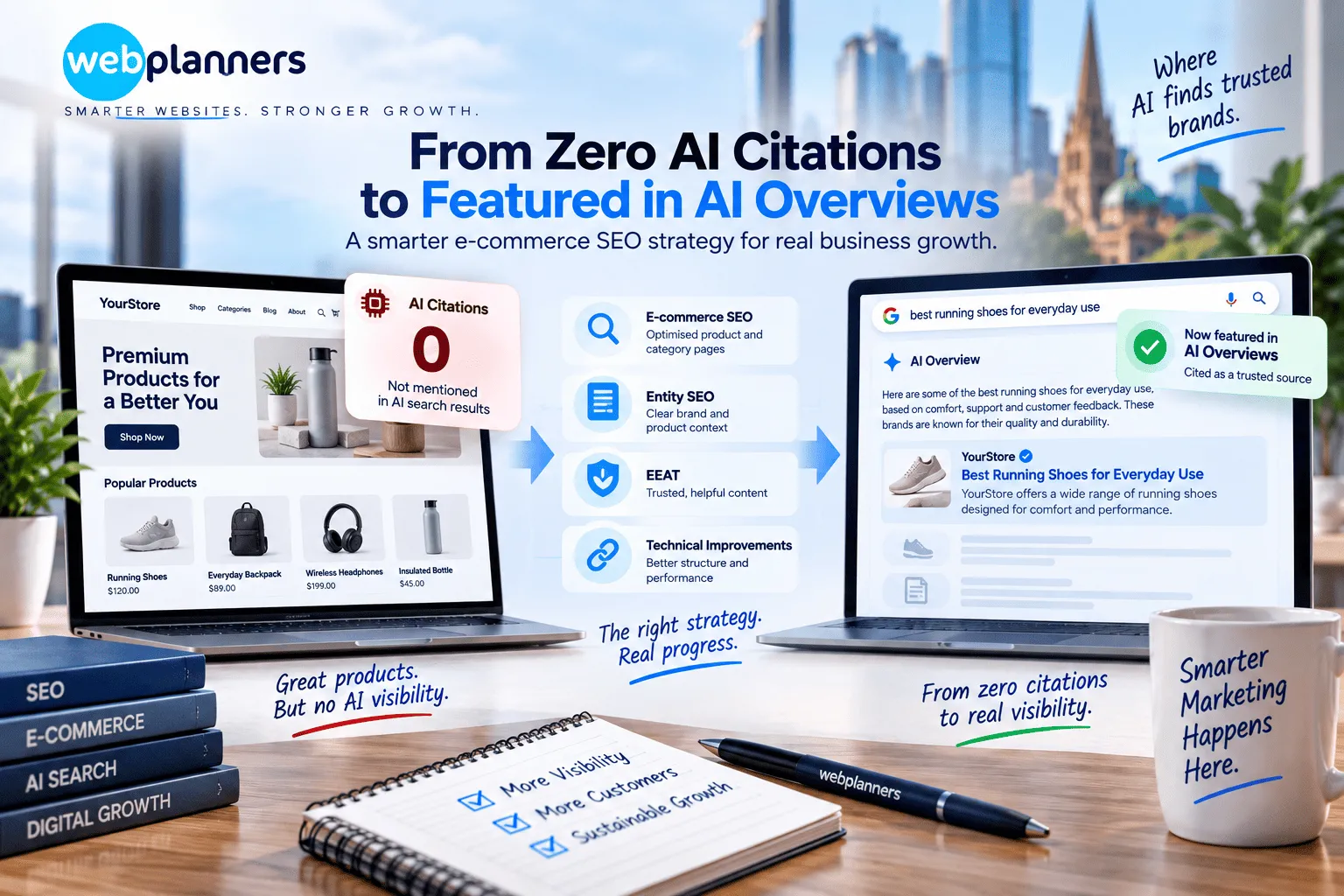
The brand started with 0 observed AI citations across the questions we were tracking. The goal was to increase its presence in AI-generated search experiences while continuing to improve its traditional organic performance.
The work combined strategic e-commerce SEO, content strategy, entity clarity, technical improvements and EEAT principles. Rather than creating content purely for AI systems, we focused on making the brand easier for both search engines and customers to understand.
Keep reading to understand where the brand started, what we changed, which metrics we tracked and what the campaign taught us about AI search visibility.
After the SEO and content work, the brand began appearing as a cited source within relevant AI Overview results.
The key metrics we used to assess progress included:
- AI citation presence across tracked questions.
- AI Overview appearances.
- Organic impressions and clicks.
- Non-brand organic traffic.
- Product and category visibility.
- Conversions from organic search.
- Revenue influenced by organic traffic.
The important point is that AI citations were treated as one visibility metric, not the only measure of success.
Where Was the E-commerce Brand Starting From?
The brand already had the basic ingredients of an established online store: products, category pages and an existing organic search presence.
But its visibility across AI-driven search was different from its traditional Google performance.
When we tested relevant questions, the brand was not being cited consistently.
That created a gap between:
Traditional search visibility → AI search visibility
A shopper might search for a product category on Google, then ask an AI platform:
- Which products are suitable for a particular need?
- What should I consider before buying?
- Which brands offer this type of product?
- What are the differences between these options?
- Which option is suitable for a particular customer?
These questions move beyond a single product keyword.
Google’s current documentation says AI Overviews can use information from Google’s Search index and related searches to respond to more complex queries. There is no separate AI-only SEO system or special markup that guarantees inclusion.
How Did We Measure the AI Search Gap?
We did not treat one AI response as proof of visibility.
Instead, the assessment centred on a repeatable set of questions relevant to the brand and its product category.
For each query, we looked at:
| Metric | What we measured |
|---|---|
| AI citation presence | Whether the brand appeared as a cited source |
| AI Overview presence | Whether relevant queries generated an AI Overview |
| Citation frequency | How often the brand appeared across tracked queries |
| Competitor presence | Which competing brands were being cited |
| Query coverage | Which customer questions produced opportunities |
| Organic visibility | Rankings, impressions and clicks |
| Business outcomes | Conversions and revenue from organic search |
This gave us a more useful baseline than simply asking whether the website ranked on page one.
It also made the campaign measurable over time.
Improve Your E-commerce AI Search Visibility
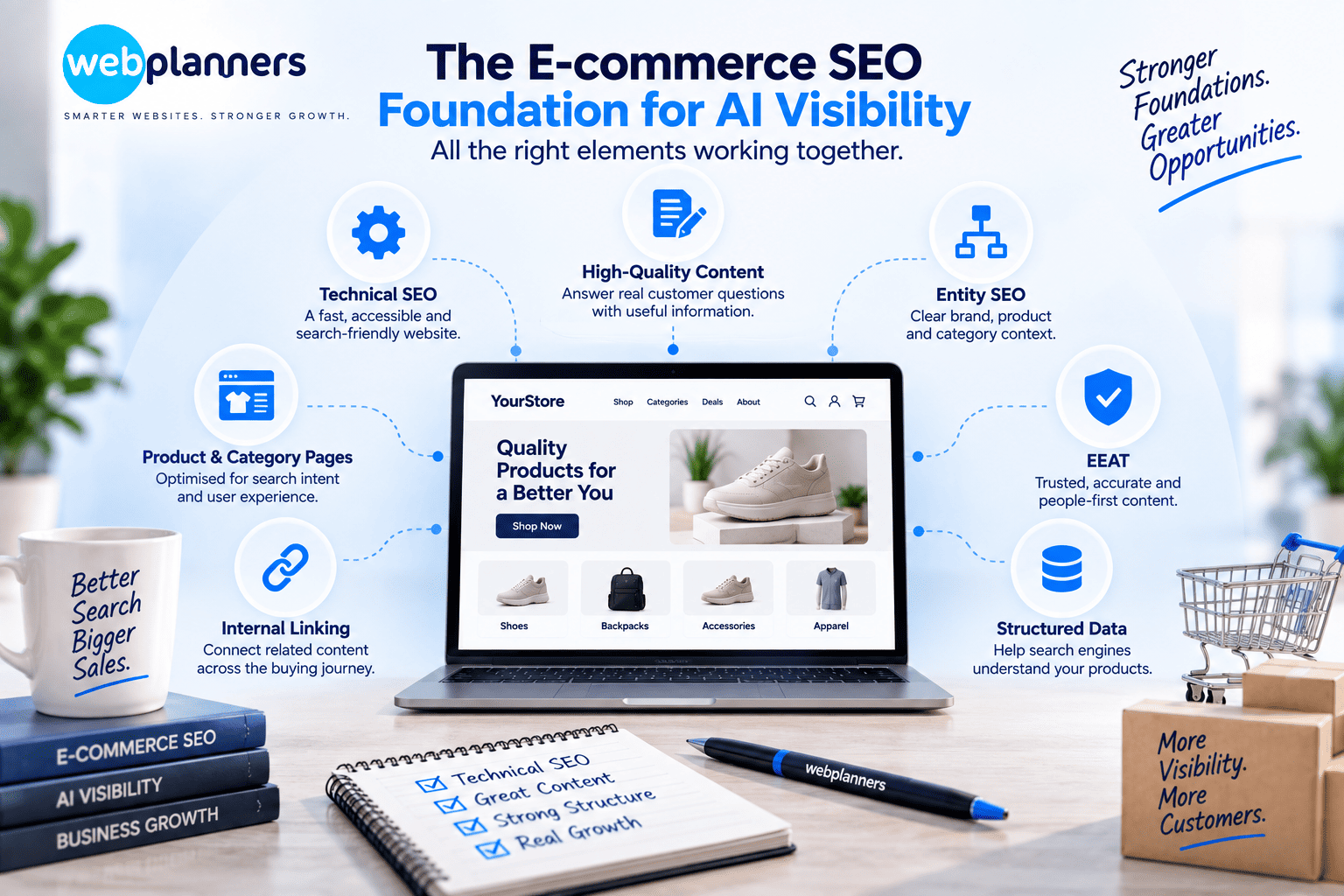
Step 1: We Strengthened the E-commerce SEO Foundation
AI visibility still depends on a website that search engines can access, understand and evaluate.
The first stage therefore focused on the core e-commerce SEO work behind the store.
That included:
- Product and category page structure.
- Search intent alignment.
- Internal linking.
- Technical accessibility.
- Product information.
- Structured data.
- Content quality.
- Page performance.
This matters because AI search does not remove the need for strong e-commerce SEO.
If product information is incomplete, categories are poorly structured or important pages are difficult to access, there is less useful information for search systems to work with.
As a leading eCommerce SEO company in Melbourne, our strategy focuses on technical audits, crawlability and indexation, product and category optimisation, internal linking, structured data, EEAT signals and AI visibility monitoring.
Step 2: We Changed the Way We Looked at Content
The next question was not:
“Which keyword should we add next?”
It was:
“What information does a customer need before choosing this product?”
That changed the content strategy.
Instead of relying only on product descriptions and commercial category pages, we looked at the questions surrounding the buying journey.
This included:
- Product comparisons.
- Buying considerations.
- Product differences.
- Common customer questions.
- Use cases.
- Selection criteria.
- Supporting category information.
The aim was not to create hundreds of pages.
It was to build useful coverage around the topics customers were already researching.
Google’s current guidance recommends useful, original, people-first content rather than producing large volumes of pages simply to target search variations.
Step 3: We Made the Brand Easier to Understand
This was one of the most important parts of the campaign.
The website needed to communicate more than what products it sold.
It needed to make the relationship between the brand, products, categories, expertise and customer needs clearer.
That is where Entity SEO became relevant.
Instead of treating each page as an isolated keyword target, we looked at the wider business entity:
- Who is the brand?
- What does it sell?
- Which categories does it operate in?
- Who are its products for?
- What evidence supports its expertise?
That is the practical role of Entity SEO, giving search systems clearer context around a business and the things associated with it.
Step 4: We Added Stronger EEAT Signals
Generic product content is easy to reproduce.
Useful experience is harder to reproduce.
So we looked for opportunities to show genuine knowledge through the content rather than simply claiming expertise.
The focus included:
- Practical product information.
- Clear explanations.
- First-hand insights where available.
- Useful comparisons.
- Transparent business information.
- Relevant supporting evidence.
- Customer-focused answers.
This is where EEAT SEO principles became part of the wider content strategy.
The aim was not to add the phrase “expert” repeatedly.
It was to give readers and search systems stronger evidence about why the business was a useful source.
This approach also aligns with our content framework, which places first-hand experience, expertise, authority and trust at the centre of useful AI-ready content.
Step 5: We Improved the Connections Between Pages
An e-commerce website can contain thousands of URLs.
That makes page relationships particularly important.
A product page should connect naturally with its category.
A category can connect with a buying resource.
A buying resource can connect with comparisons.
A comparison can then lead customers back to relevant products.
This structure helps customers move through the buying journey while giving search engines more context about the relationship between pages.
Internal linking therefore became part of the content architecture rather than a separate task added at the end.
Step 6: We Looked at the Technology Behind the Store
Content alone cannot solve every search visibility problem.
The e-commerce platform also affects how products, categories, URLs, structured data and site performance are handled.
Magento e-commerce development can be particularly relevant for stores focused on building a strong online presence, as technical changes can affect URL structures, page templates, product data, site performance and search functionality.
What Happened to AI Citations?
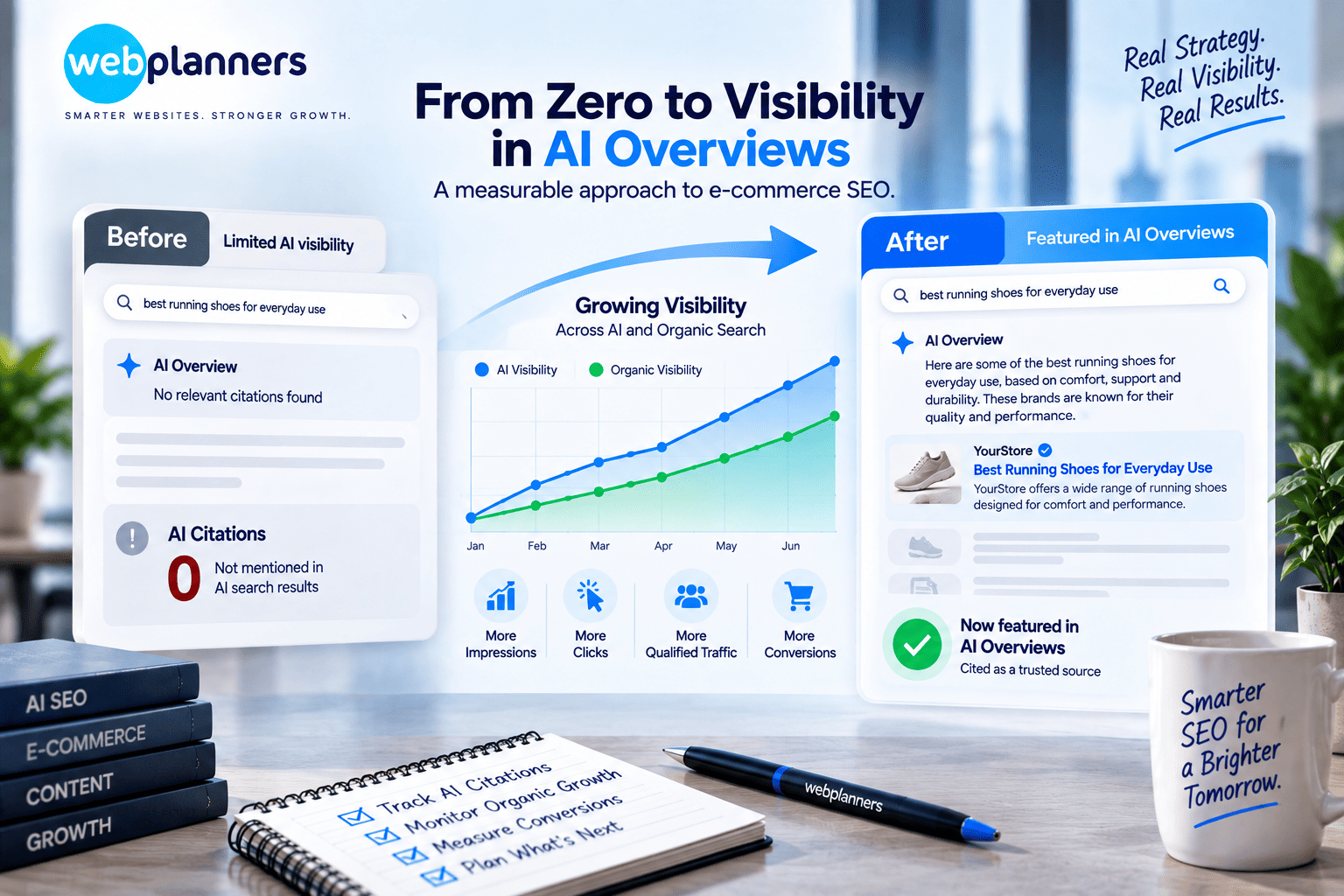
The starting point was:
0 observed AI citations
After the campaign work, the brand began appearing as a cited source in relevant AI Overview results.
That gave us a clear before-and-after visibility signal.
But we did not treat citation presence as the final business metric.
The wider measurement framework included:
AI visibility → Organic visibility → Qualified traffic → Conversions → Revenue
This distinction matters because an AI citation can indicate visibility, but it does not automatically mean a customer will click, enquire or purchase.
The campaign therefore measured AI search as part of the wider organic growth strategy.
What Did the Campaign Teach Us?
1. Page-one rankings are only one visibility signal
A strong organic ranking remains valuable, but customers may encounter a brand through AI-generated answers before clicking a traditional result.
2. AI visibility needs its own measurement
TTrack AI citation presence, query coverage, ranks, impressions, clicks and conversions.
3. Product pages need supporting context
A product page can tell you what something is, but customers need comparisons, selection advice and practical information before they buy.
4. Entity clarity matters
AI systems need to understand the relationship between the brand, its products, category and expertise.
5. More pages do not automatically mean more visibility
The emphasis should be on useful information that’s contributing something meaningful for customers.
6. Traditional SEO still matters
Technical accessibility, internal linking, product optimisation and strong site architecture remain part of the foundation.
What Should E-commerce Brands Measure Now?
If you want to assess your own AI search visibility, start with a consistent measurement set.
AI search metrics
- Number of tracked customer questions.
- AI Overview presence.
- Brand citation rate.
- Competitor citation rate.
- Number of AI platforms being monitored.
- Changes in citation frequency over time.
Organic SEO metrics
- Organic impressions.
- Organic clicks.
- Non-brand organic traffic.
- Product page visibility.
- Category page visibility.
- Click-through rate.
Commercial metrics
- Organic conversion rate.
- Organic-assisted conversions.
- Revenue from organic traffic.
- Revenue per organic visitor.
- Product-level organic performance.
This prevents AI SEO from becoming a vanity exercise.
The goal is not simply to say:
“Our brand appeared in an AI answer.”
The better question is:
“Did stronger search visibility help more relevant customers find and choose the brand?”
Where Does Local SEO Fit Into E-commerce?
Not every e-commerce business needs a local SEO strategy.
If a brand sells nationally online, forcing suburb or city pages into the website can create unnecessary content.
But local search can matter when the business has:
- Physical stores.
- Showrooms.
- Local pickup.
- Location-specific services.
- Multiple branches.
- Regional delivery options.
In those cases, Local SEO can support the connection between the online brand and its physical presence.
For a business with a genuine local footprint, working with a local SEO company can make sense as part of the wider search strategy, rather than treating local search as a separate campaign disconnected from the e-commerce site.
Strengthen Your Brand For AI Search
The Bigger Lesson
This campaign was not about finding a secret way to make AI cite an e-commerce website.
It was about improving the quality and clarity of the information available to search systems.
The brand started with 0 observed AI citations.
The campaign then strengthened:
- E-commerce SEO.
- Product and category content.
- Entity clarity.
- EEAT signals.
- Internal linking.
- Technical foundations.
- Customer-focused question coverage.
- AI visibility measurement.
The result was a shift from being absent from the tracked AI citations to appearing as a cited source in relevant AI Overview results.
Conclusion
For an e-commerce brand, AI search visibility starts well before an AI Overview cites a page.
It starts with strong e-commerce SEO, clear product information, useful buying content, sound technical foundations and a recognisable brand entity. From there, businesses can monitor AI citation rates alongside organic traffic, conversions and revenue.
If your store is already well established on Google but not appearing consistently on AI-driven search, our experienced team of SEO consultants can assess the gap in terms of content, technical SEO, entity signals and search performance.
FAQs
How many AI queries should an e-commerce brand track?
There is no fixed number that works for every business. A useful set should represent the main product categories, buying questions, comparisons and customer needs. The same questions can then be tested periodically so changes in citation presence are easier to measure.
Should AI citation rate be treated as a conversion metric?
No. Citation rate measures visibility, not sales. It should sit alongside organic clicks, qualified traffic, conversions and revenue. A brand may gain more AI citations without seeing an immediate commercial increase, so the metrics need to be assessed together.
Can a small e-commerce brand measure AI search visibility?
Yes. A smaller brand can start with a focused set of commercially relevant questions rather than monitoring hundreds of prompts. Consistency matters more than volume: use the same questions, record the results and compare changes over time.
What should a brand do if competitors are cited but it is not?
Compare the information available on both websites. Look at product depth, buying resources, brand information, expertise, supporting evidence and how clearly each business is represented. This can reveal information gaps that a traditional keyword report may not show.
Our Recent Blogs

Couldn't be happier with how things have gone since working with Webplanners. The team genuinely cares about getting results and has helped us stay ahead of the competition. Thanks for all the hard work, legends!
Webplanners has been a huge part of our digital growth. Managing multiple websites isn't easy, but they've made the whole process feel effortless. The results have exceeded our expectations.
The team has been great to work with and always keeps us in the loop. We've seen steady improvements over time and the whole process has been straightforward. Very happy with how things are going.